On March 11, the Lemkin Institute for Genocide Prevention and Human Security released its third Red Flag Alert for the United States, declaring the existence of an anti-trans genocide perpetrated under the second Trump administration. The Lemkin Institute attributes this ongoing genocide to the rash of anti-transgender policies implemented throughout the country in the past few years, “the goal of which is to completely erase transgender people not only from public life but also from existence in the U.S. and globally.”
Two particular examples of such policies include the Bureau of Prisons’ (BOP’s) decision to block gender-affirming care for incarcerated individuals and the incredibly restrictive law recently passed in Kansas, which limits the bathroom use of transgender individuals and invalidates their driver’s licenses. Both policies are the subject of ongoing litigation and both highlight a broader project of discrimination and erasure, which limits the freedom of transgender people in America to exist as transgender.
Anti-Trans Executive Orders
Though recent court battles have propelled this issue into the spotlight, the Trump administration’s extreme rhetoric around transgender rights is hardly new. In the final months of his 2024 campaign, President Donald Trump put anti-trans rhetoric at the center of a ubiquitous attack ad, claiming: “Kamala is for they/them; President Trump is for you.” Even before he was in office, Trump painted trans people as the othered enemy of the average American, and, after his inauguration, was quick to match this rhetoric to action.
Among President Trump’s Day One executive orders was EO 14168, titled “Defending Women from Gender Ideology Extremism and Restoring Biological Truth to the Federal Government.” This executive order asserts that “women are biologically female, and men are biologically male,” and that United States policy is “to recognize two sexes, male and female…[which] are not changeable.” In doing so, EO 14168 attempts to write off the lived experience of nearly three million transgender Americans as “unmoored from biological facts,” and more importantly, write them out of our laws and our society entirely.
Since that first executive order, Trump has put his anti-trans philosophy into practice in a myriad of ways. He has ordered that funding be stripped from K-12 schools that teach about gender identity or support students’ social transitions. He has prohibited federally-funded medical institutions from providing gender-affirming care to minors and blocked federal insurance providers from covering such treatments, referring to them as “mutilation.” He has even expelled transgender service members from the military, claiming that their very identity “conflicts with a soldier’s commitment to an honorable, truthful, and disciplined lifestyle.” Collectively, these policies lay bare the Trump administration’s blatant hostility towards the rights, and very existence, of transgender people. A PhD student in Sociology at the University of Chicago (they/them pronouns) who has research experience with faculty at our Center for the Study of Gender & Sexuality—and who asked to remain anonymous—emphasized that these policies, particularly those barring access to gender-affirming care, represent “a stepping stone in a broader effort to foreclose the possibility for trans bodies to exist.” To this interviewee, the current discrimination and genocide is part of “a long historical process of enclosure and erasure,” which “takes on different formations depending on its particular context.” In that light, naming this assault on transgender rights a genocide is crucial, as it exposes “attempts towards erasure in practices that are often packaged as bureaucratic, rational, necessary, natural, or inevitable.”
Gender-Affirming Care in Prisons
Another byproduct of EO 14168 is the BOP’s stringent new policy against gender affirming care, which the Lemkin Institute explicitly highlighted. The issue of transgender care in prisons has been a subject for debate for decades, with countless legal battles taking up the question of what level of care is adequate under the 8th Amendment for incarcerated individuals experiencing gender dysphoria. Recently, lower courts have often ruled favorably for transgender plaintiffs. Moreover, for the past nine years, BOP policy has required institutions to “ensure transgender inmates can access programs and services that meet their needs,” including the provision of medical treatment, which the Biden administration explicitly expanded to include surgical interventions.
Arguably, this policy was a big part of the reason that transgender rights issues arose during the 2024 presidential campaign. After all, the focal point of the infamous anti-trans campaign ad was Kamala Harris’ stated support of gender-affirming surgeries for incarcerated trans people. It is not surprising, then, that gender-affirming care in prisons would become a target of the Trump administration’s attention.
In addition to its more abstract goals, EO 14168 instructed the BOP to halt any federal funding for medical care with “the purpose of conforming an inmate’s appearance to that of the opposite sex.” On February 19, 2026, the Bureau released a policy change implementing that instruction, under which the primary form of care for gender dysphoria shifted to psychiatric treatment, as opposed to gender-affirming care. In line with the executive order, this new policy explicitly prohibits “sex trait modification surgeries,” the provision of hormone therapies, and social accommodations for transgender people in prisons.
Even before the February policy put these changes into writing, many of its key points were already being implemented. Not long after EO 14168 was signed in January 2025, prison officials began to reduce or deny hormone treatments to individuals that had received them for years. They also confiscated clothing items that aligned with inmates’ gender identities, and even transferred some post-transition transgender women into men’s facilities.
The early stages of these changes triggered numerous lawsuits across the country. These included three separate cases from GLAD Law that successfully secured preliminary injunctions against the transfer of transgender women to men’s facilities, which the Trump administration then appealed to the D.C. Circuit Court of Appeals (Doe, Jones, and Moe v. Bondi). Similarly, the class-action suit Kingdom v. Trump, argued by the American Civil Liberties Union (ACLU) and the Transgender Law Center, achieved a preliminary injunction against the policies blocking access to gender-affirming medical care and social accommodations.
It is notable, then, that the February 19 policy was put out after these preliminary injunctions, albeit prefaced by the instruction to comply with court orders. In other words, the BOP and the Trump administration show no signs of abandoning these policies in the long term, which could have devastating consequences for trans people in prisons.
For example, studies consistently find that gender-affirming care is very effective at reducing the high suicide rates among transgender individuals. Inversely, denial of such care will inevitably increase the extreme distress faced by trans people experiencing gender dysphoria, potentially costing their lives. For trans people in prisons, research points to the denial of gender-affirming care as a major risk factor for life-threatening attempts at autocastration, which one plaintiff in Kingdom v. Trump brought up explicitly.
The Gate’s interviewee, who has also worked on research and advocacy with formerly incarcerated people for almost a decade, highlighted that mental health problems are already particularly acute among incarcerated people, “due to the feeling of isolation, indeterminacy, lack of freedom, and violence of imprisonment.” In this environment, forced de-transitioning presents an “added harm of enhanced depression, discomfort, dread, and despair” which “will greatly damage the health and survival of incarcerated trans people.”
The policy of transferring transgender women to men’s facilities will have particularly severe consequences if it is implemented in full. Transgender women are already disproportionately vulnerable to sexual victimization within the prison system, and have long struggled to be placed in facilities that match their gender identity, despite protections mandated by the national Prison Rape Elimination Act. Indeed, the previously mentioned cases brought by GLAD Law emphasize that plaintiffs would be “at an excessive and obvious increased risk of sexual assault in men’s prisons” due to their gender expression.Viewing all of these elements in concert, The Gate‘s interviewee asserts that the new BOP policy “will force thousands of trans people who fought to gain access to gender-affirming care…to confront life within a body that they do not feel is truly theirs, within an institution that was not made with their needs in mind.” They stressed that this not only represents an example of prisons being used as “laboratories for violent experimentation,” but also “sends the message that trans people do not belong anywhere in society, including prison.” Viewed in that context, this attack on a particularly marginalized subset of the transgender population is not an isolated incident, but rather falls under the broader pattern of erasure highlighted previously.
Proliferation of Discriminatory State Laws
Federal policies like the BOP’s are only one facet of the ongoing assault on transgender rights. During the first year of Trump’s second term, 126 anti-trans bills passed into law throughout the country (representing an increase of 668% since 2021), and already during 2026, legislators have proposed more than 750 similar bills in 43 different states. This process of anti-trans action within the states is intimately connected to the similar project of erasure on the federal level.
The Gate’s interviewee emphasized that Trump’s executive actions, particularly EO 14168, “told states that believed in asserting a binary conception of gender that the federal government had their backs.” They argued that this emboldened those states to “pass legislation that experimented with enforcing a gender binary” through a wide range of policies, including “curricular restrictions, ‘parental rights’ laws, limiting gender-affirming care, banning drag, or restricting student clubs.”
Among these numerous state-level laws, one particularly notable example is Kansas’ SB 244, passed over Governor Laura Kelly’s veto on February 18, 2026. This new law has two primary functions: mandating that transgender people use public restrooms that match their biological sex as opposed to gender identity, and invalidating driver’s licenses that reflect a trans person’s gender identity rather than their biological sex.
The portions of the bill relating to bathrooms have come under particularly harsh criticism, with Lambda Legal likening the bill’s enforcement mechanism to a “bounty hunter regime.” Under the law, Kansans who come forward with an accusation that a transgender person has used the wrong bathroom are eligible to receive $1,000 in damages. Critics of the law, including Democratic State Representative Lindsay Vaughn, argue that this financial incentive will turn “everyday Kansans into gender police…making it harder for people who already experience some of the greatest rates of violence in our community.”
Both provisions in the bill risk the privacy and safety of transgender people in Kansas, prompting the ACLU of Kansas to file a lawsuit on behalf of two trangender men the day after SB 244 was passed. The complaint in this suit emphasizes that if transgender Kansans are required to hold licenses that reflect their biological sex, they will be forced to disclose their transgender status every time such identification is necessary, which not only violates their “hard-won privacy” but also risks stigmatization, discrimination, and harassment.
In addition to highlighting the uniquely problematic provisions within SB 244, the suit stresses that SB 244 is “just the most recent law in a shameful litany of statues…meant to discriminate against and dehumanize transgender people.” This mirrors the arguments made by The Gate’s interviewee, who pointed to a “broader project that seeks to make no place for gender diversity within society.” When asked about the long-term effects of this project, the interviewee emphasized the extent to which these policies “change the material conditions under which trans life in the US is possible.” While restrictions on medical care, prohibitions against using certain bathrooms, and the invalidation of driver’s licenses may all appear to be discrete policy actions, all make it fundamentally less possible for transgender people to live out their lives in accordance with their own identities. This may not fit neatly into the way our laws define genocide, but a project aimed at systematically eliminating the ability of trans people to exist as trans people is very much a project of genocide, and calling it out as such is a crucial first step towards mobilizing against it.
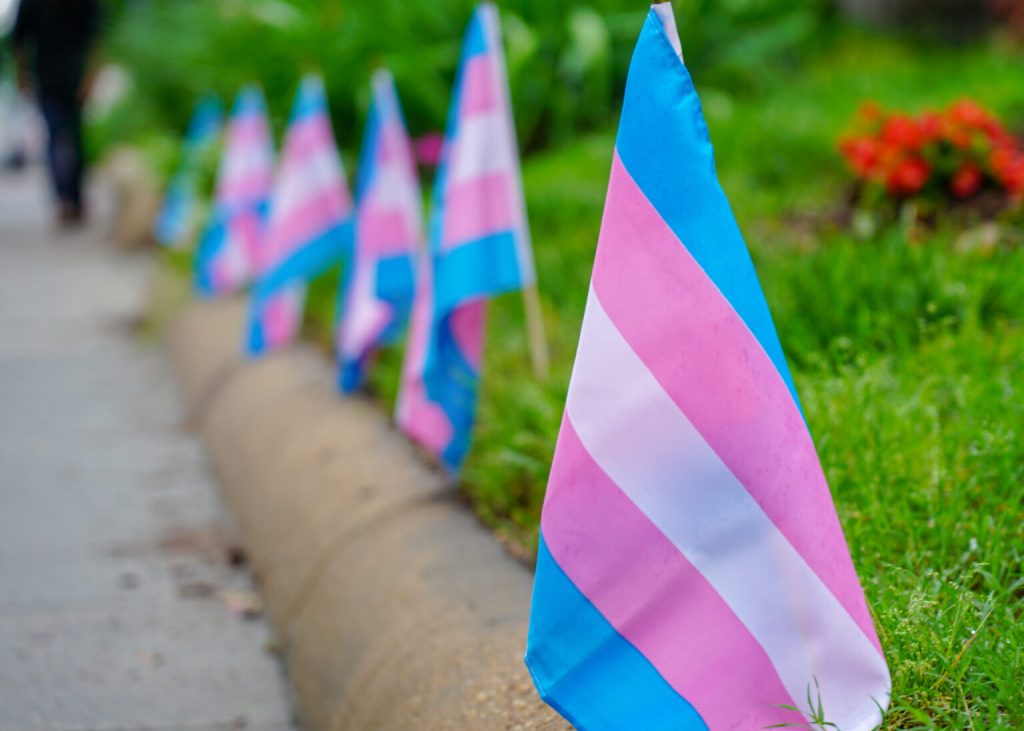
Image from Ted Eytan, licensed under CC BY-SA 4.0.
 The Gate
Leave a comment