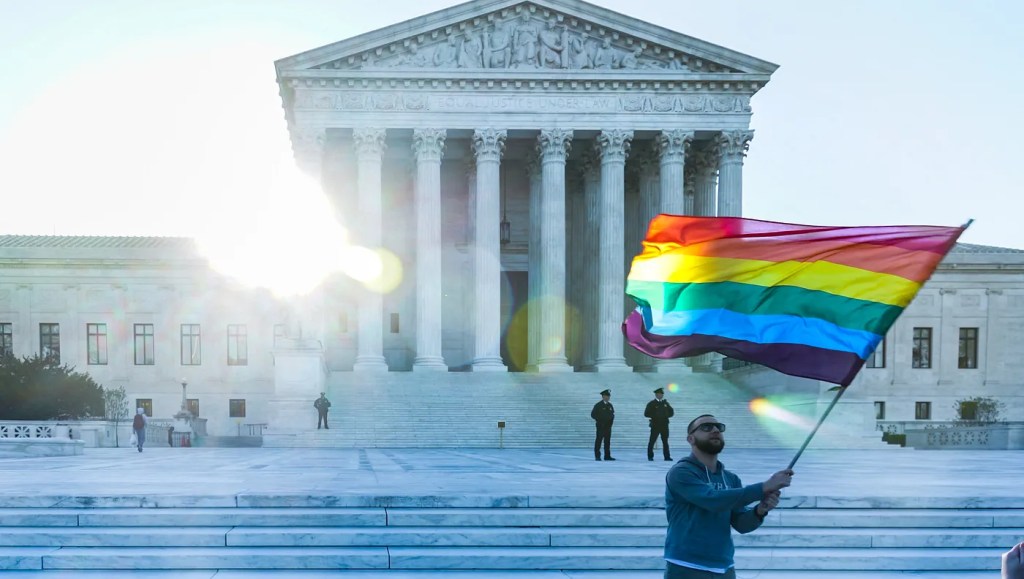
“Outlaw to outcast may be a step forward, but it does not achieve the full promise of liberty.” These words, from the landmark Supreme Court case Obergefell v. Hodges (2015), represent the ideal that the promise of liberty cannot be fully achieved until all individuals are equally welcome in our American society and institutions. More than ten years after the Obergefell ruling, this lofty vision remains unrealized, in large part due to the many exceptions carved out by the very Court that once defended it.
Although support for the Obergefell decision has increased considerably over time, Obergefell has also faced increasing backlash from a vocal minority of Christian conservatives. Taking advantage of a Supreme Court dominated by Federalist Society justices, the religious right has been able to successfully push back against LGBTQ+ rights in the years since Obergefell, culminating in two key decisions this summer: Mahmoud v. Taylor and United States v. Skrmetti. Though the Court declined to hear a case challenging Obergefell this November, this escalating erosion of its efficacy nonetheless represents a notable shift away from the Court’s role as a protector of individual liberties. Taken together, these decisions warn that the promises of landmark cases like Obergefell can be hollowed out over time, maintaining the veneer of justice while enabling the persistence of inequality.
The (Unfulfilled) Promise of Equal Dignity
Obergefell v. Hodges (2015) was a landmark victory for the LGBTQ+ rights movement, which guaranteed a right to same-sex marriages based on the principle that all people are entitled to “equal dignity in the eyes of the law.” The circumstances of the case, in which Obergefell was forced to cross state lines just to marry his dying partner on an airport tarmac, underscore just how desperately such protections were needed at the time.
But barely three years after the Court established this ideal of equal dignity, it began to narrow its scope. In Masterpiece Cakeshop, Ltd. v. Colorado Civil Rights Commission, the Supreme Court delivered a narrow ruling, affirming the plaintiff’s right to refuse to create a wedding cake for a gay couple, while claiming to reaffirm that same-sex couples have a broad right to equal service. As it would turn out, this careful compromise was an early warning sign that the Court’s commitment to the promise of equal dignity was conditional, at best.
Five years later, with 303 Creative LLC v. Elenis (2023), graphic designer Lorie Smith challenged the Colorado Anti-Discrimination Act (CADA), which she claimed compelled her to create work that conflicted with her religious beliefs, as it would require her to equally serve all couples in a wedding website-design service she had not yet started to offer. The majority asserted that because Smith’s hypothetical websites would be highly customized, her service qualified as “pure speech,” and it would thus be unconstitutional for CADA to “compel speech” that went against her “sincerely held religious conviction.”
A core component of the majority’s reasoning was the claim that Smith’s refusal to serve same-sex couples did not constitute discrimination, because she merely objected to providing services, not to customers’ identities. This ignores the fact that a same-sex wedding website definitionally differs from a different-sex wedding website only because of the identity of the customers. Thus, as Justice Sonia Sotomayor pointed out, the ruling created “a constitutional right to refuse to serve members of a protected class,” thereby betraying the ideal of equal dignity promised in Obergefell. In effect, the Court manufactured a non-discriminatory reason to permit discrimination, a pattern which has continued to re-occur in the cases we see today.
From Outlaw to Outcast
The gradual erosion of the right of equal dignity established in Obergefell culminated this summer with the case Mahmoud v. Taylor. In Mahmoud, the Supreme Court ruled in favor of a group of parents (represented by Tamer Mahmoud) who claimed that the Montgomery County Board of Education in Maryland violated their First Amendment rights by withholding opt-outs from instruction that involved “LGBTQ+ inclusive” storybooks. Based on the principle that parents have a right “to direct the religious upbringing of their children,” the Court determined that prohibiting opt-outs posed “‘a very real threat of undermining’ the religious beliefs and practices that parents wish[ed] to instill in their children.”
Justice Alito, who wrote the opinion, acts as if the simple statement that “[t]wo men who love each other can decide they want to get married” is imposing a normative message, backed by the “coercive pressure” of authority figures. In reality, however, it is nothing more than a factual statement that has been true since the Court’s own ruling in Obergefell. The storybooks Alito rebukes were never intended to challenge a student’s religious views. Rather, defenders of the county policy assert that they were designed to “help young children appreciate people with individual characteristics that differ from their own.” The books conveyed a normative message only insofar as ‘all human beings deserve dignity and respect’ is a normative message. Otherwise, the books simply depicted the existence of LGBTQ+ individuals within real-world scenarios, without any expectation that a student or parent could be asked to change their opinions about gender identity or sexual orientation.
Despite this, the likely result of Mahmoud, as the dissent warns, is that schools may “strip their curricula of content that risks…religious objections.” Though it is still too early for these concrete effects to be seen, there are already signs that the administrative burden of accommodating opt-outs may lead to such pre-emptive censorship. This will only worsen the situation of LGBTQ+ families, who are already exposed to stigma and harassment on a daily basis. More than 80% of students with LGBTQ+ parents report hearing negative comments about their families, while almost 70% are explicitly discouraged from talking about their parents at school. This is the precise reason that Montgomery County originally chose to prohibit opt-out — to protect students from the social stigma and isolation of watching their peers leave the room to avoid reading about families like theirs.
This brings us back to Obergefell. An important line of reasoning in the case was the idea that precluding same-sex couples from the institution of marriage exposed their relationships and their children to a unique stigmatization. If the state did not have to acknowledge their relationships, then the government was inherently treating them as unequal in important respects. Barely a decade later, the decision in Mahmoud, by allowing religious families to exempt their children from content that simply acknowledges the existence of LGBTQ+ children and families, enables the perpetuation of the very indignities that Obergefell sought to address.
The Fight is Not Over
Meanwhile, in Skrmetti vs. United States (2025), the Court upheld a Tennessee ban against gender affirming care for minors. Skrmetti began when a group of transgender teenagers, along with their parents and a doctor, challenged Tennessee’s SB1. The bill in question prohibits the use of puberty blockers or hormone treatments for the purpose of treating gender dysphoria in transgender individuals. When they first filed this challenge, District Judge Eli Richardson put the ban on hold, on the grounds that SB1 both discriminated on the basis of sex and infringed on the parents’ “fundamental right to direct the medical care of their children.” Interestingly, for a group of justices that seem to care so much about religious parental rights, the Court chose not to consider the parental rights claim in Skrmetti.
Instead, the majority focused on the sex discrimination claim, arguing that the law did not discriminate on the basis of sex, because it “prohibits healthcare providers from administering puberty blockers and hormones…for certain medical uses, regardless of a minor’s sex.” Chief Justice John Roberts insists that to call the law sex discrimination is to “contort the meaning of the term ‘medical treatment,’” because a transgender boy who “takes puberty blockers…receives a different medical treatment than a boy whose biological sex is male.” The majority asserts that the Tennessee law draws distinctions only on the basis of age and medical purpose, not on the basis of sex or gender identity.
This is — to put it simply — factually wrong. As Justice Sotomayor points out in her dissent, “the very ‘medical purpose’ SB1 prohibits is defined by reference to the patient’s sex.” The Tennessee law quite specifically draws sex-based distinctions, in that it allows biological males, for example, to receive testosterone treatments, but not biological females, and vice versa. This is because the medical purpose highlighted and prohibited by Tennessee’s bill is “enabling a minor to identify with, or live as, a purported identity inconsistent with the minor’s sex.” This is a medical condition specifically characteristic of transgender individuals. Not only is it true that only transgender people experience the kind of dysphoria described by SB1, but definitionally all transgender people seek to “identify with, or live as” an “identity inconsistent with [their] sex,” as the bill describes.
The effects of the majority’s ruling, which will presumably enable 25 states to retain their bans on gender affirming care, will be devastating for transgender youths. Studies consistently prove the efficacy of these treatments at lowering tragically high transgender suicide rates. Even beyond the specific effects of the decision for transgender youths, however, there is also a concern that Skrmetti provides precedent for a much narrower definition of sex discrimination in future cases. Much like how the majority in 303 Creative grasped for a non-discriminatory reason to discriminate against same-sex marriages, the majority in Skrmetti cleverly disguises sex-based distinctions behind the language of “medical purpose.” This is despite the clear fact that the two are definitionally linked in this context.
However disastrous the decision may have been, though, Amy Coney Barrett’s concurring opinion highlights that it could have easily been much, much worse. While the majority explicitly chose not to weigh-in on the currently ambiguous question of whether or not transgender individuals qualify as a protected class, Barrett’s concurrence did just that. According to Barrett, not only are transgender people an “insufficiently discrete and insular minority” to qualify as a protected class, but the evidence is “suggestive of relatively little [legal] discrimination.” Barrett would have us believe that the 1.6 million transgender people in this county are apparently a group more “large, diverse, and amorphous” than the more-than 40 million African Americans — our oldest protected class — and that more than a century of literally criminalizing cross-dressing doesn’t qualify as legal discrimination against the transgender community.
Though Barrett’s extreme opinion was the minority in this decision, the mere fact that she authored this concurrence does not bode well for the future of LGBTQ+ rights under this Supreme Court. The Court’s apparent unwillingness to honor the promises of equal dignity established by Obergefell is all the more relevant when we consider that the Court was recently asked, for the first time since its ruling, to overturn Obergefell. Although the Supreme Court declined to hear this case on November 10, the gradual erosion of Obergefell’s efficacy nonetheless falls into a broader trend of the current justices chipping away at rights that the Court itself once championed. Seen in cases like Dobbs v. Jackson Women’s Health Organization, Students for Fair Admissions v. President and Fellows of Harvard College, and Fulton v. City of Philadelphia, among others, this is a trend that should concern anyone who values the Court as a bulwark for equal rights.
The image featured in this article is licensed for reuse under the Creative Commons Attribution-Share Alike 2.0 Generic license. The photograph was originally taken by Ted Eytan. No changes were made to the image, which can be found here.
 The Gate
Leave a comment