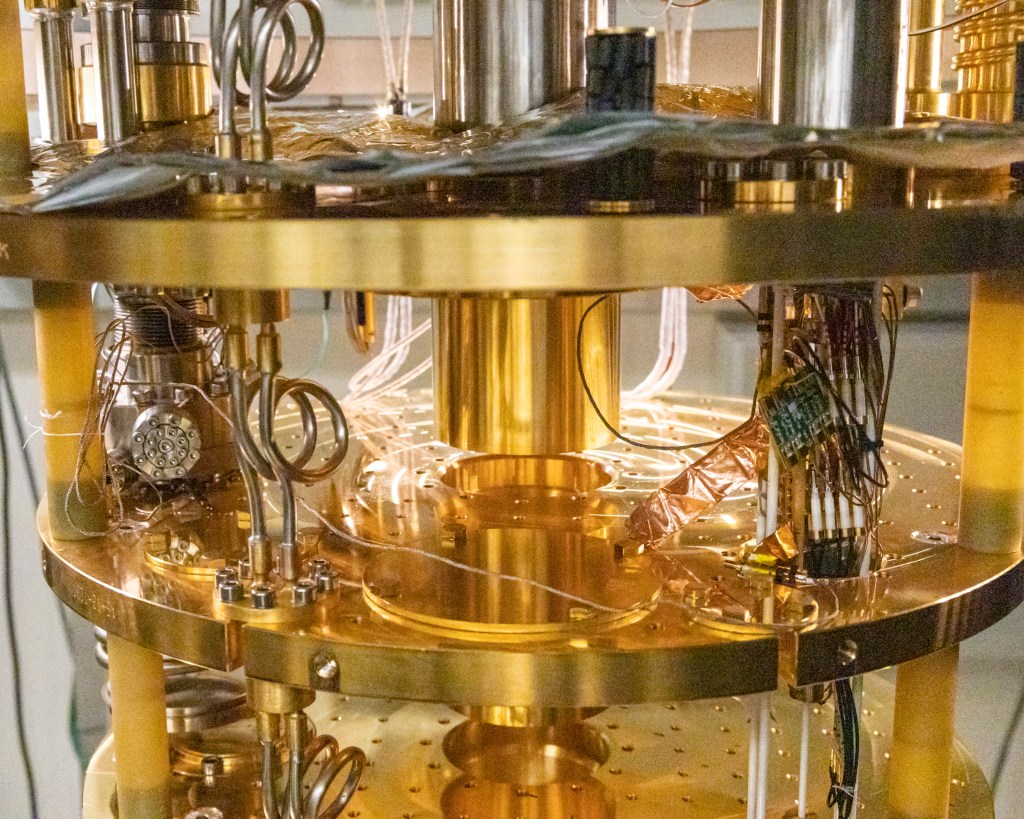
As Washington tightens export controls and pours billions into “force-multiplying technologies,” a new frontier of great-power competition is taking shape: this time inside university laboratories rather than missile ranges or naval chokepoints. Quantum computing has emerged as a defining arena of the U.S.–China tech rivalry, and the University of Chicago sits at its center.
To understand the policy architecture driving this shift, I spoke with Kevin Wolf, former Assistant Secretary of Commerce for Export Administration under the Obama Administration. Wolf, now a partner at Akin Gump, provided essential background on how quantum technologies became national security priorities, explaining the logic behind today’s unprecedented restrictions and their ripple effects across academia.
Policy is only half the story, however. Its consequences play out in real time inside university labs. To capture that perspective, I also interviewed Professor Cheng Chin, a leading quantum physicist at UChicago and the Chicago Quantum Exchange (CQE). Chin emphasized that beyond formal regulations, the practical constraints they create—tighter export controls, visa uncertainty, and limits on specialized equipment—directly shape how universities hire talent, collaborate across borders, and conduct day-to-day scientific research.
Their combined insights point to a central tension now shaping quantum research in the United States: universities are no longer just scientific institutions, but emerging geopolitical actors. The CQE—a consortium linking UChicago, Argonne National Laboratory, Fermilab, and private partners—illustrates this shift. As one of the nation’s largest federally supported quantum hubs, it brings unprecedented resources and opportunity, yet it also places UChicago scientists on the front lines of a research landscape increasingly defined by strategic competition and national security concerns. These new pressures intersect directly with the policy landscape governing advanced technology, most notably, U.S. export controls.
Modern U.S. export controls—rules governing the transfer of sensitive technologies—are rooted in the Cold War. At the time, the U.S. and its allies used “strategic trade controls” to limit Soviet access to advanced computing and dual-use technologies. After the 1990s, these regimes shifted toward non-proliferation, particularly with regards to nuclear and missile technologies.
In the past five years, however, export controls have undergone a dramatic expansion. In 2018, Congress passed the Export Control Reform Act, directing the Bureau of Industry and Security to identify “emerging” and “foundational” technologies essential to national security. By 2022, the U.S. had imposed multilateral controls—controls agreed upon between multiple countries—on Russia after the invasion of Ukraine. Then in October of that year, it introduced sweeping unilateral restrictions on China targeting advanced semiconductors, AI-enabling chips, and quantum-related equipment.
National Security Advisor Jake Sullivan articulated the new doctrine clearly: technologies like advanced computing, biotech, and clean tech are “force multipliers,” and leadership in them is a national security imperative. For the first time, U.S. controls now reach deep into commercial technology supply chains and restrict items earlier in the development cycle.
Universities occupy a gray space in this governance ecosystem. Much academic work falls under “carve-outs” from the Export Administration Regulations, meaning the research does not require a license because it qualifies as:
- Fundamental research, whose results are ordinarily published and freely shared
- Information released through instruction, such as catalog courses or teaching labs
- Published work, including patents and open patent applications
However, once a research group accepts restrictions from a private partner—such as a company asking that results not be published—the work no longer qualifies as fundamental. Traditional export rules apply. And licenses, Wolf emphasized, are not waivers; they often impose additional compliance burdens. These shifting definitions are not abstract policy changes but lived realities in university labs. As the federal definition of “strategic technology” expands, the boundary between fundamental inquiry and controlled research narrows. Professor Chin has watched the shift unfold.
Chin credits an investment boom in quantum research—in the form of CQE’s rapid growth, federal grants, and the State of Illinois’s $500 million investment in a new quantum park—for accelerating innovation in the discipline. The funding surge has opened up new research avenues and built unprecedented networks across universities and national labs. For example, CQE, UChicago, and Northwestern’s collaboration provided joint funding to create a quantum network across universities, expanding infrastructure for quantum communications research. Yet the same forces fueling progress can constrain academic freedom and talent recruitment.
Chin’s lab once drew roughly half its members from abroad, many from China, but that share has plummeted. Growing visa uncertainty—from graduate admissions to H-1B sponsorship and green-card backlogs—now shapes career decisions and deters applicants. “Meaningful research requires an atmosphere of continuity and openness,” Chin said. “That atmosphere has been harder to sustain recently, and it has consequences for retaining top talent.” Because foreign researchers make up a large share of the U.S. quantum workforce, the Commerce Department acknowledges that quantum faces unusually broad restrictions on foreign talent recruitment compared to other tech fields. Labs are not yet understaffed, but shrinking diversity threatens long-term U.S. leadership in quantum science. Even with new funding, faculty struggle to recruit, and international students often lack equal access to research opportunities, raising both equity issues and concerns about the nation’s competitiveness.
Chin also pointed to new policies affecting the acquisition of research instruments, including delays, tariffs, and scrutiny of equipment originating from restricted countries. Even so, he remains hopeful about the quantum industry’s trajectory. A new ecosystem is taking shape, one that links academic research, national laboratories, and emerging industrial capabilities to drive real-world quantum applications.
Globally, momentum is accelerating. The UN has designated 2025 as the International Year of Quantum Science and Technology, and McKinsey estimates that the quantum market could reach $100 billion within a decade. In 2024 alone, governments committed $1.8 billion to quantum initiatives. China and the United States now lead the world in patent filings—China in quantum computing, the U.S. in quantum communication—underscoring how deeply national strategies are driving the field’s growth. This is because the stakes extend far beyond academia: quantum technologies promise transformative advances in AI and machine learning, robotics, sustainability and climate modeling, and next-generation cryptography.
UChicago’s position at the heart of U.S. quantum research brings both extraordinary advantages and new responsibilities. As export controls tighten and geopolitical scrutiny grows, the future of the field may depend on how universities manage the tension between open science and national security.
Image “Quantum lab (53804358991)” by Oak Ridge National Laboratory is licensed under CC BY 2.0 and can be found here.
 The Gate
Leave a comment