After September 11, 2001, President George W. Bush and the Bush administration became obsessed with linking Iraq—and Saddam Hussein’s regime—with the attacks. Just a few days after the attacks, President Bush told British Prime Minister Tony Blair that he was planning to “hit” Iraq. Despite having only three days to draw connections and gather intelligence, Bush suspected Iraq was involved.
This resulted in a years-long campaign to associate, without explicitly implicating, Iraq with al-Qaeda and the 9/11 terror attacks. First, the United States intelligence community trusted faulty sources who insisted that Iraq possessed weapons of mass destruction (WMDs). Second, President Bush—through speech patterns, word association and strong implication—cultivated public opinion, incorrectly connecting the events of 9/11 with the Iraqi regime.
It is debatable the extent to which the Bush administration knowingly employed false intelligence. However, Bush’s consistent rhetoric linking the two was intentional and facilitated the conditions for a “popular” war when Operation Iraqi Freedom was launched in 2003 (71% of Americans supported the decision in March of that year).
What is striking about Iraq is the painstaking, deliberate effort undertaken by the Bush administration to prosecute this case to the public. For all its tribulations, the Bush administration took two principles as given: (1) wars needed public support; and (2) it was their job as the prosecutors of the war to make a case to the people.
In short, the Bush administration felt they at least needed to pretend the public mattered. Earnest miscalculation, blatant negligence or manipulative lying, the President, Vice President Dick Cheney and Secretary of Defense Colin Powell were all devoted to convincing the people that war was worth it.
Nearly twenty-five years later, the Trump administration has decided they don’t have to. That’s extremely dangerous, and has cascading ramifications for the administration’s beliefs on courting public opinion.
For an administration insistent on deconstructing conventions, this marks yet another grave departure from an already uninspiring status quo around war and the public. And it speaks to a hubris and carelessness ill-fitting for a county school board, let alone the American government.
Last month, the United States and Israel launched a joint operation against the Iranian regime. In his remarks following the strikes, President Trump announced Operation: Epic Fury, inspired by the notion that Iran must “never have a nuclear weapon.” Of course, this is curious given that the U.S. launched Operation: Midnight Hammer last June which, according to the president, “obliterat[ed]” Iran’s nuclear capabilities.
Even disregarding that contraction though, the Trump administration has delivered inconsistent and often contradictory justifications and characterizations of the conflict with Iran. The message, through it all, seems clear: we don’t need to convince you.
This is most evident in Ambassador to the United Nations Mike Waltz’s absurd remarks on “Face The Nation” last month. Pressed on polling that indicated roughly 60% of Americans disapprove of military action against Iran, Waltz—in what must have been a slip-up—said: “Well, I could quote a whole slew of polls that show, for example, self-described MAGA Republicans give the president 100% approval.”
This perspective, which disregards the majority of the country, explains why the administration has felt little need to justify itself. Transparency is an outgrowth of a perceived need to explain oneself. Lie or not, the Bush administration made their case to the American people.
In fact, throughout the 1960s, Defense Secretary Robert McNamara appeared on television screens every week during the Vietnam War. For three years, McNamara made a disingenuous and misleading case to the public about the war. Still, he felt the need to feign honesty. He felt the need to feign having a plan.
President Trump, by contrast, has abandoned this shackle. On March 9, he told CBS News that “the war [was] very complete, pretty much.” What that means I am not entirely sure, but just four days later, the President changed that tune, instead claiming the war would end “when [he] feel[s] it in [his] bones.” Over a month later, as if deliberately enhancing my argument for me, the Department of War and Secretary Hegseth, a week after Trump’s above remark, asked for $200 billion in additional funding to “kill bad guys.”
This inconsistency and lack of transparency is further evidenced by the administration’s various characterizations of the conflict: on Monday, it’s a “war,” on Tuesday, it’s a “military operation.” Trump has shied away from calling it a war at various points, citing the implications of that characterization (i.e. congressional approval, hostile and sacrificial perceptions); of course, see the above quote for glaring, obvious contradiction. While a semantic criticism, the lack of definite vision in this capacity indicates the lack of strategy. Not only is the administration unconcerned with explaining this conflict to the people; it doesn’t itself seem to know the goals.
Trump, on March 6, claimed he would have an outsized role in selecting Iran’s new leader: the U.S. will “work with them to help them make the proper choice.” This sounds like a regime change approach, in which the U.S. installs a more America-friendly leader to prevent ongoing animosity. That hasn’t happened. Iran’s new Supreme Leader, as far as I can tell, was not hand-picked by the Trump administration; in fact, Trump called Mojtaba Khamenei an “unacceptable” option. Yet, the President insisted on Tuesday that “we really had regime change.” This, at least, is more historically consistent with the misinformation of the 1960s, where government officials just misled the people as to the real conditions of Vietnam.
That said, I am most bothered by the off-handedness with which this administration has characterized the conflict—and the sheer ineptitude of its pitch to the American people.
Part of what propelled President Trump to the White House in 2016 was his split from the GOP on the Iraq War. He called it a “big fat mistake,” accused the Bush administration of “kn[owing] there were no [WMDs]” and lamented the cost of the conflict. He was right.
But Trump is repeating much of the same rhetoric in defending the war/military operation in Iran. He has constantly appealed to Iranian nuclear capability and its threat to the U.S. as the buzzword guiding U.S. action. Yet, U.S. intelligence, after the strikes last June, claimed Iran’s program was “obliterated.” Moreover, Sen. Mark Warner (D–VA), who is privy to classified information, has stated publicly that their briefings revealed that Iran posed “no imminent threat to America.” What’s different then?
When Bush and co. argued for escalation in Iraq, though, the information they gave the public—accurate or not—was not self-contradictory. Here, the Trump team is unburdened by the shackles of even performative truth-telling.
That is to say: the motives for this war/military operation are unclear and will remain so, thanks to Congress abdicating its responsibility over the prosecuting of war (a power it does not have for military operations).
The other element of this, beyond all the contradictions and the haziness, is the flippancy. Trump, on March 2, remarked that sadly, “there will likely be more [fallen soldiers] before it ends.” This has become a reality. Moreover, Trump told NBC News, “we expect casualties, but in the end it’s going to be a great deal for the world.” Couple this flippant rhetoric around putting American lives in danger with an unclear and opaque pitch to the public, and what remains is an embarrassment.
It used to be that the American people were at least entitled to reasons—with at least fake or misleading evidence—for why they were being shipped off to die. It used to be that American taxpayer dollars, representatives in government and blood commanded at least some respect from the people in charge. It used to be that the institutions we empower had to act like we had at least some control over them.
It used to be that they had to pretend. Apparently, that is no longer the case.
And if this administration feels entitled to prosecute a war/military operation that isn’t predicated on public support, it seems unlikely that they’ll stop there. These actions are indicative of a broader, passive disinterest in the public opinion—and a government entitled enough to not listen to its electorate is one unworthy of trust.
Art is a mirror of reality. Recently, a line in Andor—a television series depicting resistance to the Galactic Empire in Star Wars—reflected this reality perfectly: “They don’t even bother to lie badly anymore. I suppose that’s the final humiliation.”
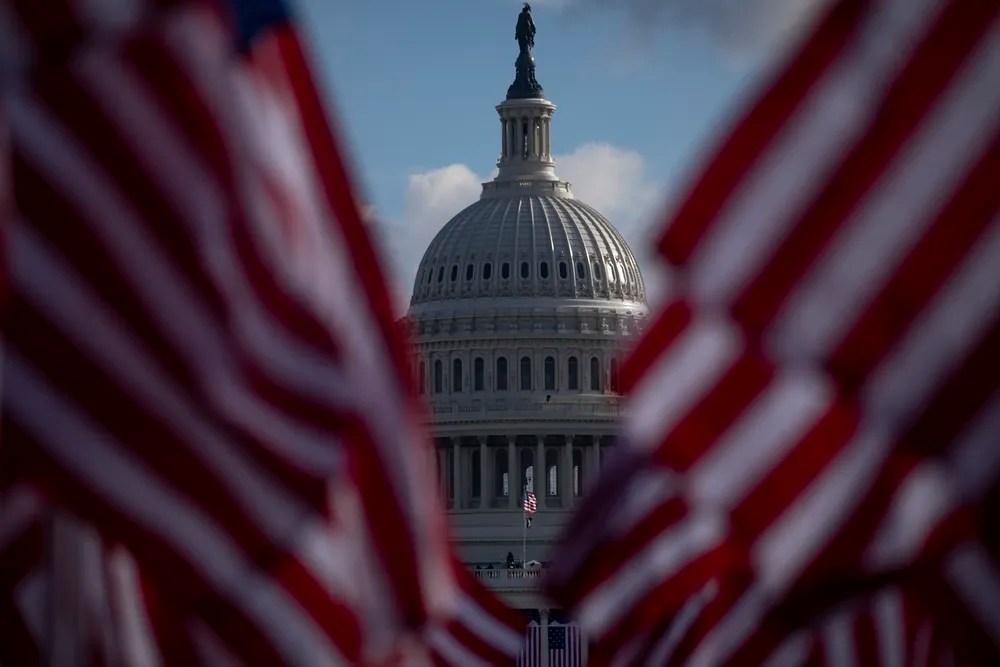
The image featured in this article is licensed for reuse under the Creative Commons 1.0 universal license, and accordingly is in the public domain. No changes were made and the original photo can be found here.
 The Gate
Leave a comment