
The British Left Needs a Voice Again. Jeremy Corbyn Must Be the One to Give It.
The state of British politics is at an all-time low. In what should have marked an era of renewed power for the British left, moderate Keir Starmer won one of the Labour Party’s biggest majorities in history.
Yet, less than a year later, Labour sits at its lowest polling point in a decade, barely ahead of a Conservative Party that has burned through leaders and credibility alike. Labour no longer speaks for the left and the Conservatives are a hollowed-out shell. They have burned through 4 leaders in the last 5 years, and only managed to win 121 seats in the last election – the lowest since before World War 1. Meanwhile, the most popular party in Britain is the Reform UK Party led by Nigel Farage, a right-wing British political figure best known for leading the UK Independence Party (UKIP) — a political party crucial in shaping the populist, anti-immigration rhetoric that drove the Brexit campaign.
For those familiar with British politics, Farage has completed an incredible turnaround. After his departure from UKIP in 2018, it finally seemed like Farage would fade into political irrelevance — where he ought to belong. He could spend the remainder of his days on Cameo, being paid £20 for wishing people happy birthdays and talking about ‘big chungus,’ or spouting pro-IRA slogans. All of which he has done.
Instead, Farage has revitalized his political career as head of Reform UK, a party considered “racist” by 40% of the population. A favourite refrain of Farage’s is to ‘stop the boats,’ claiming that immigrants are the root of all British issues. He even calls for a ‘Britain first’ approach. This scapegoating, favored by fascist rulers across time, is being eaten up by disgruntled former Conservatives looking to restore Britain to its former glory.
How has Keir Starmer responded?
He has steadily pushed Labour further to the right, so much so that it can barely be considered a left-wing party, chasing the populist surge instead of trying to challenge it. Take his approach to immigration. Under Starmer, Labour has embraced a much tougher stance, treating residency and settlement as privileges to be earned rather than inherent rights. Starmer extended the period for permanent settlement to ten years and raised English-language requirements for all adult dependents. Even before the act implementing these laws was passed, 24,000 immigrants were deported — the highest rate in eight years.
On top of this, Labour’s digital ID scheme would force all workers to hold a government-issued digital identity to prove their right to work, disproportionately burdening low-income workers, migrants and part-time employees who often have unstable jobs, non-standard contracts or limited access to government services. By requiring every worker to prove their legitimacy through a centralized ID system, Starmer is adopting a punitive, exclusionary approach to welfare and migration that, historically, the left has fought. Let’s not sugarcoat it — Starmer is courting the moderate conservatives. So, if the left is now the center, who represents left-wing policies?
I’d point to the Islington North MP and former leader of the opposition: Jeremy Corbyn.
I live in Islington North, the constituency Corbyn has represented for over 20 years. We know he cares. We know that he spends time with his constituents, that he is principled and attends protests and that he gives back to the community that has continued to re-elect him. He makes us feel heard. It’s telling that he kept his seat running as an independent against the candidate Labour chose for us.
Less than three months ago, Corbyn co-launched a new party, provisionally named “Your Party.” Corbyn’s pitch was revolutionary: policies, party strategies, even the name — everything will be decided by its members. When their inaugural party conference took place in November 2025, members were supposed to be given the opportunity to come up on stage and debate policies with the politicians. And the policy platform was going to be voted on by all members in a one member, one vote system. Although not all of this happened, and the conference was more punctuated by questions over leadership and internal scuffles, there is still no reason why the party cannot continue to challenge Labour on the left. In terms of policy, one‘Your Party’s’ main goal is to give more of a voice to the working class population by increasing trade union power – a policy which historically has been promoted by Labour leaders.
Critics of Corbyn point to the electoral disaster of 2019, where he was trounced by a Conservative Party led by Boris Johnson, as evidence that he should no longer be in politics. I disagree.
His stint as leader of the opposition did end in failure, but that is because it was not the right role for him. This new position, the co-leader of a socialist party, feels like Corbyn’s rightful place in British politics. As leader of the opposition, had to water down his beliefs in order to be successful; now he needs to be himself and speak on behalf of those who cannot. The policies considered too extreme in 2019 are precisely what will now make him popular among those Labour has abandoned.
He doesn’t need the centrist vote for success like he did in 2019. He needs to make waves on the left. Luckily, that’s always been his greatest strength.
Obviously, even this role will draw criticism. Elias Becker, a history student at Cambridge suggested that, “in a time of mass political polarization, the emergence of yet another extreme party is not something to be celebrated but instead will only entrench already existing political divisions.”
However, if increased polarization is a consequence of this new party, so be it. It’s a necessary evil.
Labour will not magically reverse their slow movement to the right; they must be pulled back forcefully, and the emergence of a new party presents what might be the only way to do it. Currently, for the left wing electorate, there is very little alternative to Labour, allowing Starmer to ignore their interests, for it is likely that, come the next election, he will win their vote regardless. By providing an alternative, Corbyn can force Labour to once again represent the interests of those who voted them into power, as they should.
We might already be seeing the effects of this. In the last few weeks, Labour has scrapped the two-child benefit cap — a cruel measure implemented by the conservatives in 2017 that prevented families from getting financial support for their third child or more. The government estimates that, as a result of getting rid of this act, there will be 450,000 fewer children in relative poverty by 2030. It makes one wonder why Starmer ever continued the policy in the first place.
In a political landscape where Labour has drifted to the centre-right and the conservatives have imploded, Britain is as close to fascism as it has ever been. ‘Your Party’ must succeed. It must serve to hold Labour accountable for its shift and resultant policies and force them to represent the people that they used to. If it does so, even moderately, it may just pull Labour back to its natural role.
If not, the left will continue to drift, leaderless, while Farage shapes the national narrative. That’s not a future we can accept.
We need Corbyn to do what he does best: give voice to the voiceless. There might not be anyone else left who can.
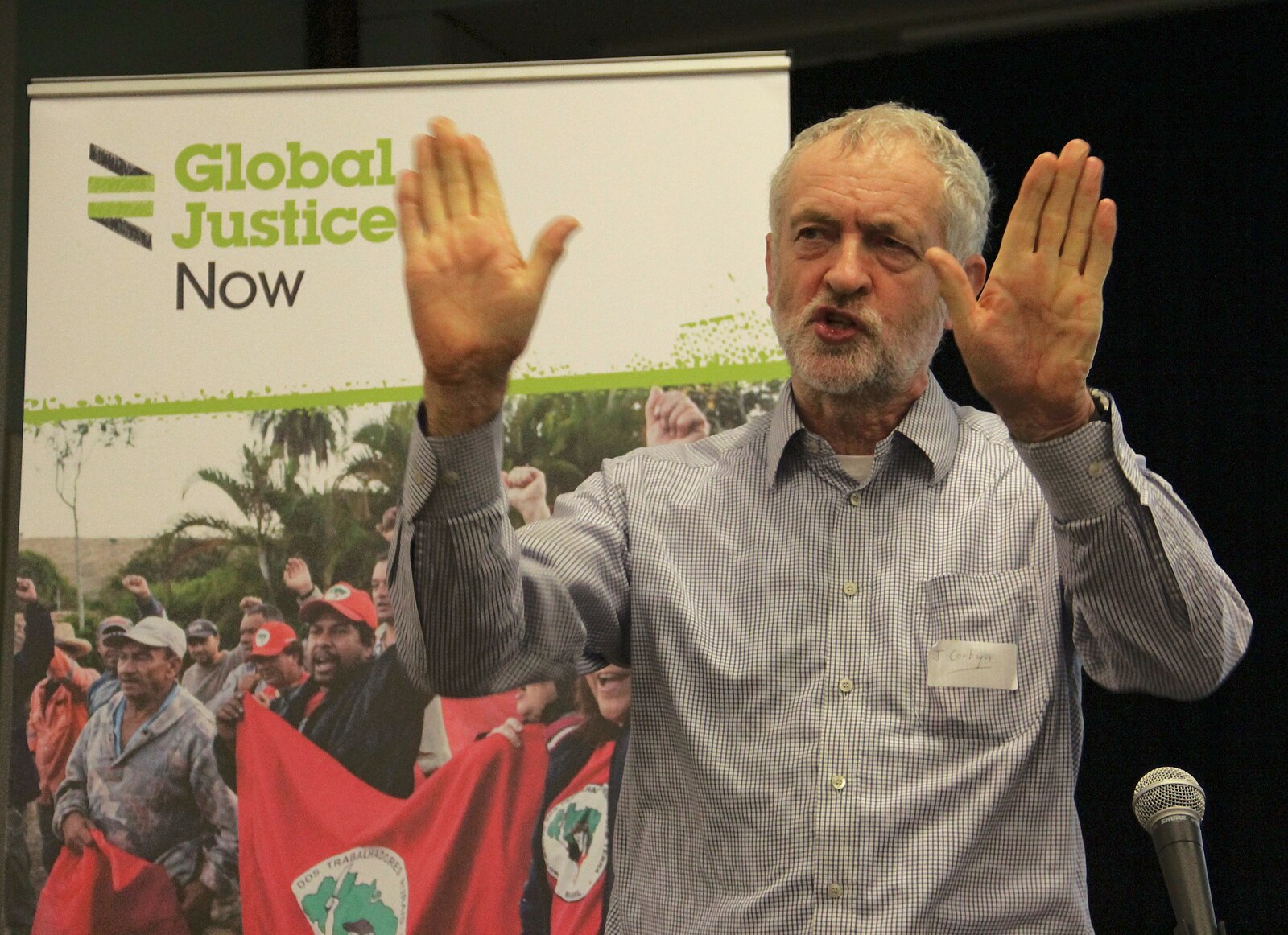
The image featured in this article is licensed for reuse under the Creative Commons Attribution 2.0 Generic license. No changes were made to the original photo, which was taken by Global Justice Now. It can be found here.
