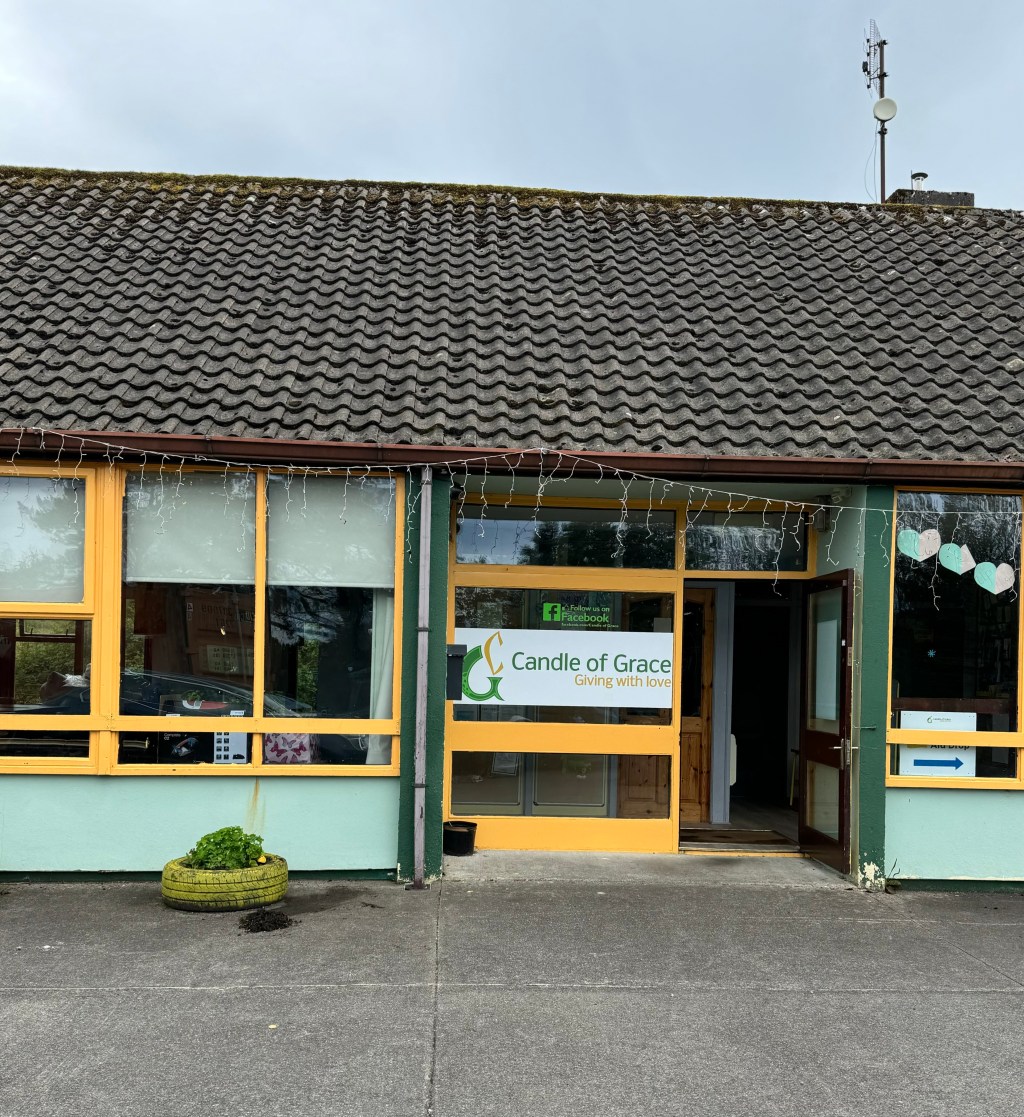
One of the most active centers of support for Ukrainian refugees operates far from the front lines, in Castlebar, County Mayo — a small town on Ireland’s western coast. As Russia intensifies its campaign to secure Ukraine’s eastern Donbas region, civilian displacement continues at a steady pace, even while international attention wanes. Nearly three years after Russia began their full-scale invasion of Ukraine in 2022, funding streams, media coverage, and public urgency have declined across Europe, creating mounting pressure on local aid networks that were never designed to sustain a prolonged crisis.
For decades, County Mayo has quietly welcomed displaced families — first children affected by the 1986 Chernobyl disaster and, more recently, Ukrainians fleeing war. At the center of this effort is Candle of Grace, a small but influential volunteer-run charity providing housing assistance, medical aid, respite care and settlement support. Its headquarters sits in a former schoolhouse amid rolling farmland dotted with sheep, far from the urgency of global headlines. Nearby Castlebar is modest in size, a town of only a few main streets, yet the organization’s reach extends far beyond its rural setting.
“It’s kind of a chain of kindness,” Belarusian-born founder of Candle Grace, Lily Luzan, said. “You do something little, they do something little, and that’s how it keeps going.”
That chain, however, is currently under strain.
Founded in 2016, Candle of Grace initially provided healthcare and summer respite programs for children still living in the contaminated Chernobyl zone. When Russia launched its full-scale invasion of Ukraine, the organization pivoted overnight. Since then, Luzan has personally brought more than 400 refugees to safety in Ireland — arranging transport out of Ukraine, securing paperwork and helping families settle into new lives. She receives no salary, has no administrative staff and relies entirely on donations. Locals call her “The Queen of Ukraine,” a title that she earned through her work.
Luzan traces her passion for charity back to her own childhood. As a “Chernobyl child,” she was welcomed by an Irish host family for respite. When it came time for her to start her own family, she settled down in Ireland to raise her two children, seeking a similar community of support.
According to Mika, a volunteer with the charity who requested their last name not be used, donations and capacity have dropped sharply since 2022. At the height of public attention for the Russia-Ukraine conflict, Candle of Grace could easily fill shipping containers with aid; now they struggle to gather even the bare minimum. The annual Christmas gift drive tells the same story: once filled with hundreds of shoeboxes for children, this year they expect “maybe 20 [shoeboxes], if we’re lucky.”
Government support is shrinking as well. Ireland’s Accommodation Recognition Payment program — through which the state pays Irish homeowners for hosting Ukrainian refugees — has been reduced from €800 per month to €400 this January before it is expected to be eliminated by March.
Mika explained the consequences clearly: once the payment ends, many Ukrainian families will no longer be able to afford housing. “The cost of living here is really expensive,” Mika said. Of the roughly 400 refugees who arrived through Candle of Grace, only about 200 remain in Ireland; many have already left for more affordable countries like Poland.
With less funding and support, the pressure for Candle Of Grace is mounting. Luzan fields calls “all day,” she says — from families losing housing, from those placed in temporary hotel accommodations being asked to leave after 30 days, from new arrivals with nowhere to go. “Nobody wants them anywhere,” she said. “And I don’t know why they’re still letting them in when the system [in Ireland] is overwhelmed.”
The shift in funding is also changing what the charity can do. Candle of Grace still runs English classes and sends aid shipments to Ukraine, but helping families secure housing — a task that once defined the organization — is becoming nearly impossible.
Yet volunteers persist. Mika is pursuing a master’s degree full-time. Luzan and Noel, the secretary and another core volunteer, each hold full-time jobs as well. All three give their remaining hours to Candle of Grace.
For them, the work is exhausting but meaningful. Last week, a Ukrainian family invited Luzan and Noel as the first guests into their newly purchased home. When Luzan asked why they invited her over, the woman explained that she had followed every instruction Luzan gave her “like 1-2-3-4-5” — learning English, finding employment, moving out of temporary housing, securing transportation. For her, the visit was a gesture of profound gratitude.
“For the amount of resources we have,” Mika said, “we’re doing as much as we can anyway.”
Even as global attention drifts, organizations like Candle of Grace remain on the front lines of a crisis that has not ended — quietly sustaining the same chain of kindness that once sustained their founder.
Image taken and provided by Margot Furman.
 The Gate
Leave a comment