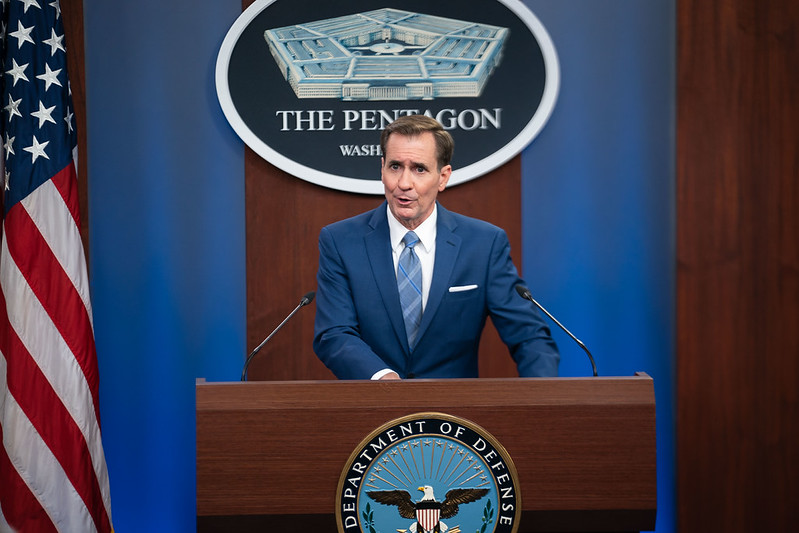
On the afternoon of January 15, I had the opportunity to sit down with John Kirby, the new director of the University of Chicago’s Institute of Politics. I asked him about his background, his plans for the future of the IOP and his perspective on ongoing global political and military issues, and he responded with sincerity and enthusiasm.
Kirby’s remarks have been edited for clarity and concision.
Introduce yourself to the world, introduce yourself to UChicago students. Explain who you are beyond your titles. Who are you? Where are you from? What do you care about?
I am the son of an auto mechanic, and my mom sold real estate. My parents never had more than a high school education. They moved down to Florida when I was five years old, so that’s home to me, Tampa Bay, St. Pete. Big Irish Catholic family, 5 boys, one girl. [My] dad felt very strongly that we owed this country a debt, and he wanted all of his boys to join the military. He was a little old fashioned. He did not make my sister join. And so, like my brothers, I went in. I chose the Navy; not all of my brothers did.
I never intended to make the Navy a career, but it turned out that they just kept giving me great opportunity after great opportunity, so I stayed. I was in the Navy for 30 years. I rose to the rank of two-star admiral. […] I was the head of all of Navy communications [and] public affairs. I was also the Pentagon press secretary, the first to be in uniform. Typically, press secretaries at these cabinets are political appointees. I was not.
After I left the Navy, I did become a political appointee. I decided that I was more aligned with the Democratic Party than I was the Republican Party. I worked in the last two years of the Obama administration as John Kerry’s spokesman at the State Department. During the first Trump administration, I was an analyst at CNN and I taught at Georgetown. When [President] Biden got elected, I had no plans to go back into government, but he selected Lloyd Austin to be his Secretary of Defense. […] He asked me to come back into government. So I was, again, the Pentagon press secretary, and then got invited to go work at the National Security Council for the last couple of years.
How did you get into the communications side of things? Why was something that interested you?
The way I describe it is “the best decision that I never made.” After my first tour aboard a ship, I went to the US Naval Academy to teach. And while I was at the Naval Academy, I decided that I wanted to do something different in the Navy than what I had been doing, but I didn’t know what I wanted to do.
There’s lots of different skill sets that you can transfer into. They all sounded good to me on one day, and then the next day they didn’t. I met a guy at the Naval Academy, […] and we’re still very close. He, literally and figuratively, was in the same boat. Every day we’d sit over coffee before we would teach our classes, and we would think about which one of these skill sets we wanted to go into, and we couldn’t make up our minds.
One day, just as a joke, because we were 25 years old and kind of stupid, we went and got a paper plate. We took a marker and we drew 8 slices of pie. In each slice, we wrote the name of a different skill set that we could transfer into. We went to the clinic at the Naval Academy. We got a tongue depressor. We drew an arrow on it. Stuck it to the plate with a tack, then started spinning it. Every day, over coffee, before class, we’d spin the dial, and every day, it would land on something different, and we would laugh and laugh about just how stupid we were.
One day, after two or three weeks of this, Jamie, my friend, came into my office, and he had a different look on his face. He was more serious, and he said “look, let’s do it for real today. Let’s not joke around.” So we shook hands, we spun the dial and we both became public affairs officers.
What is the story behind how you ended up here? Did you ever expect yourself to be in an academia or academia-adjacent role?
After the administration ended, I took a few months off to just relax. I didn’t realize how tired I was. When I started looking for a new job, I just assumed that the only real options to me were corporate communications, and maybe consulting.
I got an email one day, this was late August, from one of the members of the board of advisors for the IOP, and this email said “we’re looking for a new director, if you know anybody.” I wrote back and I said, “look, what about me? You know, do you think I might be competitive for this?” Next thing I know, I’m out in Chicago doing the interviews.
As soon as I saw the email, I had this good feeling about it, because it scratched […] a lot of itches. I still felt like I had some gas in the tank when it comes to public service, and I see this as public service. In fact, we’re all about giving the students here opportunities to serve in public roles. So, to me, it was a perfect sort of next step.
The other thing I really like about it is the university itself. I mean, I didn’t go here. Even back in the 1980s, I wouldn’t have been smart enough to get into the University of Chicago. But, this school has such an amazing reputation around the country. You tell people you’re at the University of Chicago and they know immediately what you’re talking about. There’s a special place that this school occupies in the public mind — its academic excellence, but also free expression, a real diversity in the student body, and its [location] right in the center of the country. There’s just something special about this place.
And then, honestly, I had applied to the Pritzker Fellowship program back in 2020 and got accepted and I was very excited. Donna, my wife, was gonna come out with me. Then COVID hit, and they canceled it that year, or at least for that quarter. So, I never got a chance to be a fellow. There was also a little part of me like, you know, I get to go back. I get to try this again.
And now you’re here.
And now I’m here.
That’s a quick turnaround. How do you feel like the adjustment has been?
It’s been a whirlwind. I mean, that email came in late August. By mid-September, I was out here for the interviews, and then my tenure officially started on 15 November.
Yeah, it was fast. We’re selling our house in Virginia. It’s not sold yet. We’ve moved everything to Chicago, we’re living downtown. My wife and I decided, if we’re gonna do this, we’re gonna do it. We’re going to jump in.
I wanted to physically be in Chicago, to come to the office every day, be around the students every day, and we wanted to move everything we had. Now, we’ve settled in, and yeah, it’s been a whirlwind, but it’s been so exciting. We’ve never lived in a high rise before, never lived in Chicago before, never even lived in the Midwest. So, we’re excited; we’re fired up.
What is your vision for the IOP? Are there things you want to implement? Are there goals you have for yourself as director, for this building, this institution?
The main thing I want to do is preserve it. The IOP is a very special place, and that’s a credit to David Axelrod, who founded it and really nurtured it for that first decade or so, and Heidi Heitkamp, my predecessor, who really started to take things to the next level; I want to make sure that I don’t do or say anything that sets the IOP back. It’s so special, and the programs they offer, the resources they provide are a real gem. So, number one is to preserve and protect what is already a very special place on a very special campus.
Number two: I believe that because the IOP has done so well, it’s primed for growth. Now, what does that growth look like? I’m not sure right now, but I believe we’ve got an incredibly professional staff, we’ve got a very motivated student advisory board, both graduate and undergraduate, and we’ve got these amazing programs that are already in place and running well. I think we should look at how we grow the IOP, grow it in resources, grow it in programs, grow it in ideas, maybe even grow it in staff. But, I want to approach the job from a growth mindset, because this place is ready for that.
The only other thing that I have been thinking about is based on my background. Unlike Heidi or David, it’s not in electoral politics, it’s more national security and policy. And so, while I don’t want to do anything counter to the DNA of the place, I would like to explore the intersection of politics and national security a little bit more. I’ll be pulling on my Rolodex and my own network to see if we can do some programming and events around the nexus between politics, policy and national security.
There are students who had mixed feelings about you coming here, and some even protested your appointment. How do you plan to engage with those students and to bring those people in? Do you think that’s your job?
I absolutely understand the concern that some students have. They stem from genuine anguish about what’s happened to innocent Palestinian lives over the course of the war in Gaza and are still being affected by operations there. I know where that’s coming from. I also believe that those concerns come from a very honest, noble desire to not see people suffer, and I know some people may not agree or may not believe me, but I share that same anguish. How can you not? How can you have a beating heart and not feel for the tens of thousands of innocent Palestinians? They didn’t ask for this war. They had no control over what Hamas did on the 7th of October, and Hamas has put them in the crossfire on purpose, digging under their homes and under hospitals and under their schools. How could you not feel for them?.
Going in, my position is that I am willing and able, and look forward to, having conversations with students and faculty alike, to hear those concerns out, and to answer whatever questions I can about those concerns. Look, if I was afraid of having those conversations, if I didn’t believe [that] they were legitimate, I wouldn’t have taken this job. I would have gone to work in a company somewhere where nobody would have asked me. But, those are important concerns, and these are critical times.
Just like any of my colleagues in the previous administration, now that we’re out of office, we have time to think. I’m thinking about how we approach these problems and about what other things we could have done, or if there was something we missed, I’m working myself through that as well. I can’t sit here and tell you that I have all the answers. I don’t think I do, and I don’t know that I ever will. But, I’m willing to have the conversation with myself.
I want that conversation to be informed by conversations I’m having with others, particularly others who don’t see the problem maybe the same way I do. I’m very open to it. I’ve been trying to make it clear in all the discussions I’ve had with students so far that I welcome their views and I respect their criticisms and I understand whatever objections that they might have. Those objections may not cease, but I hope over time they at least come to see me as an honest broker.
It’s entirely possible that even after these conversations, their minds about me won’t be changed, and my views may still be with me. I don’t know where these conversations are going to go, but I am willing to have them, and at the end of the day, we may still not agree on everything about the policy that the previous administration executed and that I articulated from the podium. I think we all have to recognize that there may still be disagreements. But, isn’t that what this place is all about? It’s about the ability to disagree agreeably and to be honest with one another. And I fully intend to be honest.
I knew coming in, even before I was hired, that this might be an issue. But I’m not gonna run from that, any more than the people that object to me are gonna run from objecting to me. I wouldn’t want them to. Let’s talk about it. Let’s have a conversation, and at the end of the day, like I said, we still may not agree on everything, but at least we’ve seen each other as fellow human beings, and were able to have a conversation. Again, that’s what the IOP’s all about. That’s what makes it special.
There’s another aspect of this that I think is worth talking about, and that’s the issue of conflict and controversy and public service. Whether you agree with the policy or not, whether you think I was a noble public servant or not, I have had plenty of experience, not just in the course of the Middle East, but the war in Ukraine, or the withdrawal from Afghanistan. I have, as a professional communicator, dealt with a lot of very tough, very controversial issues. I think that I have something to offer students who are wanting to pursue careers in public service about how you handle those tough issues.
People may say that I didn’t handle these things well, and that’s fine. But, I have gone through those gauntlets, and I think anybody that wants a career in public service has got to understand that there are going to be tough times. There are going to be tough decisions. There are going to be compromises that have to be made, and there are going to be controversies that have to be dealt with. I’d like to believe, at the risk of sounding arrogant, that I have something to offer in terms of how you handle tough situations from the podium. It’s a very important thing to discuss and talk about and think about, especially in a place where people have aspirations to do really big things.
Is there anything I didn’t ask about that you want to mention, or that you think is important for people to know? Leave it all out there, put it on the table.
I would just go back to the issue of Gaza and policymaking. National security policymaking is very, very difficult. And it’s important to come into these policy discussions with a set of values and principles. But, you also have to appreciate that the American military, the United States of America, is not always omnipotent. Other actors get a vote. Other actors have a voice, other actors that you can’t control sometimes affect what decisions you end up making down the road, and can affect the evolution of your own policy.
On the situation in Gaza, as I said, I understand the concerns. I’m certainly in my own mind working my way through it, and willing to think through what we might have done differently. But, Hamas had a vote. Mr. Sinwar, hiding in that tunnel, had a vote. I think it’s important to remember the slaughter on the 7th of October of 1200 innocent Israelis, who also didn’t ask for that war in that conflict, and the dozens taken hostage, brutally tortured. To a very real degree, there was a limit to what we could do to affect the decisions of Mr. Netanyahu and his war cabinet. We had certain influence there, and discussions with them, meaningful discussions, and we were able to affect some decision making, but not all decision making. It’s a sovereign government.
The point I’m trying to make is that policymaking in the real world is very difficult. Sometimes you succeed, and we did have some success. We got two ceasefires. We got dozens of hostages out. However, you don’t always have the impact that you want, and that’s why you have to keep trying.
On any given day, if I had come to work, and I saw people from President Biden on down not caring about the Palestinian people, not caring about trying to end the war, not caring about doing what we could as a responsible ally to Israel to make sure that Israel could defend itself because while this is all going on, they were getting hundreds of missiles and drones flown at them from the Houthis and from militia groups in Iraq and Syria and from Iran, if I felt like on any given day, we weren’t doing our best to try to end this conflict and keep it from spreading, I would have quit. I would have walked away. I didn’t do that because I didn’t see that. I saw people from Joe Biden on down doing their utmost to try to do the right thing. Did the result always end up the way we wanted to? Of course not, but that’s the case in just about any national security policy problem. But, it was never, ever, on any given day for a lack of an honest, noble effort to get there.
That is not to suggest, and I don’t want people to take away from my comments, that there’s an excuse for the killing of nearly 70,000 innocent Palestinian lives. There’s no excuse for that. It’s a horrific toll. And as I said many times from the podium, each and every civilian casualty is in of itself a tragedy that should have been prevented.
And I think, with all the respect for people that object to me being here — and I mean that genuinely — I do hope that as we have the conversations that I know we’re going to have, that we together can recognize that this is policymaking at its most difficult and there are no silver bullets.
There’s no one-size-fits-all answer, and the Trump administration is learning this for themselves. Since Mr. Trump came into office, the war in Gaza has continued and there hasn’t been much of an effort to restrain what Mr. Netanyahu and his war machine had been doing. As for Ukraine, I believe he honestly wants to end that war. I think he wants to end both wars. But he’s learning, and his team is learning, how hard this is, because other actors get a vote and a voice.
You have to be innovative. You have to be creative. You have to be willing to try new things. You have to be humble enough to admit when you’re not having the impact and the effect that you want, but also recognize that there are going to be certain limits to your power, no matter how big that power is. You have to try to work within those limits as best you can.
The image featured in this article is licensed for reuse under the Creative Commons Attribution 2.0 Generic. No changes were made to the original image, which is accredited to the Chairman of the Joint Chiefs of Staff and can be found here.
 The Gate
Leave a comment