
Why “No Kings” Forgets the Legacy of American Dissent
While the No Kings movement achieved record-breaking turnout, its prioritization of broad accessibility over strategic tension has traded institutional leverage for an impotent, high-volume cultural event.
Following the second large-scale No Kings Protest, drawing more than seven million people nationwide, uncertainty lingers: what’s next? However, the more important question, overlooked since June’s initial demonstration, is instead: what was accomplished? With a lack of legislative impact, most opinions tout the protests as an end within themselves or applauding the protest for its massive turnout — fourteen times the size of MLK’s March on Washington. But I believe this discrepancy between the movement’s scale and its lack of tangible impact within courts or legislation suggests a worrying shift in American protest culture. The history of contentious political action has always been cumulative, building upon the movements of the past and innovating when prompted. But to me, No Kings replaces political impact for accessibility, representing a movement away from strategic disruption toward a form of high-volume, low-stakes performance without any cultural or institutional leverage.
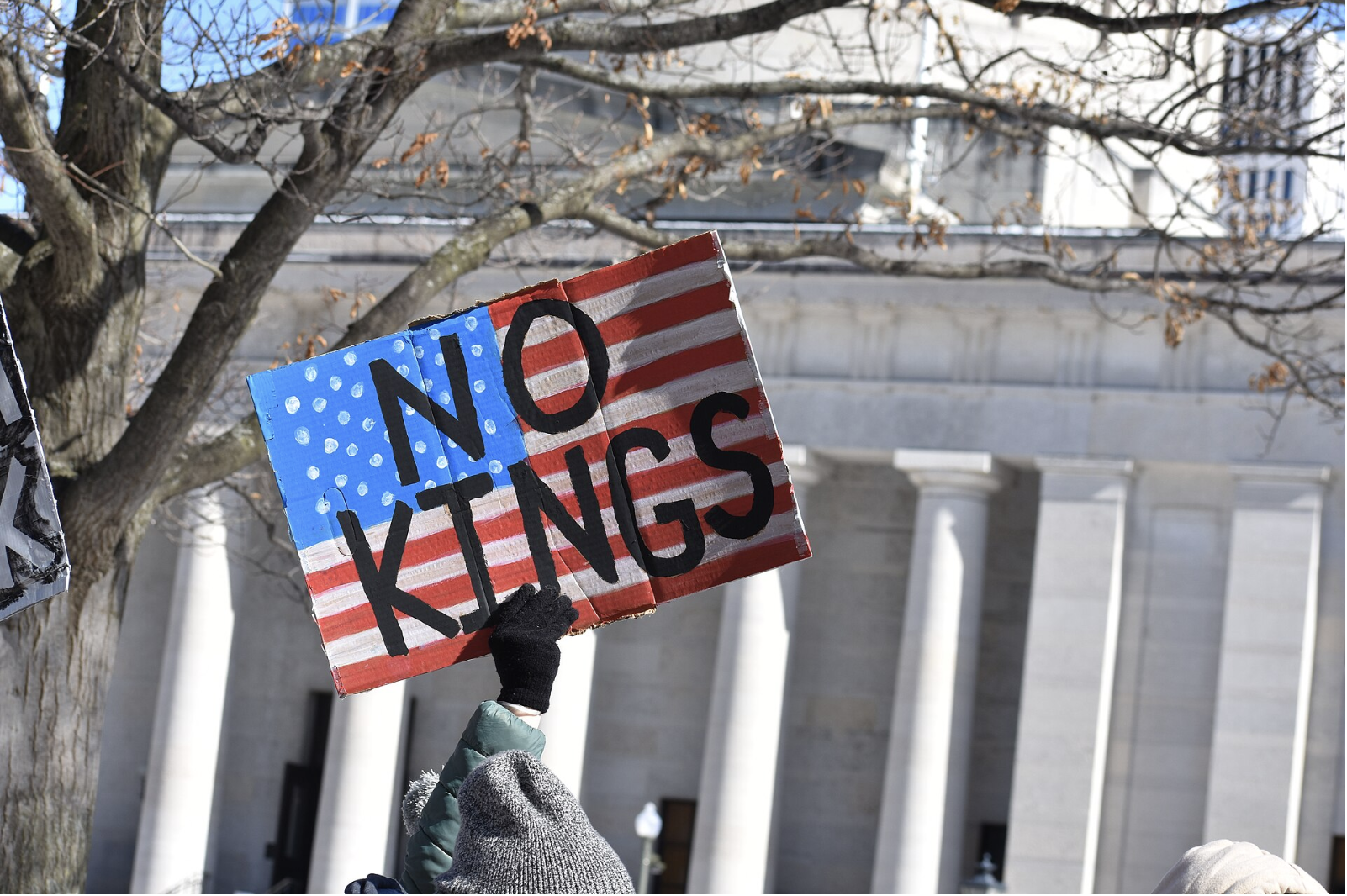
Turning to the No Kings Protests, we see many traits reminiscent of the great American protest movements of the past, besides a clear platform. On their website, the declaration “to fight dictatorship together” is the only positive action statement. While movements of the past sought concrete change through bus boycotts, No Kings offered only vague disapproval of a wide range of laws. To be fair to the organizers, they made a clear effort to capture the narrative by swapping radical iconography for a sea of American flags — a strategic attempt to capture the American ethos and claim the mantle of true patriotism. Yet, they forgot that a flag is not a substitute for a demand.
This isn’t the first time we’ve seen massive numbers result in minimal returns. Consider the 2017 Women’s March — one of the largest single-day demonstrations in U.S. history — which, despite its fervor, struggled to translate that energy into a unified policy agenda. No Kings has followed in the path of the Women’s March, optimizing for quantity over contention. Contrast that with Earth Day 1970, where 20 million Americans took to the streets. That movement succeeded because it funneled citizens’ energy into specific institutional changes. With the nationwide attention on the ecological disasters of the 1969 Cuyahoga River fire and Santa Barbara oil spill and with the organization of both Gaylord Nelson (D) and Pete McClosky (R), Earth Day was, at its core, fundamentally more effective than No Kings because of the presence of specific policy demands. Beginning with its foot in the door of Congress, and only then leaning into public support, Earth Day led to the creation of the EPA with bipartisan support.
Historically, the most impactful movements in America have been characterized by the attraction of public support from outside of the movement through high-stakes disruption. The participants of the sit-ins and marches of the Civil Rights movement put their own safety on the line to claim moral superiority in the eyes of moderates, simultaneously tapping into the cultural importance of rights in Cold War America. Exacerbating the cognitive dissonance many white Americans already felt, Civil Rights leaders leveraged the popular support their mass disruption garnered them to signal to the Democratic party that by aligning themselves with civil rights, leaders would lend them a political constituency, (a legacy that is still maintained today).
The reason for this void of impact lies in No King’s complete and total lack of tension. In his Letter from a Birmingham Jail, Dr. King stressed that nonviolent direct action seeks “to create such a crisis and foster such a tension” that a community which has refused to negotiate is forced to confront the issue. The No Kings protest did the opposite. It was a movement impotent by design, and the government responded with a masterclass in democratic diffusing.
White House Deputy Press Secretary Abigail Jackson’s dismissive “who cares?” and President Trump’s weekend at Mar-a-Lago weren’t just insults, but a strategic choice to let the movement let out steam. This diffusion was evident even among those sympathetic to the right to protest. Connecticut House Republican Leader Vincent Candelora affirmed the protesters’ right to express themselves, noting that “democracy is still strong as ever”. When your political opponents are comfortable enough to compliment your right to complain, you have failed to create tension.
The movement failed because it lowered the barriers of entry so completely that it abandoned a platform to press. Without crystallized demands, the protest fractured into a motley cultural event — a costume party and funny sign competition. This low-stakes activism is perfectly summarized by a protester in Los Angeles wearing a unicorn costume. He told reporters the outfit helped “de-escalate interactions with law enforcement” and proved the event wasn’t a “war zone”. but a “block party”. He is correct. And in his correctness, he identifies the core failure: it is impossible for the state to take an action seriously when its own participants describe it as a party.
Strategically, the timing was equally baffling. Unlike the 2020 BLM protests, which occurred months before a pivotal election, No Kings took place a full year before midterms in a lame duck president’s final term. The participants chose a target they had no leverage over, at a time when they had no strategic voting power to wield.
This points to a worrying direction for American dissent. Historically, protest movements either radicalized in the face of repression or became institutionalized through state appeasement when the stakes were raised. But we are entering an era where the state has mastered a third option: exhaustion. By ignoring a movement that is by design unthreatening, the state simply waits for the individuals to tire out. Seeing a movement fizzle out after burning bright is exactly what the Trump administration wants.Reaping all the sowed anger and fervor within the American populace, No Kings spent all that stored-up energy with virtually no material returns. Ultimately, the protest was the political equivalent of a baby being left to cry it out. With the positive reception and praise it has received, this is a broader sign pointing towards the state’s domination of the dialogue between them and their citizens. What we need to remember is that the right to protest is not protected because of its capacity to express grievances, but for its value as political currency. Protest’s importance comes from being able to galvanize frustration into political force by centering movements around policy and pressuring the correct offices of power at opportune times. Without this edge to cut with, protest becomes a vain expression of frustration.
The image featured in this article is licensed for reuse under the Creative Commons Attribution 2.0 Generic license. The original image can be found here.
