The University of Chicago’s proclaimed values emphasize free and open discourse. On its website, the University insists that it “believe[s] in the power and protection of free speech.”
On this campus, those priorities are visible. The University, and affiliated organizations such as the Institute of Politics, maintain a commitment to fostering “non-partisan” discourse. They invite diverse speakers—ranging from progressive internet personalities like Hasan Piker to conservative Sen. Lisa Murkowski (R–AK)—and engage in good faith conversations across differences.
UChicago largely practices what it preaches when it comes to free speech and open inquiry. Being non-partisan is an integral part of doing so. But it’s high time we stop conflating being non-partisan and non-political.
The whole world is political; I mean, it’s even a category on dating apps. And in a landscape where the President brazenly proclaims his indifference towards bridging the Grand Canyon-sized partisan divide, it is advantageous to Trump for everything to be political. To politicize everything means to widen that divide. This is to say: being non-political is impossible; feigning it is dangerous.
I’m not interested in UChicago weighing in on the merits of tariffs or the government’s supplying Patriot missiles to Ukraine. In fact, UChicago’s “institutional neutrality” dates back to 1967, when the University issued the Kalven Report. The document calls for a focus on the “widest diversity of views,” and makes clear that the University itself “is not a critic.” So, UChicago is no stranger to staying out of political conversations, as an institution. In the last year, following student activism around the conflict in the Middle East, many other peer institutions followed suit. Good. Let partisan fights remain in D.C.
But the line between being non-partisan and non-political is thin—and UChicago cannot find it. Or worse—it doesn’t want to. This fine line is most clearly delineated in the fight against federal interference in university education.
This is a fundamentally non-partisan matter: federal influence in the American university system is neither strictly legal (see: lawsuits over constitutionality of executive actions) nor does it contribute to the mission of any self-respecting institution. Which is why the University’s broad policy of inaction in the wake of federal intervention at peer private institutions is so alarming – and disappointing.
This policy of inaction is best evidenced by the University’s absence from a letter written by the American Association of Colleges and Universities (AAC&U) and the American Academy of Arts & Sciences from April. The statement, entitled “A Call for Constructive Engagement,” called for a more intelligent course of action from the federal government with respect to reforms at universities.
Conservative critiques of academia are not new; Charlie Kirk wrote a book called The College Scam, railing against universities for being biased and not worth attending. Trump echoed this sentiment on the campaign trail, and later, commented on TruthSocial: “Higher Education has lost its way, and is now corrupting our Youth and Society with WOKE, SOCIALIST, and ANTI-AMERICAN Ideology.”
Still, the letter was organized in response to the Trump administration’s unprecedented wielding of federal funds as leverage against institutions. In his first year-or-so, Trump has cut $400 million in federal funds to Columbia and Harvard for anti-semitism issues following pro-Palestine student protests that, at times, intimidated and endangered Jewish students. In addition, the administration has eliminated upwards of $8 billion in grant awards, which were broad and not ideologically targeted. Trump has threatened to revoke further federal funds from universities who do not cooperate with the administration’s anti-DEI agenda.
It’s worth noting that UChicago has largely avoided the wrath of the federal government, at least with respect to institutionally-targeted funding. I will concede that the University’s attempt to be non-political has likely prevented greater federal intervention. In response to a now-rescinded funding freeze issued by the Trump administration, the University readily complied, causing faculty to pen a letter expressing frustration over its eagerness to do so. I understand why the University did so. Limited pushback will probably put the University on the administration’s good side; and other institutions who have acquiesced have been rewarded.
Nine universities Trump deemed respectful and engaged in good faith were offered an “olive branch” pact – with promises to return revoked federal research funds if they signed. While those universities largely rejected his compact, in the name of institutional freedom, the point stands that compliance with the administration can prevent funding losses and further attacks. But the price of compliance is relinquishing that freedom – now, six months from now, or three years from now.
For an institution fervently committed to free expression and diverse viewpoints, that institutional freedom should be at the center of UChicago’s mission. That is precisely why its absence from the “Call for Constructive Engagement” is so infuriating.
In my estimation, the letter is uncontroversial. The most politically charged statement in it comes when the universities speak out “against the unprecedented government overreach and political interferences now endangering American higher education.” At no point does the article speak with hostility towards the Trump administration, beyond rejecting “the coercive use of public research funding.”
In fact, I was particularly struck by one sentence from the letter: “Our colleges and universities share a commitment to serve as centers of open inquiry where, in their pursuit of truth, faculty, students, and staff are free to exchange ideas and opinions across a full range of viewpoints without fear of retribution, censorship, or deportation.”
I could’ve read that on the UChicago website.
665 colleges and universities co-signed that letter. And UChicago’s “institutional neutrality” is no excuse: Harvard, Yale, Penn, Michigan, and Brown all joined the neutrality pact and signed. Other universities represented include: Duke, MIT, Princeton, Northwestern, Georgetown and 653 others.
Nearly every other list that includes those universities has UChicago on it. Not this one. This is the difference between non-partisan and non-political in action. Apparently, nobody at UChicago got the memo.
Luckily, I’m not the only one who noticed: more than 250 UChicago faculty members penned a letter expressing displeasure at the university’s absence. It’s good to know some adults on campus have spines.
Look, Trump’s national policy on universities hurts all of them. Despite its primary policy of complacency and silence, UChicago remains under investigation by the U.S. Department of Education for engaging in “race-exclusionary” admissions practices. It, too, has seen hundreds of millions in federal grants and research funds cut. No university is safe – save, perhaps, Liberty and BYU.
I understand the University’s impulse not to wage war with the administration. The impulse to not appear partisan is perhaps a sound one. But it isn’t partisan to be outspoken against federal interference in university education. And not standing up for academic freedom, and the ability for its peer institutions to practice what UChicago so ardently claims to preach, is unacceptable.
Hiding from these problems does not make them go away. Power and acquiescence begets more of the same. And as Thanos tells the Asgardians in Avengers: Infinity War: “Dread it, run from it – destiny arrives all the same.”
And the longer the “University of Free Speech and Expression” fails to speak out against clear violations of institutional free expression, the more hypocritical that emblem sounds.
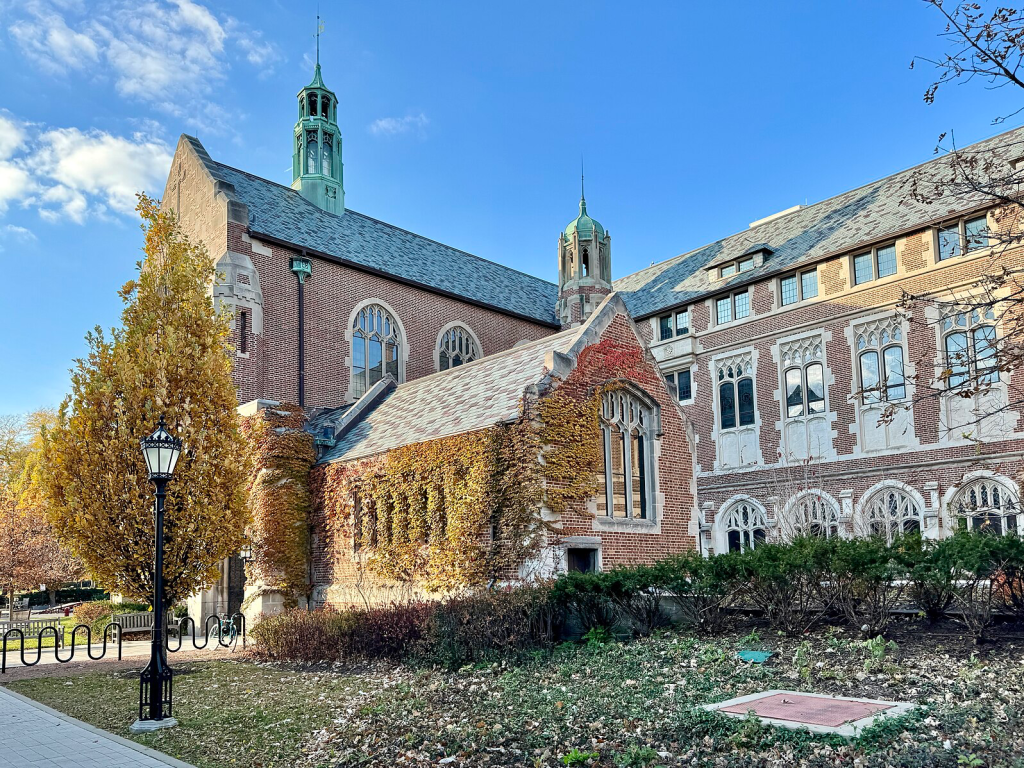
The image featured in this article is licensed for reuse under the Creative Commons Attribution-Share Alike 2.0 Generic license. The photograph was originally taken by Warren LeMay. No changes were made to the image, which can be found here.
 The Gate

Leave a comment