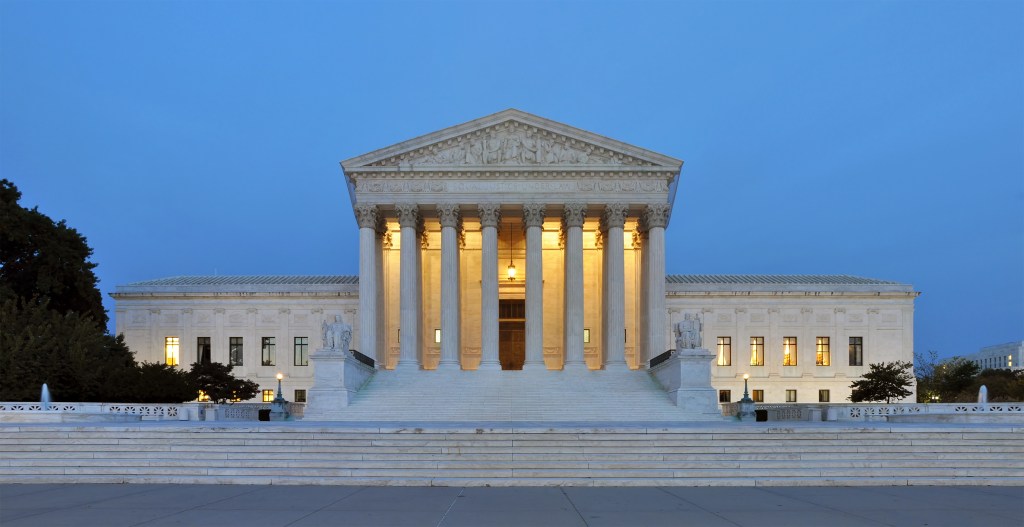
Over the last few months, Democrats have faced the challenge of how to present a unified opposition to Trump. Left without a U.S. Supreme Court majority, executive power or control of Congress, they have frequently resorted to criticism of Trump’s attempts to expand presidential power and extreme policy changes. Although their constituents are pushing them to fight back, Democrats’ combative options are limited primarily to the courts. However, the extent to which this form of resistance will continue to succeed remains to be seen.
Even in his first few months of the presidency, it is clear that President Trump will stop at nothing to enact his agenda, overwhelming the American public with dozens of executive orders, lawsuits and federal workforce cuts. One of his primary concerns appears to be reducing the size of the federal workforce through targeting a swath of federal agencies, notably the Department of Education and USAID. Overall, Trump has laid off nearly 50,000 federal workers since January and frozen funding for many federal programs. Additionally, he has cracked down on immigration, including through an attempt to revoke birthright citizenship for the children of illegal immigrants.
Politicians and civilians alike depend upon the US legal system as a check on executive and legislative power. However, the conflict between the executive and judicial branches has dramatically escalated in recent years. One important example of this dynamic was the landmark Loper Bright Enterprises v. Raimondo ruling by the Supreme Court in July 2024. This case famously overturned the 1984 Chevron deference doctrine–which held that courts should defer to the judgment of federal agencies to interpret vague federal statutes–and dealt a blow to the autonomy of federal agencies. Conflict between the courts and the executive branch has only increased with the dozens of cases against the Trump administration in recent months.
The High Court’s ruling in Loper Bright represented the culmination of a broader conservative push to reduce the power of executive agencies, particularly the agencies that Republicans see as out of their control or a drain on resources. The controversial Project 2025 policy agenda included dozens of suggestions to drastically diminish the influence of federal agencies. Trump’s second term is shaping up to be the culmination of a decades-long Republican effort to expand the power of the presidency while weakening the influence of regulatory elements of the executive branch.
A particularly robust target for many lawsuits is Trump’s relatively new Department of Government Efficiency (DOGE). Progressive activists have filed several lawsuits against the newly established entity, threatening its autonomy and influence over other federal agencies. States, nonprofits and former members of USAID have sued under the Freedom of Information Act, arguing that the public has a right to some of DOGE’s internal records in order to hold DOGE accountable. They have also cited the Federal Advisory Committee Act and the Appointments clause of the Constitution, which prevent the delegation of regulatory and monetary power to non-elected citizens. In court, the Trump Administration has countered these arguments with the claim that DOGE has very little regulatory power and is not organized in a way that it may be considered an agency. If courts rule against the administration, these lawsuits will at a minimum require DOGE to restructure and release some of its internal records to the public.
Already, courts have made progress in addressing many of the lawsuits filed against the Trump Administration’s earliest orders. In late January, 22 states filed suit to block Trump’s effort to revoke birthright citizenship for the children of undocumented immigrants, a cornerstone of US law since 1868 with the Fourteenth Amendment. Several district and circuit courts quickly opposed the Executive Order as judges issued preliminary injunctions against Trump’s decree. An order that ended the protected status of around 350,000 Venezuelan immigrants recently reached the Supreme Court, which ruled on April 7 that deportations of these migrants may continue but that future individuals marked for deportation must be given notice beforehand to allow them time to mount a legal challenge.
Similarly, a court issued a temporary restraining order in response to Trump’s move to effectively shut down the operations of USAID by forcing the sudden resignation of 10,000 employees, citing laws that require termination notice.
Nevertheless, the Trump administration has continued to fight legal efforts to rein in its authority. In nearly every case, the administration has appealed decisions in which courts ruled in favor of opposition to the abrupt and controversial changes. In one high-profile suit, the Administration filed against the state of Illinois and the city of Chicago for alleged interference with Trump’s crackdown on illegal immigration. Separately, an executive order threatened to dramatically cut federal funding for Chicago and other cities that refused to comply with executive orders.
In March, a nonprofit advocating for transparency in government sued Secretary of Defense Pete Hegseth and several other officials who were part of a Signal chat under the Administrative Procedure and Federal Records Acts. After National Security Advisor Mike Waltz added the editor-in-chief of The Atlantic magazine to the Signal chat, the nonprofit has argued that utilizing an auto-delete messaging app for crucial agency communications amounts to destruction of federal records. A judge in the US District Court heard preliminary arguments for the case and issued an order on March 27 for the retention of the Signal messages by Trump administration officials.
Another important case to watch right now is Trump’s battle against a number of the nation’s largest law firms. Trump recently passed an executive order barring members of several firms from contact with federal employees and terminating contracts between the firms and the government. The order was a direct attack upon law firms that had previously argued against Trump in court and represents a challenge to the autonomy of the US justice system. One law firms—Skadden, Arps, Slate, Meagher & Flom LLP—struck a deal with the Trump administration rather than fighting back by bringing their cases to court. The firm Paul, Weiss proactively negotiated a deal with the administration to avoid a similar attack. The deals will force the firms to perform millions of dollars in pro bono work on causes backed by the Administration. Meanwhile, three other firms—Perkins Coie, WilmerHale and Jenner & Block—sued the Trump administration after executive orders targeting them. The case is still in its early stages, but a federal judge has issued a temporary restraining order to block sections of the mandate. On April 4, over 500 law firms and 300 judges signed onto friend-of-the-court briefs in support of Perkins Coie.
A series of cases ranging from early to late April challenged various tariffs instituted by Trump, originally established under the International Emergency Economic Powers Act. The plaintiffs range from private corporations to the state of California. Their arguments center around the question of whether or not the tariffs should have required congressional approval in order to be implemented. The state of California also challenged the applicability of the Economic Powers Act in this case. However, recent developments such as a mutual agreement between China and the US to ease some tariffs complicate rulings on this issue.
Some of these cases will make their way to the conservative-dominated US Supreme Court. Although many predict that the court will remain friendly to Trump’s agenda, SCOTUS may not be entirely in Trump’s pocket. After a lawsuit challenging an executive order to freeze most foreign aid, a US District Judge issued an order for the Trump administration to unfreeze $2 billion in spending by February 26. The Administration appealed to the Supreme Court, but the Court simply responded with a one-paragraph statement passing the responsibility back to the District Judge who had originally heard the case.
Additionally, when President Trump suddenly fired Hampton Dellinger from the position of head of the Office of Special Counsel (OSC), the Supreme Court declined to block a temporary order from a lower court to allow Dellinger to remain as head of the OSC until a decision was reached. These cases–some of the first to reach the highest US court since Trump took office–point to a reaffirmation of the power of the lower courts to impose orders upon the president and issue decisions in lawsuit cases despite apparent pressure from the administration. US Supreme Court Chief Justice John Roberts and Justice Amy Coney Barrett voted against the administrative orders in both cases.
Critics of President Trump have also argued that the administration is often hesitant to obey court orders, even outright disobeying them in some cases. One prominent example of this is the deportation of an immigrant from El Salvador. Despite an order from a Federal District Court judge that demanded the “facilitation” of the immigrant’s return to the US and an unsigned Supreme Court statement that proclaimed the immigrant’s removal from the US “illegal”, the administration has taken no steps to comply with this order and implied in public remarks that they currently have no intention of doing so. On April 22, the Federal District Court judge who issued the original order accused the administration of acting in “bad faith” through their lack of action. If the administration’s trend of defiance continues, there is no doubt that this will cause further confrontation between the executive branch and the justice system.The judicial pushback against the broad-reaching actions of the Trump administration appear to be slowly, if not uniformly succeeding. The judges who are ruling on these cases have been across the political spectrum: Bush, Biden, Obama and even Trump appointees. For many, this trend is a promising sign of the strength of the justice system and American democracy as a whole. However, rising tensions between the executive branch and the judicial system, as evidenced by cases such as Loper Bright, continue to test the separation of powersv. It is clear that the Trump Administration will not give up easily, and the battle will continue to unfold in the courts as Trump’s term continues.
Image from Joe Ravi, licensed under Attribution-ShareAlike 3.0 Unported (CC BY-SA 3.0).

 The Gate
Leave a comment