Throughout his 2024 presidential campaign, Donald Trump repeatedly claimed at rallies across the country that he would be the president to “restore free speech.” However, for Trump, restoring free speech is a project directly at odds with the media. During the campaign, Trump would often transition directly from discussions of free speech to rants about “the fake news threat” in America. Since his inauguration in January, President Trump’s attacks against the media have only escalated. The President has launched lawsuits against various news outlets and exerted increasing control over the White House Press Pool. This, of course, begs the question: how can a president claim to defend free speech and the First Amendment while simultaneously undermining the free press at every turn? Despite his rhetoric around freedom of speech, the Trump Administration’s consistent undermining of press freedom poses a broader threat to the First Amendment itself. This, in turn, reflects uncomfortable similarities to authoritarian regimes elsewhere in the world, which have solidified their control over public discourse.
Media Lawsuits:
In the last months of the 2024 campaign, Trump launched several lawsuits against media outlets that portrayed him and his opponent, Kamala Harris, in ways he disliked. In doing so, Trump has forced media outlets—and their parent companies—to choose between shouldering significant legal costs or settling and risking a chilling effect on future coverage. This began with a defamation lawsuit against ABC News, after its anchor George Stephanopoulos repeatedly stated on-air that Trump had been found “liable for rape” in the 2023 civil case involving E. Jean Carroll. In the aforementioned case, Trump had been found liable for sexual abuse and defamation, but not rape, because of the limited definition of the term rape under New York state law. In fact, the judge who oversaw the case, Judge Lewis A. Kaplan, later stated that, despite the language of the ruling, the jury’s verdict suggested that Carroll had proved rape, “as many people commonly understand the word.”
Considering these facts, ABC initially argued against the suit, in part on the grounds that Stephanopoulos’ statements were “substantially true.” Although ABC’s motion to dismiss the lawsuit was denied by a District Judge in the Southern District of Florida, many legal experts believed that ABC would have ultimately won their case. This is largely because of the incredibly high bar to prove defamation against a public figure, under the Supreme Court case New York Times Company v. Sullivan (1964). This standard requires the plaintiff to demonstrate “actual malice,” in which a false statement was made “with reckless disregard” for its falsity.
Despite their relatively strong case, ABC’s parent company, Disney, ultimately chose to settle the lawsuit on December 14, 2024, with a $15 million donation to Trump’s presidential library and a public apology. This has led many commentators to express concern that Disney capitulated to Trump in order to protect their business interests, potentially setting a dangerous precedent that the threat of lawsuits can, in fact, be used to silence undesirable speech. Disney is not the only major corporation that has been involved in settlement talks with President Trump, however.
On April 7, 2025, Paramount Global and President Trump selected a mediator to begin settlement negotiations in Trump’s $20 billion lawsuit against CBS News. This suit, originally for $10 billion, was filed in the weeks before the 2024 election, on the grounds that CBS “deceptively edited” portions of former Vice President Kamala Harris’ “60 Minutes” interview to improve the clarity of her responses. On March 6, 2025, Paramount filed a motion to dismiss the lawsuit, claiming that the sole purpose of the lawsuit was to “punish a news organization for constitutionally protected editorial judgments they do not like.”
Despite that bold statement, however, settlement negotiations have continued and Paramount’s controlling shareholder, Shari Redstone, seems to support the possibility of a settlement. This position is presumably motivated by an upcoming merger between Paramount and Skydance, which requires the approval of the Trump-appointees at the Federal Communication Commission (FCC). Though Trump’s lawyers have asserted that the merger has no connection to this ongoing lawsuit, Brendan Carr, the current head of the FCC, indicated in January that the commission would be looking into the “60 Minutes” interview while reviewing the Paramount merger. Trump has also ratcheted up the pressure by recently suggesting via social media that CBS “should lose their license” over two additional “60 Minutes” pieces about Greenland and Ukraine, respectively.
Much like the ABC lawsuit, the Paramount case has prompted a fear that corporate interests are enabling lawsuits against media companies to successfully infringe on the rights of our free press. Adam Steinbaugh, a lawyer involved in yet another Trump media lawsuit, against the Des Moines Register, has warned that “[w]hat gets rewarded gets repeated.” Though the Des Moines Register lawsuit is still ongoing, these words point to the broader ramifications of this repeated litigation.
According to Steinbaugh, by rewarding President Trump’s efforts through settlement, Disney and (potentially) Paramount are effectively encouraging the administration to continue targeting media companies that report on him in disagreeable ways. Indeed, other members of the Trump administration, including Secretary of Defense Pete Hegseth and FBI Director Kash Patel, have issued similar legal threats since the ABC case was settled.
This pattern could potentially have a chilling effect on First Amendment rights more broadly, as organizations without the resources for a prolonged lawsuit may self-censor to avoid facing legal action.
The White House Press Pool:
Since his inauguration, President Donald Trump’s attacks against the media have expanded to include not only lawsuits, but also limitations on access through the White House press pool. This has been used to both punish individual outlets for their editorial choices and to open the press pool to increasingly Trump-friendly reporters. The press pool is a small group of journalists selected from among the hundreds of existing White House correspondents, generally consisting of: three wire service reporters, two print or online reporters, a radio reporter, four photographers and a three-person television crew. The members of this pool rotate, typically under the direction of the White House Correspondents’ Association. While in the pool, reporters produce a pool report that documents the president’s words and actions.
Normally a relatively unknown part of the White House’s inner workings, the press pool has drawn increasing attention during the first months of President Trump’s second term. This controversy began with the president’s removal of AP News reporters from the press pool over the Associated Press’ (AP’s) continued reference to the Gulf of Mexico in its AP Stylebook despite a Trump executive order rebranding this body of water as the “Gulf of America.” In its style guide, AP has asserted that because “Trump’s order only carries authority within the United States…other countries and international bodies do not have to recognize the name change.” Despite this explanation, Trump has insisted that AP news is a group of “radical left lunatics,” maintaining that “we’re going to keep them out until such time as they agree that it’s the Gulf of America.”
In response to the Trump administration revoking their access to certain areas of the White House, AP News filed a lawsuit on February 21. Julie Pace, AP’s executive editor, wrote in an op-ed for the Wall Street Journal that the lawsuit is not about the Gulf of Mexico, but about “whether the government can control what you say.” On April 8, U.S. District Judge Trevor N. McFadden ruled in favor of AP, ordering the White House to restore full access to covering presidential events. In his ruling, McFadden asserted that “if the Government opens its doors to some journalists…it cannot then shut those doors to other journalists because of their viewpoints” without violating the First Amendment. That said, the Trump administration has already appealed this case to the U.S. Court of Appeals for the District of Columbia, and AP has claimed that the administration is continuing to block their access while the case is ongoing.
Even if access is restored to AP News, this case does not address the broader controversy around the increasing control the White House has exerted over the press pool. While the AP lawsuit was ongoing, the White House announced on February 25 that it would take control over which news outlets participate in the pool moving forward, a decision traditionally made by the White House Correspondents’ Association (WHCA). In its response to this decision, the WHCA asserted that “This move tears at the independence of a free press in the United States.”
The White House Press Secretary, Karoline Leavitt, has claimed that this decision is largely motivated by a desire to expand access for podcasters, social media influencers and other “news-related content” that is not typically included in mainstream media. According to Leavitt, this does not mean that legacy media outlets are going to be excluded from the press pool. Regardless of this claim, however, the fact remains that this decision gives the administration the power to skew the press pool towards MAGA-friendly journalists. Indeed, days after the White House took control over the pool, Reuters and Huffpost were both removed, while two pro-Trump outlets, Blaze Media and Newsmax, were added.
Authoritarian Warning Signs:
Though there is obviously a difference in scale, this heightened control over the press pool by the White House is reminiscent, in some ways, of the Kremlin’s influence over the media in the early days of Putin’s regime. Peter Baker, a former Moscow correspondent, recently warned that “this reminds me of how the Kremlin took over its own press pool and made sure that only compliant journalists were given access.” While the situation in the White House may not yet have escalated to such a dramatic extent, comments such as Baker’s demonstrate a real concern among members of the media that we may be moving in that direction.
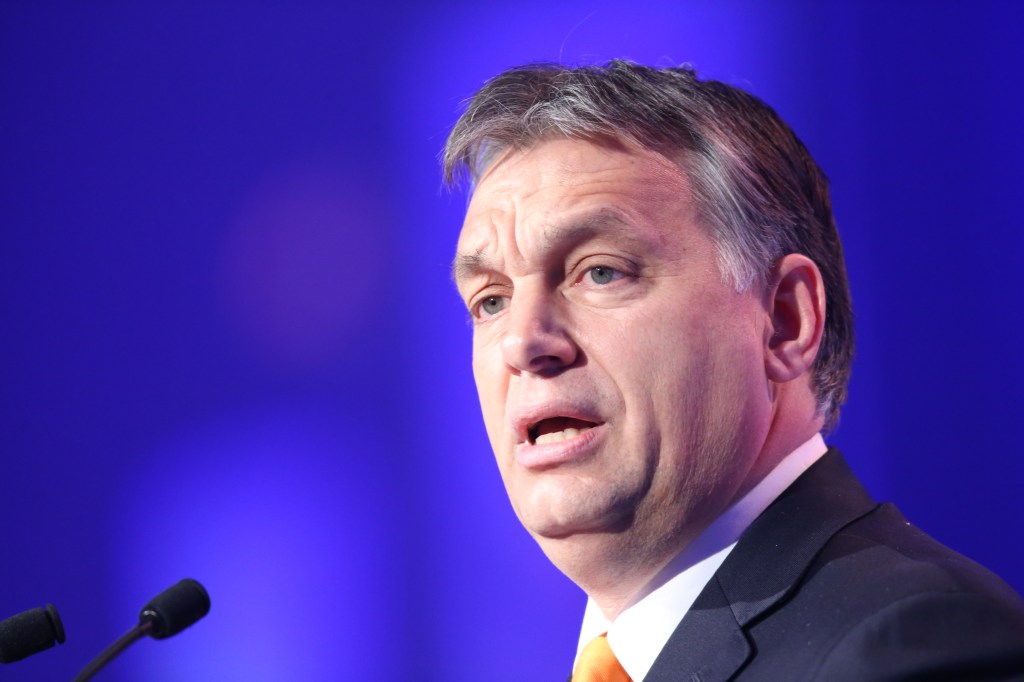
Even more notably, however, Trump’s actions throughout his second term can be easily compared to those of Viktor Orbán, the Hungarian leader who has transformed Hungary into an “electoral autocracy,” according to the European Parliament. Even back in Trump’s first term, the similarities between the two were apparent, as Trump’s former chief strategist, Steve Bannon, called Orbán “Trump before Trump.” In particular, the two share their hard-line stance on immigration, crack-down against LGBTQ+ rights, and hostility towards independent media. Orbán himself is well-aware of these commonalities, urging American conservatives at a special meeting of the US Conservative Political Action Conference (CPAC) in 2022 that “[w]e must find allies in one another.”
At the same event, Orbán asserted the importance of reshaping the media as a major key to success, recommending that American conservatives develop their own media and broadcast shows like Tucker Carlson’s “day and night.” Orbán himself has established effective control and harsh censorship over most media outlets in Hungary, much like Putin had done in Russia. Now, several months into President Trump’s second term, the administration appears to be emulating Orbán’s playbook. Through his repeated lawsuits and control over the White House Press Pool, Trump is simultaneously working to suppress criticism from the mainstream media and supplant it with a growing ecosystem of right-wing influences and podcasters, through the “new media” seat added to the press pool. Though Trump does not yet have anywhere near the level of influence over the media that is held by Putin or Orbán, this increasing hostility towards the media represents a dangerous shift in the direction of authoritarianism that cannot be ignored.
Photo by Wikimedia Commons, licensed under CC0 1.0 Universal and can be found here.
 The Gate

Leave a comment