“God bless you all. And may God protect our troops.”
For a man of many gaffes, Joe Biden concludes every speech with the same expression, and he closed out his farewell address the exact same way. Perhaps it’s a display of reverence for his late son Beau, who served as a Major for a year in Iraq and whose brain cancer derived from the burn pits he encountered there. Perhaps it’s just a habit. After all, Biden’s hardly a newcomer to national politics.
Perhaps this closing sentence should be both unsurprising and endearing. Yet, for some reason, in an America so rhetorically and explicitly respectful to the military, this line feels vaguely out of place. Of course, it shouldn’t; but it does. At least for me.
Most Presidents I can remember closed speeches with a different patriotic sentiment: “God bless the United States of America.” Trump and Obama both used this line to end their State of the Union addresses.
Call me a pedant, if you’d like, but there is something markedly different between these two lines. And I do not think it represents some lack of respect for the military on the behalf of either Obama or Trump, though the latter has delivered a few remarks that might complicate that assessment. My central point is not directed at these worldly figures. It speaks to a more general, pervasive trend, a trend I see as dangerous: military service is no longer politically advantageous, and the people don’t seem to value the troops beyond semantics.
In fact, not only does it seemingly not help, I’m not convinced it isn’t completely disadvantageous.
In the history of the United States, 31 of the 45 presidents have held some military position, with George W. Bush being the last to serve, as a member of the Texas Air National Guard during the Vietnam War. Obama, Trump and Biden — who will account for the latest 16 years of the presidency — never served in the military. This is not an indictment on that decision; in no way should being in the military be a prerequisite for the office either. However, I do think this trend speaks to a changing sentiment within the United States. That trend is bubbling; it’s under the surface, of course. People are still outwardly effusive about veterans and those who sacrifice to defend the U.S. Yet, when push comes to shove, the last two candidates to encapsulate the military spirit, the devotion to service — John Kerry and John McCain — both came up short in their respective elections.
What’s more interesting, however, is not their defeat, but the ways in which they lost — and their perception post-election.
Prior to the 2004 presidential election, incumbent President George W. Bush had an approval rating just under 50%. Sure, that hardly foretold his demise, but it underscored some discontent. The door was ajar, and it was Lieutenant John Kerry who hoped to seize the opportunity. A recipient of three Purple Hearts, a Silver Medal and a Bronze Star with valor, Kerry was also an outspoken critic of the Vietnam War following his tour in 1970.
Kerry is the first person where this changing sentiment surrounding service begins to manifest. Having opposed Vietnam, Kerry positioned himself as a decorated veteran, sure, but also as a critic of American foreign policy. The latter trait led many people — ignorant people in my measure — to proclaim him unpatriotic. And baked within that accusation lofted towards Kerry, far-right organizations began to question and scrutinize Kerry’s military record.
To Bush’s credit, he delivered a statement hailing Kerry’s service and condemning his allies who peddled a manufactured narrative surrounding the validity of Kerry’s military accolades. However, the damage was done; Kerry would narrowly lose the election. Prior to Vice President Harris’ defeat in November, Kerry was also the last Democrat to lose the popular vote.
Now, elections are way more complicated than one matter of character. So, I am not purporting that Kerry’s defeat represents an absence of respect or care for the troops. However, the smear campaign against Kerry by a non-insignificant group of politicians does.
Kerry’s career has certainly not tapered off; he was Obama’s Secretary of State and Biden’s Climate Envoy. Nonetheless, the media campaign against Kerry’s record was not mere political fodder. In a subject previously seldom attacked and always lauded, politics got the better of reverence for servicemen. And that trend, unfortunately, has persisted.
When the most decorated presidential candidate, General Eisenhower, emerged victorious in 1952, his opponent Adlai Stephenson’s concession included this: “General Eisenhower has been a great leader in war.” Perhaps this is not tremendous or unusual praise, but the principle still holds. Stephenson did not criticize his opponent’s service. It was unimaginable, especially given the conciliatory nature of his concession.
Even in superficially less charged times, smear campaigns were hardly out of practice. However, military service was usually out of bounds. Until Kerry, most veterans vying for the highest office elevated that tenet of their resume. Times have changed. John McCain is the best example of the trend started by Kerry.
McCain served in the Vietnam War, retiring from the Navy as a Captain. More famously, though, he was captured by the North Vietnamese and held as a Prisoner of War (POW) for nearly six years. His service was undeniable and contributed to his political popularity, as he became a national hero. Now, it’s worth prefacing that Obama’s victory in 2008 is best attributed to his meteoric rise and perhaps McCain’s Vice Presidential pick, Sarah Palin. There was no such denigration a la Kerry towards McCain. However, McCain’s defeat does indicate a potentially diminishing interest in overlap between the presidency and military service.
What followed post-2008 for McCain, however, really speaks to the problem here. I don’t want this to become a pure criticism of Trump and his brand of politics — I really don’t. But Trump’s rhetoric towards McCain was problematic. In a 2015 interview at the Family Leadership Summit, Trump delivered remarks criticizing McCain across the board. Trump claims to have supported McCain during the 2008 campaign and being disappointed in him as a person. The notable testimony from the interview came when the interviewer called John McCain a war hero, something I cannot imagine almost any Americans disagreeing with. Trump responded with: “He’s a war hero because he was captured. I like people that weren’t captured, okay? I hate to tell you.”
The audience laughed, so take his comments as you will. From my view, though, regardless of intent, his brazenness in saying that speaks to the problem identified above. Sure, McCain lost; and that contributes to a larger narrative about service being important in politics. But Trump’s repeated doubling down directed at McCain in this vein introduces the cause behind that emerging disconnect.
I want to reiterate: I’m not saying Trump does not respect the military. He was President, he saluted the troops, etcetera. What I’m noting is rhetoric: words matter. Trump’s willingness to make comments like the one above furthers the national ambivalence towards veterans.
That ambivalence has entered the political fray even more since McCain’s run in 2008. In 2016, a year featuring two very long primary cycles, neither party’s combined six final candidates had any military experience (Clinton and Sanders for the Democrats; Trump, Cruz, Rubio, and Kasich for the Republicans). The trend carried over into the 2020 Democratic Primary (the Republicans did not run one as Trump was the incumbent), as only one candidate had military experience: now-Secretary of Transportation Pete Buttigieg. Buttigieg served as a Lieutenant in Afghanistan, and might just represent the last of the military breed — at least on the left. Sure, Buttigieg is rather young and failed to galvanize African-Americans. Still, though, his service did not elevate him much beyond 2% nationally.
The other exception to this trend is incoming Vice President J.D. Vance, whose service as a Corporal and military journalist in the Marine Corp during the Iraq War should be commended. I would argue, though, Vance’s military service was not a focal point of his selection and subsequent campaign. His nomination seemed to rely more on his upbringing, his fame as an author and his embodiment of the American Dream. I am not condemning any of those narratives, but, forty years ago, his service in the marines would have been a core tenet of his campaign pitch. And from the speeches I watched, it was noticeably absent.
Even beyond the presidency and vice presidency, the two highest-profile roles in American government, reverence for military service and credentials seem to be at an all-time low. No figure illustrates this narrative better than Trump’s pick for Secretary of Defense, Pete Hegseth.
Hegseth served in the military as a Major and received a Bronze Star, so he has military experience. However, the Secretary of Defense is among the highest ranking positions in government. For comparison, the role is currently held by Lloyd Austin, a four-star general who led U.S. Central Command and served as Vice Chief of the Army. Other recent Secretaries of Defense include: Jim Mattis, a four-star general who also led U.S. Central Command; and Leon Panetta, a former Chief of Staff and Director of the CIA. The other most recent Secretaries lacked traditional military experience, but served in policy roles like Secretary of the Army (Mark Esper) and Deputy Secretary of Defense (Ashton Carter).
Given that list and their credentials, I do not think it disparaging to Hegseth to proclaim that his nomination in-and-of-itself speaks to the problem I have identified. Hegseth has served this country, but the role of Secretary of Defense should be reserved for only the uber-qualified. Indirectly, elevating people like Lloyd and Mattis to the job displays the reverence and respect for service for which I would hope. Hegseth’s nomination does a disservice to that position, and by extension, furthers the narrative regarding respect for military service in modern American society.
I haven’t even begun to discuss Hegseth’s other qualities that make him unfit for this position. And I don’t need to get into the scandals surrounding his character. In fact, the mere existence of scandal is enough to prove my point.
The great poems of the First World War paint an extraordinarily bleak picture of war; British soldiers like Wilfred Owen and Charles Hamilton Sorley advocate against glorifying war or service. However, American society has seldom done that. With the notable exception of tension surrounding Vietnam, American troops have always felt at least explicit support and praise. General Patton put the American sentiment best: “The highest obligation and privilege of citizenship is that of bearing arms for one’s country.”
Even in the face of mass protest against the wars in Iraq and Afghanistan, the American people seldom took out their frustration on the soldiers. Yet, these sentiments have begun to sound like relics of a bygone era. As I write this, I realize I sound effusively patriotic. I have never been that way. But there is something outrageous about the way America currently sees the military. I do not mean the applause and the rhetoric. I mean the shifting levels of real reverence and respect towards servicemen.
I’ll close on this. Forget the political positions and cabinet appointments for a minute. In 1944, Franklin D. Roosevelt helped pass the G.I. Bill. It allowed, and still allows, for veterans to go to college for free (or much cheaper), and provides a whole host of additional benefits. Following a world-altering conflict, that legislation was common sense. It passed unanimously in both chambers.
Yet, following 9/11 and the wars in Iraq and Afghanistan, it took the justifiable and very public outrage from political satirist Jon Stewart to help increase the September 11th Victim Compensation Fund, a program that provided resources to people physically affected by 9/11. I recognize that pertains to firefighters and not soldiers, but the sentiment is the same across the board. The PACT Act, a bill extending and expanding healthcare to soldiers exposed to toxic materials, failed a cloture vote on a technicality before eventually passing several months later. In different times, the PACT Act would have been unanimous and immediate. Instead, it took more than a year to pass both chambers.
I recognize I’ve covered a lot of ground here, but my point is fairly straightforward. Whether it pertains to a dwindling correlation between military service and high elected office, underqualified people being elevated to respected positions, or delayed actions regarding veterans’ health and well-being, there is a trend persisting in the United States. Military service is not seen through the same lens as it used to be.
And sure, to glorify people is to neglect nuance. Yet, I see an American machine too concerned with projecting support and funneling money to the Pentagon as evidence instead of showing veterans why they care.
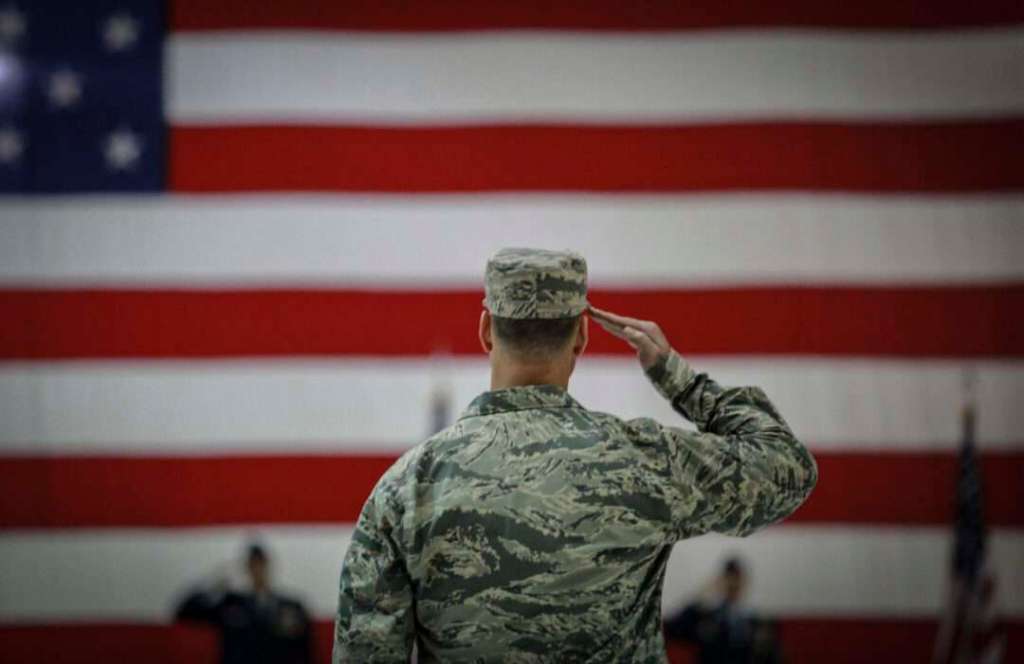
Photo by Sergeant Matt Hecht, licensed under CC0 1.0 Universal.
 The Gate
Leave a comment