
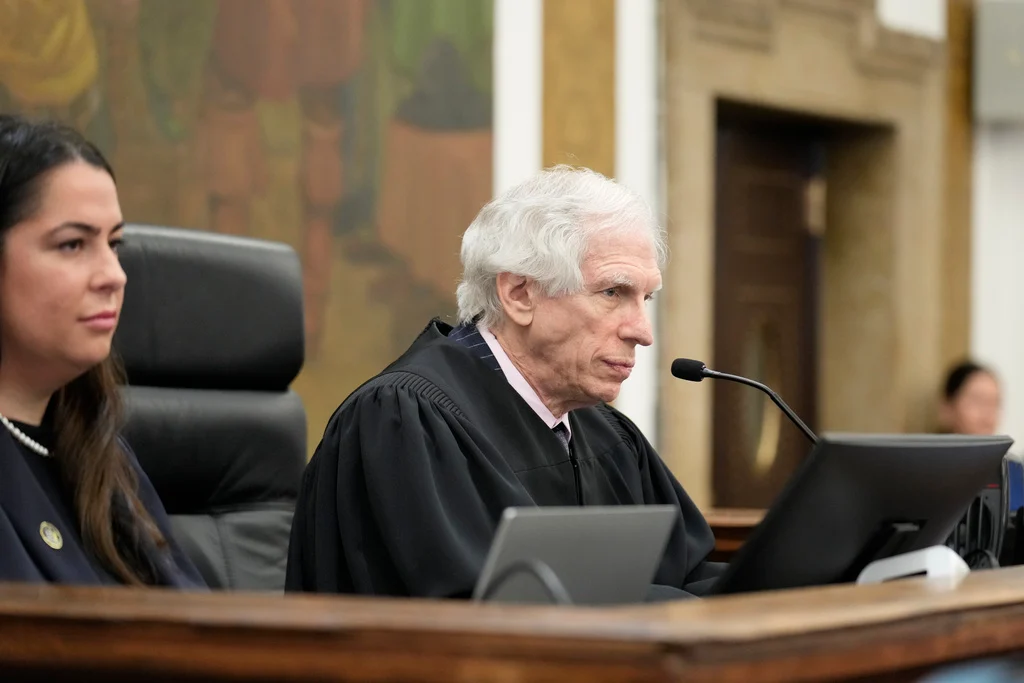
New York State Supreme Court Judge Arthur Engoron on the Judicial Philosophies That Define His Courtroom
As a New York State Supreme Court justice, Arthur Engoron has frequently handled cases involving evictions and disputes over parking garages. However, in 2023, when New York Attorney General Letitia James brought civil claims against Donald Trump for unlawfully profiting by misrepresenting inflated personal financial statements, Engoron was thrust into the spotlight.
Little is actually known from media coverage about Judge Engoron who is overseeing the half-billion-dollar civil fraud case. However, Judge Engoron faced media criticism for his perceived lack of control over the proceedings, allowing Mr. Trump’s legal team to deliver excessively long speeches and famously flashing a cheeky smile at the cameras filming inside the courtroom.
Judge Engoron sat down with me while the civil case against Donald Trump was on appeal to discuss the judicial philosophies that guide his courtroom management. With one year remaining on the bench due to New York State’s mandatory retirement age for justices, his final high-profile case has the potential to define his long career and reflect on the overall health of the New York State judicial system.
To begin, could you share how your education at Columbia University shaped your judicial philosophy?
I attended Columbia University during an exciting time. The campus was in turmoil, and the teaching reflected that sense of engagement, embracing the idea that the world is an interesting place and should be brought into the classroom. I majored in English and learned how to write. I am tempted to say that I learned I didn’t know how to write, but I certainly honed my skills there. I took at least one elective course specifically on expository writing, where the professor thoroughly critiqued my work, pointing out logical flaws, inconsistencies, historical inaccuracies, and grammatical errors. This experience reinforced the importance of writing for the reader, not just for myself. Wheatley and Columbia complemented each other well: Wheatley provided a strong foundation in science, history, and English, while Columbia exposed me to the great works of literature, art, and philosophy.
It was an interesting time in world history. The year 1968 is often cited as a significant one, marked by the assassinations of John F. Kennedy and Martin Luther King Jr. The way professors incorporated current events into their teaching influenced my perspective, reinforcing the idea that writing should not exist solely in the abstract. We must consider real-world consequences in our thinking and writing.
How do you balance the letter of the law and the spirit of the law having been educated in such a tumultuous time in history?
I try to base my rulings on the spirit of the law because I believe it leads to a better world. There are well-known judicial statements emphasizing the importance of starting with the letter of the law, and I do. I aim to understand how the letter of the law applies to the facts before me, but I also seek to interpret the intent behind it, what the legislators or preceding judges meant. Similarly, when interpreting contracts, I consider: What were the parties aiming to achieve? What was the benefit of the bargain? What did each side want, and what was each side willing to concede? Judges fall along a spectrum, from strictly adhering to the letter of the law to prioritizing the spirit of the law. I align more with the spirit of the law, as I believe it represents a stronger judicial philosophy and ultimately contributes to a better world.
Are there any specific cases from your career that helped shape this opinion?
It has been a long career. I cannot recall specific cases, but I know that, particularly in contracts, which are sometimes drafted and signed hastily, I often have an instinct that something is not what the parties truly intended. I can discern their intended meaning because, otherwise, the terms would make no sense. I once had a case involving a valuable multi-level parking garage, and I was certain that the lease did not reflect what the parties actually meant. In New York, real estate often drives the city, or the city runs on real estate, so I interpret many leases. Some are five pages long, while others extend to 50 pages or more. By focusing on what the parties intended rather than strictly on the wording, I help ensure that each side receives a fairer outcome.
Do you have any mentors, including judges, that have shaped your perception of the law?
I worked for 12 years as a law clerk for an elected New York State Supreme Court justice. At the time, I was the only clerk. He often said, “The law is what the law is,” and I would respond, “We can’t always do just what we want to do.” He was a fair and balanced trial judge who frequently considered whether it was possible to give one side something while also giving the other side something in return. At the time, my perspective was more rigid—I wanted to decide matters definitively and do what I believed was right. However, over the years, I have come to see the value in his approach. Now, I want the lawyers and the parties to feel that they received a fair outcome and that I am not some kind of rigid enforcer. If there is a way to ensure each side gets what they are entitled to, rather than an all-or-nothing ruling, I strive to do so.
He was a social creature, as am I. He made an effort to get along with everyone, and that perspective has influenced my own. I see myself less as a judge sitting high on the bench, wearing a British-style powdered wig, and more as a problem solver. When lawyers appear before me, I often ask, “What can we do to move this case along?” Judges must constantly balance productivity with the principle that justice delayed is justice denied. At times, this requires a compromise between striving for perfection and ensuring that cases are resolved in a timely manner.
Over the years, I have read thousands of judicial opinions and have been deeply moved by the intelligence of certain judges. While all judges are intelligent, some write truly remarkable opinions. Oliver Wendell Holmes, Justice William Brennan, and John Paul Stevens are among my favorites. I strive—however unsuccessfully—to emulate their intelligence, logic, and humanity in my own judicial approach.
What is the legacy that you want to leave for those who want to rise up to your position as a New York State Supreme Court Justice?
It is essential to consider the real-world implications of judicial decisions. A key part of my judicial philosophy is striving to make the world a better place, which inherently involves thinking about these broader consequences. Some cases are purely about money, and while some individuals can afford to pay, others cannot. I often preside over cases where tenants are at risk of eviction. While it is true that if someone does not pay their rent, they cannot stay indefinitely, deciding whether to remove someone from a home they have lived in for 20 years or more is a significant and weighty responsibility.
I place great emphasis on writing clearly to ensure that my decisions are well-articulated and thoroughly reasoned. A crucial part of my role is providing explanations so that the parties involved understand the reasoning behind the outcome. I want them to grasp why they won—or, more importantly, why they lost. Lawyers sometimes file motions to reargue decisions, believing that I got it wrong, and I take those challenges very seriously. There is a rule that prohibits lawyers from simply rearguing the same points they previously presented. While I am permitted to dismiss such motions on that basis, I choose not to. Instead, I provide a summary of my original reasoning, ensuring that they fully understand my thought process and the rationale behind my decision. I also occasionally grant motions to reargue. Nobody is perfect, and if I believe I made a mistake, I will reissue a decision and revise it entirely. I always take these motions seriously and make a point to provide a clear explanation of my reasoning. That is a judge’s responsibility—not just to issue a ruling, but to explain it.
My legacy, of course, will include my use of humor and references to both popular and historical culture. I believe this is one of the most effective ways to make a point. On rare occasions, I have even poked fun at lawyers when I found an argument so absurd that I could not help but laugh. I have also occasionally engaged in what I call “fee-shaming” when I felt that an attorney’s requested fee was excessive. In such cases, I would humorously remark, “Well, that’s ridiculous,” as a way of addressing the issue.
And in more high-profile cases where you receive more public scrutiny, how do you maintain confidence in your decision and how you run your court?
Despite what I have said about humor, I strive to take everything seriously. One thing I do, perhaps to excess, is allow people to speak at length, particularly lawyers but sometimes clients as well. I want to hear everything they have to say and ensure they feel they have a full opportunity to present their case. I almost never interrupt, unless the remarks become excessively repetitive.
In those high-profile cases, why do you think it’s important for the public to see the legal system holding all individuals accountable under the same law?
To borrow The New York Times’ credo, I decide cases “without fear or favor.” I hold everyone accountable, and at the risk of using an old cliché, no one is above the law—nor is anyone beneath it. I take seriously the idea that the public is observing what happens in the courts, and I am adamant about ensuring accessibility and transparency. For this reason, I run an open courtroom. If someone wants to sit in on a trial and criticize me, that is part of the job. I accept criticism, and I do not respond—judges are not supposed to.
Do you think there are safeguards in place to ensure that all individuals are treated equally under the law?
One significant safeguard in the judicial system is the appeal process. When I issue a decision, it is not necessarily the final word. The Appellate Division of the Supreme Court reviews cases, and I always consider how an appellate court will interpret my rulings. Above them is the state’s highest court, the New York State Court of Appeals. At least once, I wrote a decision I felt strongly about. It was affirmed 5–0 at the Appellate Division but later reversed 7–0 at the Court of Appeals. This process serves as an essential safeguard to ensure that judges make the right decisions and to maintain public confidence in the legal system.
You have one more year sitting on the bench. What plans do you have following your career as a judge?
Stepping back for a moment, I believe that New York State’s mandatory judicial retirement policy is fundamentally flawed. It is a clear case of age discrimination. In my own experience, I feel that I am a better judge now than I was years ago, and I believe I will continue to improve over the next five years. However, I am required to retire at the end of next year.
After retiring, I plan to work as a mediator and/or arbitrator. I may also consider teaching law, returning to private practice, or continuing in the court system in some capacity, but mediation is the most likely path. One of my core judicial philosophies—and something I believe I have a reputation for—is my dedication to settling cases. I will go to great lengths to facilitate a resolution. Even when parties initially insist that there is “no chance” of settling, after a few hours of discussion, many cases do reach a settlement. Given this experience, I believe I would be an effective mediator.
Is this skill of mediating something that you were only able to learn with time and age?
I have learned many lessons along the way. There are various ways to settle a case, and they are not mutually exclusive. One approach is to have a thorough understanding of the facts and the law—if time permits—to anticipate the likely outcome and then communicate that to the lawyers. I will often say, “Look, if you don’t settle the case, this is what is likely to happen.” Another approach is to determine what each side truly wants.
A classic example of this comes from commercial landlord-tenant cases, where a landlord is trying to evict a tenant from a store or office. In these cases, the tenant almost always owes rent. However, I have learned that the landlord and the tenant often prioritize different things. The landlord is usually more interested in reclaiming the premises than in collecting unpaid rent, while the tenant may be more focused on avoiding payment rather than staying in the space—since they can always rent another office or storefront.
I also take a personal approach to settlements—when permitted. First, I ask for permission from each side to speak with the other party alone. Then, I sometimes request permission from an attorney to speak directly with their client. Lawyers are often hesitant, but in my reading of the ethical rules, this decision ultimately rests with the client. When I have the opportunity, I try to see the case from their perspective and explain why I believe my proposed resolution is the most logical. A lawyer once taught me that some cases are brought for financial or practical reasons, while others are based on principle. I often remind clients and attorneys of this by saying, “Okay, you made your point. Now, let’s settle the case.”
Some judges, understandably, use what I call shuttle diplomacy. When speaking with the plaintiff, they might say, “You have a terrible case.” Then, when addressing the defendant, they might say, “You have a weak defense.” I take the opposite approach. When speaking with a plaintiff, I will acknowledge the strength of their case: “You have a strong argument. The defendant left a banana peel on the floor—that’s negligence. You suffered a serious injury, through no fault of your own. You were looking straight ahead and couldn’t have seen it. You broke your leg and can no longer play soccer.” I will go through the entire case from the plaintiff’s perspective. Then, I will add, “However, this case is not worth $8 million. I have seen many similar cases and read many verdicts. You never know what a jury will decide—they might not even find the defendant liable. They might not believe your account. So, I would suggest…” and then I offer a specific amount.
A highly effective mediator once told me they never propose a specific settlement amount. I, however, almost always suggest a number, I call it the “magic number.” Many lawyers have told me that their clients say, “If the judge recommends settling at that amount, let’s move on with our lives.” I do not use this technique as often now, but in the past, I would sometimes ask people, “Do you like spaghetti?” Most would say, “Yes, why?” I would then explain, “Because when you go home tonight and have spaghetti for dinner, it will taste just as good whether you settled the case or not, or whether you won or lost the verdict. There is more to life than lawsuits and money.”
The image featured in this article is licensed for reuse under the Creative Commons Attribution – Attribution 4.0 International. No changes were made to the original image.