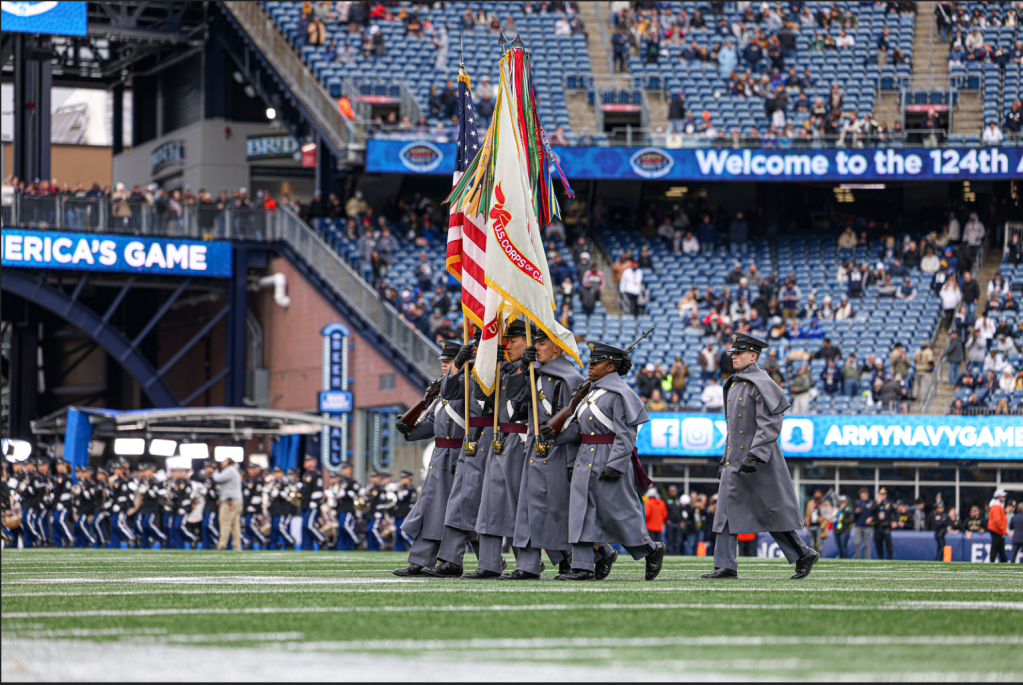
The annual Army-Navy showdown is one of college football’s most anticipated games of the year. This time, the Navy Midshipmen pulverized the 22nd ranked Army Black Knights. But, the game’s reach extends beyond football. The contest celebrates America’s military might. That alone guarantees a good turn-out. Who needs football when you have fighter jets? And, there are few better political photo-ops. So, on December 14, politicians, celebrities and most of the Defense Department dutifully filed into Northwest Stadium in Landover, Maryland. Then President-elect Donald Trump made an appearance alongside most of his braintrust: J.D. Vance, Tulsi Gabbard, Pete Hegseth, Elon Musk and the recently-exonerated Daniel Penny (surely he won’t get a cabinet position…?) I’m guessing Robert F. Kennedy Jr. was busy looking for Bigfoot or rifling through the CIA’s filing cabinets. Studying Trump’s guest-list, I started wondering: what happened to America? Or, more accurately, just what are we doing?
Trump 2.0 seems poised not just to reject the establishment, but to utterly obliterate it. Hegseth, Secretary of Defense, worked for Fox News until mere months ago. He’ll go from staring down Brian Kilmeade to jousting with Vladimir Putin and Xi Jinping — I’m sure he’s prepared. For her part, Tulsi Gabbard has long feted Vladimir Putin and Bashar al-Assad. She doesn’t just oppose our involvement in foreign wars, but roots for our enemies. Elon Musk was once a respectable entrepreneur, vowing to take humanity to Mars and cure climate change. How far the mighty have fallen. Today, he’s busy microdosing ketamine, buying Twitter and making fascist gestures. Trump’s other nominees have similar problems. Many of them appear ill-suited for government work. Whenever Marco Rubio looks like the adult in the room, we’ve lost the plot. Now, the point of this essay is not to disparage Trump’s character, question his sanity, poke fun at his cabinet selections or to otherwise defame the august personage of our President — I am more than willing to do that, just not here. Rather, I want to argue that people like these — Hegseth, RFK Jr., Elon Musk — are exactly who should be running this country. After all, a circus must have its clowns, and the United States is one big circus.
A festering strain of rebellion has long permeated American society. People always question authority, doubt the government and generally want nothing to do with anything. Contrarian impulses are not new. In the mid-1960s, protestors flooded the streets, railing against American involvement in Vietnam. They believed an assortment of elected, and unelected, officials were spending precious American lives for suspect ideological reasons. Eventually, these anti-war protests toppled President Lyndon B. Johnson’s administration and left his Great Society in ruins. Four decades later, protests rocked American cities again when George W. Bush invaded Iraq and ousted dictator Saddam Hussein. Bush and his minions infamously warned that Saddam possessed “weapons of mass destruction” and was preparing to launch an attack against the United States. As we now know, Saddam had no WMDs nor did he plan to strike America. The administration was making it all up. Bush’s lies emboldened the anti-establishment movement, those who accused the government of protecting moneyed interests — huge oil companies followed American forces into Iraq — at the expense of ordinary people. Not long after that, the 2008 financial crisis spawned the Tea Party — a right-wing populist uprising that sought to reduce the federal government’s influence and get back in touch with constitutional, limited government. They weren’t entirely sincere — many Tea Partiers had some questions about Barack Obama’s citizenship. Nonetheless, the Tea Party offered safe harbor to anyone who had grown disenchanted with the government. Concurrently, the left-wing Occupy Wall Street movement protested the 2008 government bail-outs that rescued stranded firms — Fannie Mae, Freddie Mac, AIG — while leaving millions of Americans high and dry. The government appeared willing to always swoop in and rescue irresponsible financial institutions, especially if they were “too big to fail.”
By and large, though, these protest movements fizzled. The government cracked down on the Occupy protests, withdrew from Iraq and ended the Vietnam War. The establishment remained intact. Disaffected Americans had failed to affect change from the outside. So, they took direct aim at our institutions, threw out the Obama-Bush establishment complex — the “Deep Staters” that declared war on Iraq — and installed the Trump show. Somehow, Donald Trump transformed himself from a spray-tanned, B-List, reality TV star into the avatar of one of the most potent political movements this country has ever seen — people are saying it is the greatest movement, the most fantastic movement…what a movement…(I’ll stop). On the other side, the Democrats have responded with their own brand of lunacy. They live happily in their own fantasy world, while the rest of us remain here, on Earth. Kamala Harris clung to the old ways. She ran on a warmed-over version of the Biden platform, vowing only to tweak the party’s existing agenda. Still, she had some very good ideas. The Harris-Walz ticket planned to cut taxes for middle-class families, take on Big Pharma and other monopolistic corporations, support American industry and strengthen our southern border. Regrettably, the Harris brain-trust decided to prioritize high-minded appeals to democracy, racial equality and freedom. These rhetorical cannonades overpowered Harris’ policy proposals, which should have taken center stage. The Democrats got bogged down attacking Donald Trump, playing the hits and running up the score in Libtown. Again and again, they warned us that Trump posed a clear and present danger to democracy — that he planned to weaponize the Justice Department against his enemies, that he would not accept the results of the election and that he was preparing to grind America’s middle class into a fine powder.
The whole campaign cycle was drenched in absurdity. Trump and his cronies referred to the “Biden Crime Family” and — because why not? — questioned Harris’s racial identity. For their part, Kamala Harris and allies made Trump seem like a cartoon villain or the reanimated corpse of Adolf Hitler. For those keeping score at home, one candidate — who may or may not be an American — served as Vice President in, supposedly, the most corrupt administration ever. The other wanted to destroy America and let his goons run wild. I’m no political scientist, but I don’t think those depictions were quite accurate. Either way, that’s what this country wants. We’ve become a silly society. English novelist Julian Barnes once accused Christopher Hitchens of having performed the “ritual shuffle to the right.” Barnes lamented the fact that Hitch began his political career as a Trotskyist and ended it by supporting the Iraq War. I — while making no claims to be on Barnes’ level — have noticed a similar phenomenon: the mad dash to the sensational. Public figures began abandoning their milquetoast personas and embracing hyperbolic, attention-seeking alter egos. Tucker Carlson started out as a semi-respectable, bow-tied, MSNBC host. Now, he runs around the country chatting with Alex Jones, peddling anti-semitism and hawking off-brand Zyns. Joe Rogan’s podcast used to be the ultimate oasis for independent-minded, political nomads — dudes who wanted to get stoned and talk about silverback gorillas. No longer. Rogan has embraced the culture war and hopped on the Trump train. Every episode devolves into a rant about vaccines, vaccine-mandates, Anthony Fauci, protein and how transgender people are ruining everything. Even non-political celebrities are getting in on the action. Super Bowl Champion Aaron Rodgers has gone from Green Bay Packer gunslinger to the NFL’s resident weirdo — touting ivermectin’s efficacy, doing his own research and ranting about the Epstein List. People are no longer penalized for spouting misinformation nor extreme political views. There seems to be a race to the fringes. Social media platforms give everyone and their brother a megaphone, offering constant streams of content. Legacy outlets — The New York Times, Washington Post, CBS — compete against podcasts, live-streams, Substack, and countless other forms of new media. In this overcrowded environment, content creators must yell ever louder lest they be snowed under by other, more provocative people.
You might wonder if I’m being unfair — painting with too broad a brush. Surely there are lingering redoubts of intellectual probity. Not everything has become vapid. Well, dear reader, you’d be wrong. I don’t want to make this all about me, but I attend The University of Chicago — a prestigious university with a vaunted economics department. It’s supposedly a serious place where people read serious books and talk about serious things. Plato, Aristotle, Thomas Hobbes — those guys. In many classes, we still do. Our general education social science program makes us wade through all the classics. A noble goal. Unfortunately, today’s college students are simply incapable of reading books. Personally, I make it about a page and a half into Leviathan before reaching for my phone. Professors try to compensate for our obliterated attention spans by assigning excerpts instead of whole texts but, regardless, I fear that UChicago — and the rest of American academia — have fallen prey to the culture of low expectations. A culture content to scroll Instagram for hours, mindlessly vegetate in front of our screens and aspire to nothing. UChicago has dropped its standards. Its students focus on extracurriculars, pre-professional organizations and prepare themselves for inevitable, abbreviated forays into investment banking. Professors hand out A’s like free candy — 3.8 GPAs are common-place. In turn, the administration keeps jacking up the Dean’s List cutoff to preserve its reputation. I don’t want to sound like a sixth grader complaining about their math homework, asking “what is the point of this?” “In the future, I’ll never need to know algebra!” However, I want to point out that the world does not reward intellectual curiosity—at least not at the moment. Our elected representatives — and even media celebrities — do not quote from Shakespeare in their televised speeches. They are more likely to just say the word groceries over and over and over again.
UChicago has evolved to meet the moment — shedding its historic commitment to extreme academic rigor. At one point, we boasted the most demanding core curriculum in the country. In the 1940s, President Robert Maynard Hutchins constructed a core that took all four years. Ideally, this core prepared them to tackle any challenge, no matter how difficult. UChicago students really trained their minds. Professors emphasized process and progress. Glowing results came later. That world is now long gone. People crave immediate success and lots and lots of money. The cancer of pre-professionalism has metastasized, infecting the whole university and spawning 408 registered student organizations. Overwhelmed by all these choices, students spend more and more time on pre-professional extracurriculars. Obviously, not all clubs are the same. Some are simple, fun clubs — the archery club, the badminton club, the bridge club and so forth. I don’t have any issue with students wanting to blow off steam with some weekend archery. Our school is better off with those organizations around.
Truthfully, these clubs don’t demand much attention. Instead, it is the investment banking/consulting vortex that devours students whole. I’ve had numerous friends simply vanish during recruiting season. They spent hours “networking” and working on various projects, all in the hopes of catching someone’s eye and securing a summer internship. According to this calculus, 20 minutes of awkward chit-chat over Zoom with some corporate stooge serves one better than doing classwork. Business becomes everything, replacing academics. In 2018, our economics department rolled out the Business Economics major for students who found standard Economics too difficult. Business Economics is basically just Economics-Lite. Standard Economics students have to complete a “full calculus sequence” and are encouraged to wrestle with rigorous Analysis courses. Standard Economics is synonymous with rigorous, mathematical analysis. Business Economics or “Biz-con” shies away from high-level math and toward courses like “Financial Accounting,” “Investments” and “Marketing Management.” In short, Biz-con hopes to produce c-suite executives, not economists. Choices like these indicate that the University has defaulted on its commitment to “life of the mind.” It shunts students toward consulting and investment banking, aiming to expand its future donor base and undercutting its storied reputation.
Some bemoan these developments. Classics Professor Clifford Ando recently lambasted the University for high-risk financial shenanigans that have squeezed out the Arts and Humanities in favor of pre-professionalism. The University of Chicago is deeply in debt — to the tune of almost 6 billion dollars. Desperate times do call for desperate measures and, indeed, these are desperate times. True, the University has moved quickly to ward off total financial collapse. Nevertheless, Ando accuses the administration of jerry-rigging quick fixes and prioritizing cash grabs over sustained investments. We have poured money into programs outside the University’s traditional focus. Ando highlights the Marine Biological Laboratory (MBL), the Pritzker School of Molecular Engineering and the Booth School of Business. In 2022, the University dumped 20 million dollars into MBL’s research wing, far more than the combined research budget of the Divinity School, Humanities Division and Division of the Social Sciences. At Booth (home of the Biz-con program), assistant professors earn 350 percent more than assistant professors in the humanities. This isn’t Saul Bellow or Allan Bloom’s department anymore. Not only does UChicago shortchange liberal arts professors, it doesn’t hire enough of them — especially tenure track professors. As a result, the University increasingly relies on “non-tenure stream” faculty to teach its humanities courses. Ando argues that this trend goes against a long-standing tradition that required research professors to teach Core classes. On top of that, the University’s resource allocation underscores its attitude toward the arts. Ando points out that our library system in 2006 ranked in the mid-teens of all American universities in “acquisition budget.” Twenty years later, we’re down to 30th place. These administrative maneuvers raise real questions about the nature and purpose of a modern university.
The University of Chicago has aggressively lurched toward pre-professionalism, content to churn out future Wall Street executives or Silicon Valley bros. On-campus consulting organizations (I dare not call them clubs) publish exhaustive reports, subject prospective applicants to an intense application process and promise to get their members prestigious jobs at places like McKinsey, Bain or BCG. However, the clubs aren’t the half of it. Students are just following the University’s lead. Our Polsky Center for Entrepreneurship and Innovation provides extensive start-up and private equity training. It has enough funding to transform even the most limited, unnecessary product into a serious career. Students can forego academics in favor of some quixotic quest to become the next Mark Zuckerberg. Granted, most sane people acknowledge that not everyone can invent Facebook. So, many students wind up in private equity — or consulting or investment banking. In my estimation, however, private equity is a uniquely pernicious entity. A giant pump and dump scam — extracting as much as possible and gorging itself on the remains of failing companies while the economy implodes around it.
For instance, private equity firms have latched onto local journalism and grotesquely befouled an integral part of our democracy. Tocqueville once observed that American, small-town newspapers hold local leaders accountable and increase civic engagement. Politicians under intense scrutiny tend to moderate their worst impulses. Tragically, private equity has perverted the incentive structure for local papers. Today, municipal papers prioritize readership, revenue and advertising. Objectivity and original reporting are no longer required and, in fact, are probably discouraged. Big Business looks only at the bottom line, seeking to maximize shareholder value. To these stupendously wealthy tycoons, there is no difference between running a local newspaper and selling software or cologne. Well, not so much, quality journalism has long been a bedrock of the American project. A wellspring of reason and rationality amidst the chaos. We would do well not to let it drown in the toxic sea of corporate influence, consumerism and clickbait.
What’s wrong with any of this? I can hear the counterarguments. Isn’t it amazing that college kids have access to these incredible resources? The University of Chicago is merely adapting to changing times. In a way, that’s all true. Through UChicago, I’ve secured an internship with CNN, met many political figures and traveled to Des Moines for the 2024 Iowa Caucus. Those experiences and memories are wonderful bonuses. They shouldn’t be everything. Problems arise when college becomes an all-encompassing lifestyle. And, right now, the University is a resort disguised as a place of higher learning—full of easy classes, clubs and social outings. Its students can choose an easy, pleasant and comfortable existence. You can opt out of academic rigor and focus on consulting or investment banking.
Back to me for a moment – I don’t want to give off the impression that I exclusively study string theory, perform complex economic calculations and, when I can find some free time, read Plato in the original Greek. I have neither the discipline nor the desire to do so. However, I do want to learn. I came to UChicago searching for the renowned “life of the mind.” I haven’t found it. In its place, I discovered corporate America boot camp, with course after course promising to teach me “Operations Management,” “Managerial Decision Making” and “Corporation Finance.” What purposes do classes like these serve? Other than allowing students to plaster A’s across their transcript and get ready for Goldman Sachs. Elite universities have become just another place for the offspring of America’s upper crust to burnish their already-gleaming resumes.
Our elected representatives are indeed clowns, morons, buffoons, grifters, corrupt toadies and worse (looking at you Matt Gaetz). And, some are no doubt good people — but do we really deserve better? Immediately after the election, liberal pundits professed shock, gobsmacked that this great country could elect the Bad Orange Man, ushering in an age of darkness and paranoia. They cried out for common sense, reason and normalcy. But, in the immortal words of Norm Macdonald, the worst part is the hypocrisy. For almost a decade now, the Democrats have accused the Republicans running a personality cult rather than a political party, of putting the needs of the one (Trump) over the needs of the many (their voters). Today, that accusation rings hollow. When in power, the Democrats refused to acknowledge President Biden’s obvious shortcomings and assured the public that everything was just fine. They didn’t dare defy their glorious leader. Better still, liberal commentators love to portray Republicans as stupid, uneducated, racist and fundamentally unserious. All the while, celebrated bastions of liberalism have been hollowed out and stripped of their luster. UChicago — and many other elite institutions — incentivize students to abandon their studies and commit themselves to half-baked career plans. UChicago still promises a rigorous, classic education — full of Plato, Friedman economics and experimental physics, but it doesn’t deliver.
We have to accept the consequences of our actions. We say we want serious, boring and transparent government. Our choices bely otherwise. Both parties trot out their most simplistic, pre-digested candidates. Modern voters don’t want complicated, realistic campaign platforms. No, no. We love vibes, not details. People crave candidates who promise to solve problems in simple and showy ways. Immigration problem? Just build a wall. War in Ukraine? Trump can fix it in one day. Grocery store prices are astronomically high? Vote for Kamala and freedom…don’t worry about making ends meet, think about democracy! In America today, the candidate that yells the loudest and promises the most, wins. That’s what we want. Mitt Romney and Barack Obama discussing American foreign policy during the 2012 election looks like a debate out of a time-wrap. No one is yelling about our big and beautiful missiles. Nor is anyone hollering at their opponent to “shut up” or telling Little Marco to sit down. Serious, nuanced debate doesn’t fly now. Voters want politicians to beat each other with bully-clubs and hurl playground insults.
Reform starts at the bottom. Our once-great universities have become pale imitations of their former selves. Not because of the Woke Mind Virus, rampant anti-semitism or DEI admissions. The universities cater to our coddled sensibilities. They entertain rather than enlighten. Universities slash curricula, expand extracurriculars and inflate our GPAs. Students have learned how to “game the system,” seeking out easy professors and filling their schedules with meaningless classes. Colleges don’t expect much of their students. George W. Bush, in a vastly different context, once referred to the “soft bigotry of low expectations.” That’s where we are now. The modern education system is awash in low expectations. Everyone at Harvard and Yale gets an A or an A-. UChicago isn’t all that much better. How serious is that? In my opinion, not at all. Our politicians won’t talk like Abraham Lincoln, if we can’t even read a book. We have to ask more of ourselves. Together, we can reclaim our culture, rediscover seriousness and put the goofballs back where they belong. I’m not selling a self-discipline program. You need not purchase a cryogenic chamber nor a cold plunge. We students must simply acknowledge reality — school is supposed to be hard. We are not on vacation. This is not UChicago Resort and Spa. This is a place of higher learning where A’s are supposed to be hard earned, not given away. The long-term benefits of a rigorous, grueling education outweigh the dopamine hit of a high grade in an easy class. Change never comes easy, but we can turn the tanker — if we put our mind to it.
The image featured in this article is licensed for reuse under the Creative Commons Attribution – Attribution 4.0 International. No changes were made to the original image.
 The Gate
Leave a comment