“I mean, last summer my cousin bought a big ass boat!” and “cocaine will turn you into a damn owl, homie!” are just two of the many bizarre things comedian Theo Von said to President-Elect Donald Trump during his hit podcast “This Last Weekend with Theo Von.” Throughout the one-hour runtime, they covered an assortment of topics ranging from drug addiction, struggles with sobriety, the UFC and golfing to the aforementioned “big ass boats.” In fact, for most of the conversation, they barely touched anything political. Yet viewers loved it, with the video boasting well over 400,000 likes. It was just one of many surprisingly effective media appearances Trump made this election season.
The numerous podcasts and interviews Trump appeared on during his campaign—ranging from the platforms of Twitch streamer Adin Ross to comedian Andrew Schulz’s Flagrant Podcast—were much more unstructured than any interview he had with a legacy media outlet. Yet, they boasted viewership numbers that go well beyond a New York Times article or Fox News segment (his recent interview with Joe Rogan currently has 53 million views on YouTube alone). After months of new media appearances, reaching at least tens of millions of Americans, Trump successfully used this publicity momentum to sweep every swing state come election night.
As the red wave came alive on Nov. 5, notable Democrats like Seth Moulton and Nancy Pelosi soon started shifting the blame, pointing the finger at various third party voters, minority groups and whoever else they could. From Moulton’s suggestion that they were too supportive of trans rights to Pelosi suggesting their losses were partly the fault of the pro-Palestine crowd, they managed to point the finger at everyone else, when really, they should start by pointing it directly at themselves. After all, where was Kamala Harris this campaign season, at least in the eyes of younger people? Donald Trump has been by far and away the dominant person on my social media feed for the last few months. Whether it be his interview with Theo Von, serving fries at a McDonalds, driving garbage trucks or jerking his hips to YMCA, he was always making some type of noise, all while getting his talking points across on topics like immigration and the economy. Maybe Democrats thought they were pulling a move straight out of Sun Tzu’s The Art of War by not interrupting an enemy who is making a mistake, but by not responding to or challenging his claims publicly, they only validated Trump’s antics and behavior. Come election season, it’s possible that, as long as you’re getting your talking points across, there is no such thing as bad publicity. If that’s true, then the only bad publicity would be having little to no publicity at all, which is something the Harris campaign is undoubtedly guilty of when compared to Trump. As media consumption increasingly shifts from legacy news to social media with each election cycle, so too should Democratic strategy.
Harris does not need to recreate Trump’s bizarre self-marketing campaign beat for beat to appeal to younger voters, but at the very least, she could have pivoted away from the traditional legacy media environment and started making some noise of her own online to get her policy plan across to younger voters. While some could point to her embrace of viral trends like the “Kamala is Brat” and “coconut-pilled” memes as an attempt to engage users, these trends ultimately failed to convince voters because there was a complete lack of any substantial messaging. Instead, the Harris campaign leaned into an ambiguous “vibes-driven” appeal, one that came across as superficial, infantilizing to the audience and ineffective. The biggest lesson for Democrats from this election is that social media is now a dominant and inexpensive form of publicity, and publicity is power. It should be wielded wisely. To truly grasp what the Left should learn from this election, we must first understand how Trump marketed his own campaign so successfully.
Recent polling from USA Today demonstrates that presidential-candidate appearances on podcasts this election season have been heard by just under 30% of Americans, with a majority of listeners being, unsurprisingly, on the younger side. The podcasts Trump targeted have largely been referred to as “bro podcasts” for their largely young, male audience. In a deadlocked presidential race, increased voter turnout from younger male voters (who normally have the lowest voter turnout rate) was one of the key factors Trump needed to help flip battlegrounds, and it worked.
In this election, Trump picked up a larger proportion of young voters—voters under the age of 30—than any Republican candidate since 2008. Trump even stated on Adin Ross’ livestream that his youngest son, 18-year-old Barron Trump, occasionally tells him what podcasts to go on—a small but telling example of Trump’s willingness to adapt to an ever-evolving media landscape. Unlike for Republicans, this election had a disappointing youth turnout for the Democratic Party, so it’s clear that Harris and the Dems cannot take such a large voting block for granted in the future. But if that’s the case, why do they generally refrain from participating in such forms of media as much as Trump does?
The answer may lie in the fact that Harris, simply put, seems less likable than Trump on podcasts. According to the same USA Today poll, over 50% of podcast listeners said their opinion of her lowered after listening, while only 28% said the same about Trump. On the flip side, only 34% said their opinion of Harris improved, while 50% stated the same for Trump. The numbers favor him for a reason. For one, he’s simply more charismatic than her in the podcast space. Trump’s near-complete avoidance of political issues on podcasts, opting to talk about cultural topics instead, also makes him seem more down-to-earth and less rehearsed. He has even remarked on the Andrew Schulz podcast that he “weaves” himself out of certain politically charged questions. To understand how Democrats can better approach such spaces in the future, we have to see what Harris did wrong.
Harris charted the opposite path on her rare podcast appearances such as Call Her Daddy, where she solely talked Democratic policy relating to women’s rights. While she most likely expected her policy on topics like abortion rights to resonate with the podcast’s largely female audience, it did not. Her appearance has almost ten times more dislikes than likes on YouTube. Listeners complained that she sounded like she was running through a checklist of talking points rather than engaging in an actual conversation. While Trump’s strategy may seem illogical, it is undeniably effective. The problem is that Harris’ campaign fails to understand that people don’t treat podcasts like they would an article. It’s less about policy and more about persona, and that’s why Trump thrives in this environment while she does not.
Trump’s approach also shows a keen understanding of what younger people prioritize, which is authenticity above all else. According to a study by American University, the two most sought out values by younger voters in presidential candidates were integrity and authenticity. Trump showcases such traits when he talks to Theo Von about his own struggles with sobriety, family and health or when he gives Adin Ross gossip about AOC and other major political figures on his stream. While Democrats like Kamala Harris may see their policy-focused appearances as essential, they risk missing out on recreating the authenticity that Trump captures, an authenticity that younger voters who are increasingly distrustful of legacy media outlets desire. Only thirty two percent of Americans fully trust mainstream media as of 2024, and the number declines each election cycle. If Democrats want to capture the attention of younger voters, they need to meet them where they are: on podcasts, on YouTube, and on other social media platforms. Not only that, but when future Democratic candidates do step into these spaces, they should approach them less like scripted interviews and more like genuine conversations, connecting with the audience rather than trudging through the same talking points they use with legacy media. A great candidate can find a way to get their talking points across without sacrificing authenticity. In podcast spaces like The Breakfast Club and Pod Save America, young progressive Democratic Representative Alexandria Ocasio Cortez manages to both cover key issues like climate change, racism and the economy while also being authentic and relatable through language and anecdotes, connecting such topics to her time as a bartender or grassroots activist. As Trump’s appearances suggest, connecting with audiences through casual, unscripted conversations can be just as impactful, if not more so, than any policy-heavy interview.
Analysis of this election should entail both a recognition of smart political strategy and a caution for the Democratic Party, who I fear have already started arriving at the wrong conclusions regarding their electoral failures. Around fifty eight percent of Americans favor stricter gun laws. Sixty three percent of Americans support abortion rights in all cases. Seventy five percent support the idea of a child tax credit. When a party running on multiple objectively popular stances loses, the problem generally lies not in policy, but in messaging. Democrats need to take a page from Donald Trump’s playbook next time and speak to the people where they are—not through institutions they’re starting to tune out of. If Democrats want to win, they’ll need to rethink how they’re being heard, not just what they’re saying.
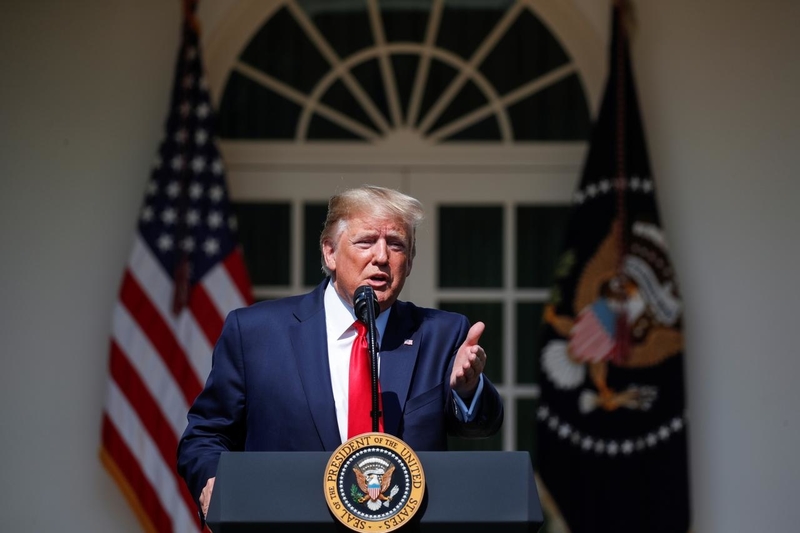
The image used in this article is licensed for noncommercial reuse under Creative Commons Attribution 4.0 International Deed. It was taken by Reuters and has been unaltered from its original form. It can be accessed here.
 The Gate
Leave a comment