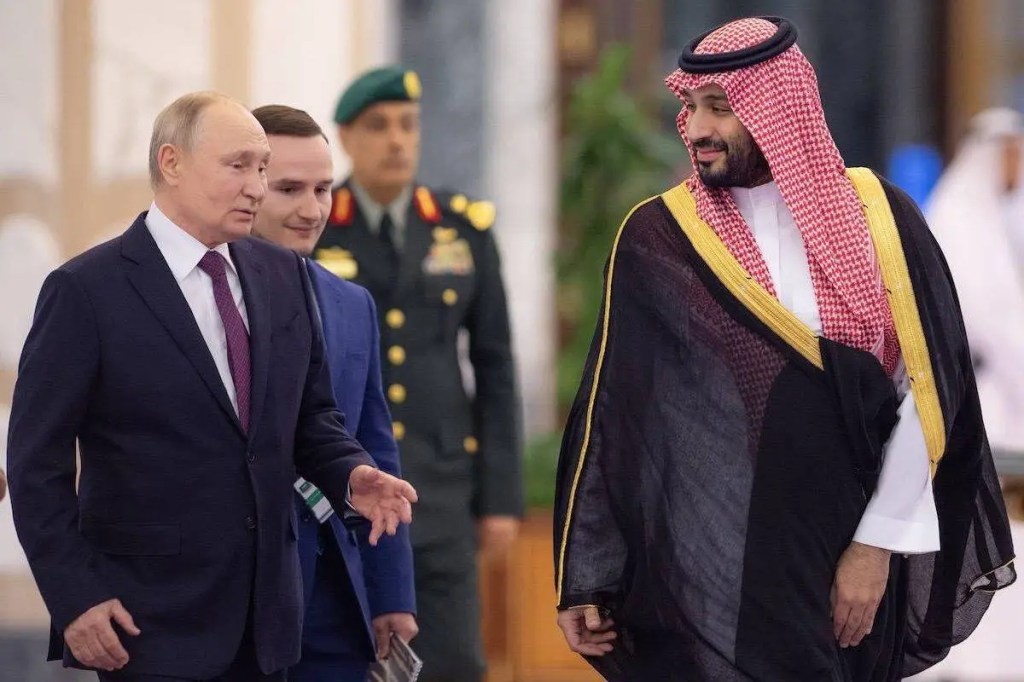
This past September, the United Arab Emirates played a key role in the exchange of a total of 206 prisoners between Russian and Ukrainian forces. One month later, a separate deal resulted in the release of over 200 more prisoners, again mediated by the UAE. President Vladimir Putin directly thanked the UAE’s President Sheikh Mohammed bin Zayed Al Nahyan, citing a “strategic partnership” between the two nations.
In the spring of 2024, Saudi Arabia hosted the “Riyadh International Disputes Week”—a weeklong conference featuring speakers, workshops and forms centered around mediation and reconciliation. Qatar, meanwhile, reemerged as a player on the stage of international conflict mediation, notably striking the later-criticized Doha Agreement between the Taliban and the United States that led to the American withdrawal from Afghanistan. Seemingly, the region’s largest economies are recognizing the value mediation and neutrality may hold for them, both regionally and globally. But what is exactly valuable about the role of global conflict mediator for the Gulf region?
REGIONAL MEDIATION EFFORTS
As the UAE, Saudi Arabia and Qatar seek to diversify their economies, the allure of a stabilized region has become more and more attractive. All three are making significant efforts to support de-escalation and normalization with their Middle Eastern neighbors, such as Israel and Iran. Riyadh and Abu Dhabi have struck surprisingly neutral tones when discussing the Israel-Hamas war. Indeed, it took until May of this year for Saudi Arabia to officially denounce Israel’s invasion as a “genocide”—much later than Iran, Iraq or Egypt. And while their calls for peace have gotten increasingly stronger as the war has dragged on, Riyadh is technically neutral in the conflict.
Legal frameworks in the region are also evolving. In the years following the signing of the Singapore Convention in 2020 by several Gulf states, a number of regional laws promoting mediation have been put into place. The UAE, Saudi Arabia and Qatar each issued similarly designed “Mediation Laws” to guarantee and protect a party’s right to request a mediator when settling disputes, in the hopes of reducing conflict and disputes.
This collective push towards normalization and stability in the region is strategic (as countries notice “the symbiotic relationship between regional stability and national prosperity”), but it’s also worth looking at the ways the Gulf region is well-suited for mediation from a cultural perspective.
CULTURALLY DISPOSED TOWARD MEDIATION
Two cultural elements are key to understanding the Gulf region’s approach to mediation. The first is the idea of the Majlis or the sitting areas in residences used for resolving disputes and welcoming guests for in-depth discussions. The second is the traditional concept of reconciliation, known as Sulh. Professor Ahmed El Shamsy, the Chair of the Department of Middle Eastern Studies at the University of Chicago, says that the two concepts are behind the Gulf region’s unique approach to resolving disputes.
First, the Gulf tradition for settling disputes relies less on an official “judge-like figure” and more on open, community debates, such as the Majlis. According to Professor El Shamsy, this is in part due to historically weaker central governments, where the judiciary system retained less trust and protections than in the United States for example. In COP28 President Sultan Al Jaber’s closing remarks at the forum, he claimed the Majlis hosted at the forum allowed negotiators to start “speaking to each other from the heart,” leading to the UAE Consensus (a breakthrough on climate action agreements in 2023). Second, Professor El Shamsy described Sulh as a concept of reconciliation that is more about peace than “deciding who’s right and who’s wrong.” In tandem, the two provide both the physical space and framework for interlocutors and Gulf negotiators to debate. On the other hand, Western negotiation traditions tend to be conducted through far stricter frameworks with greater senses of urgency and the need to adhere to norms and principles.
MOVING FORWARD: FILLING THE POWER VACUUM
If they follow the trajectory they set for themselves, the Gulf states will continue to emerge as go-to mediators for global conflicts. The world is frayed at the moment—wars persist in Ukraine and Gaza, tensions rise in the South China Sea and uncertainty about the American next steps following President Trump’s reelection grows. The need for neutral and reliable mediators will increase, especially if President Trump upholds his promise of remaining uninvolved with international conflicts. In a world facing increasing bipolarity, a region situated between the East and the West perhaps holds a geographic advantage for mediation. Riyadh and Abu Dhabi would be extremely happy with this outcome: a global reliance on the Gulf states for a resource other than oil only furthers the goals of the countries’ economic and social diversification plans.
However, following through on this vision requires more than just cultural foundations. There is an immediate question over the legitimacy of their intentions. Saudi Arabia’s response to Israel’s invasion is likely as much an attempt to cozy up to the West as it is as it is a genuinely neutral perspective; likewise with the UAE’s willingness to assist Russia. Should their geopolitical goals begin to affect the outcomes of their mediation roles, they will quickly lose credibility. Moreover, the region must be willing to collaborate with the United Nations in a way that is conducive to conflict resolution. The UN has historically been critical to mediating global conflict, but its capacity has become stretched as of late. Should the Gulf states cooperate meaningfully with UN officials, they could be of massive assistance. If they clash, it will be a significant hindrance.
It’s fair to be skeptical of the Gulf state’s true intentions as mediators. However, there is something to be said for the potential the region holds as peacemakers, especially in the current climate. Saudi Arabia, the UAE, and Qatar should be encouraged to continue to expand as conflict mediators but should be held to the same standard we set for other neutral nations. If they can meet those expectations, there is room for a region of mediators on the international stage.
The image used in this article is licensed by the Royal Court of Saudi Arabia and can be found here.
 The Gate
Leave a comment