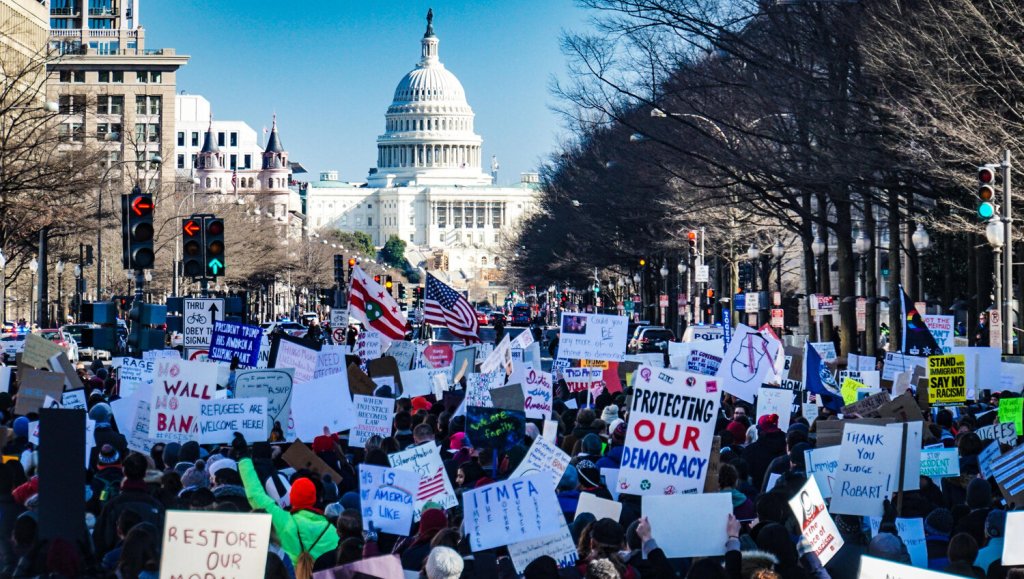
Protest voting has been a means of communicating dissent and putting pressure on party politics for decades by staking what candidates value immensely: one’s vote. For many left-leaning Americans, voting for Democratic presidential candidate Kamala Harris was not an obvious choice. The 2024 election saw many protest votes against America’s funding of Israel’s war on Gaza.
Pro-Palestine voters across the U.S. have cited various reasons for withholding their vote from Harris or at least for being dissatisfied with her platform. Voters point to American weapon sales to Israel and complacency towards the upwards of 44,000 deaths in Israel’s war on Gaza since October 7. The ballot proved to be a powerful tool for showing party leaders the demands of the left and expressing general dissent with the party’s support of Israel and its violence in Gaza. With the many issues at stake, Democrats urged voting for “the lesser of two evils”, arguing that policy for Gaza would be worsened under a Trump presidency. More so than in prior elections, this sentiment was challenged by many.
Protest voting, or withholding one’s vote from the candidate more likely to win an election, is a form of protest to indicate one’s dissent against their party’s policies or disagreement with the platform’s candidates. Protest voting against Harris’s policy on Gaza as vice president in this election was a widely discussed voting option in pro-Palestine circles.
University of Chicago Professor Elisabeth S. Clemens, William Rainey Harper Distinguished Service Professor of Sociology and the College, explains potential reasons behind protest voting as an effective mechanism for change, and the decisions voters must make to reflect their interests: “The challenge is that once you get to the general election, so many issues are at stake. It’s really difficult because protests … are directed towards the candidates or the party that are most sympathetic,” she explains, where voters are faced with the dilemma of “prioritiz[ing] my anger that the candidate of my party isn’t responding to my vote,” or voting for the candidate despite disagreement, for more successful mobilizing and protesting odds in the future. The internal dilemma many voters faced in bright-line voting on American support of Israel’s war on Gaza is one that runs deep. “I’ve heard activists who are just clearly deeply torn, really anguished over how to deal with this, this moment where there are sort of conflicting priorities between their bright line issues and everything taken into consideration, I should choose this party over that party,” says Clemens.
Protest voting for Gaza has proven unique in several ways, shaping how young people view voting and their civic duty. Clemens discusses the “danger there, because the lesson people take away could be that democracy doesn’t work.” Many voters will see their efforts and involvement and feel “yet nothing happened.” Looking at the understanding protesters have on the effects of their protest, and how the candidate looks to “provide a narrative of what that protest was” is important. Protest voting and its results are tied to voter efficacy and demonstrate passionate civic engagement.
The war on Gaza, beginning just over one year ago, complicates the timeline for seeing protest voting effectiveness. “The ability of the political system to respond is really important there,” says Clemens. She contrasts the issue with climate change, where the time frame has been a lot longer. “…People have pretended as if it’s been difficult to get people to put that front and center in their political demands, and it’s as though we’ve shifted from it being too far off to even think about, to being too late to do anything. The time frames of politics and the problems are a real challenge too”. Protest voting is often sustained over multiple election cycles to enact concrete long-term change in party politics.
Efforts for such sustained change are already underway. Members of Students for Justice in Palestine (SJP) at UChicago have voiced a similar sentiment: “I, for a while, have been very committed to not voting for Kamala Harris. Specifically, my reason for not voting for Kamala Harris is because her administration, with Joe Biden, has facilitated the genocide in Gaza for over 13 months, and their administration has done more harm to the Palestinians than any other administration in US history. So not voting for them is a pretty easy choice”, says a student member of UChicago’s SJP chapter. They continue, “I didn’t vote for Joe Biden in 2020 either for a whole host of reasons, not just Palestine. I reject the idea that Biden or Harris are some kind of a lesser evil, I think, besides just you know, them supporting genocide in Palestine, which has killed hundreds of thousands of people”.
Youth voters sharing the same sentiments exercised protest voting for Gaza looking beyond the idea of having the lesser of two evils. The student elaborates, “I think we had to. It’s not just Palestine. I think that the direction of the Democratic Party in general just keeps moving more and more to the right, and unless you stop voting for them, they’re not going to have any reason to stop doing that. So you can’t just unconditionally support them”. Dissent with the party’s platform is expressed through voting, a powerful means of sending a message. When asked how the student felt about the effectiveness of their protest in action against America’s support of Israel’s actions in Gaza, they said “I obviously don’t like Trump or his policies, but I think just given the the scale of the crimes of the Biden and Harris administration, that it was necessary to punish them, and because if we had continued down that path, I don’t see the Democratic Party just reversing course on its own if we voted for them. Donald Trump didn’t actually surge too much in the total number of votes he got. The main difference was for Kamala, votes just went way down. I think that sent a pretty strong message, and I think that it’s important that we in the Palestine movement take credit for a large part in denying her re-election”.
When asked about their perception of their peers’ opinions of voting for Harris, the student says “Among Palestine movements on college campuses the shared sentiment is that we can’t cast any votes for genocide. We can’t support Kamala. In terms of the general campus, my sense is that [it was] overall pro-Kamala. The position that we took is definitely not a majority position.” Engaging in protest voting was, for this student and many others across America, intentional. Many students have deliberated about the weight of their vote and have chosen to cast their ballots in ways they believe will most influence the landscape of American politics and the left. Given the shorter timeline of the issue and the reelection of President Trump, much is still left to be seen with how the Democratic party approaches its policy on Gaza and if the message sent by many students, including those at UChicago, was received.
The image featured in this article is licensed for reuse under the Attribution-ShareAlike 4.0 International license. No changes were made to the original image, which was taken by Ted Eytan and can be found here.
 The Gate
Leave a comment