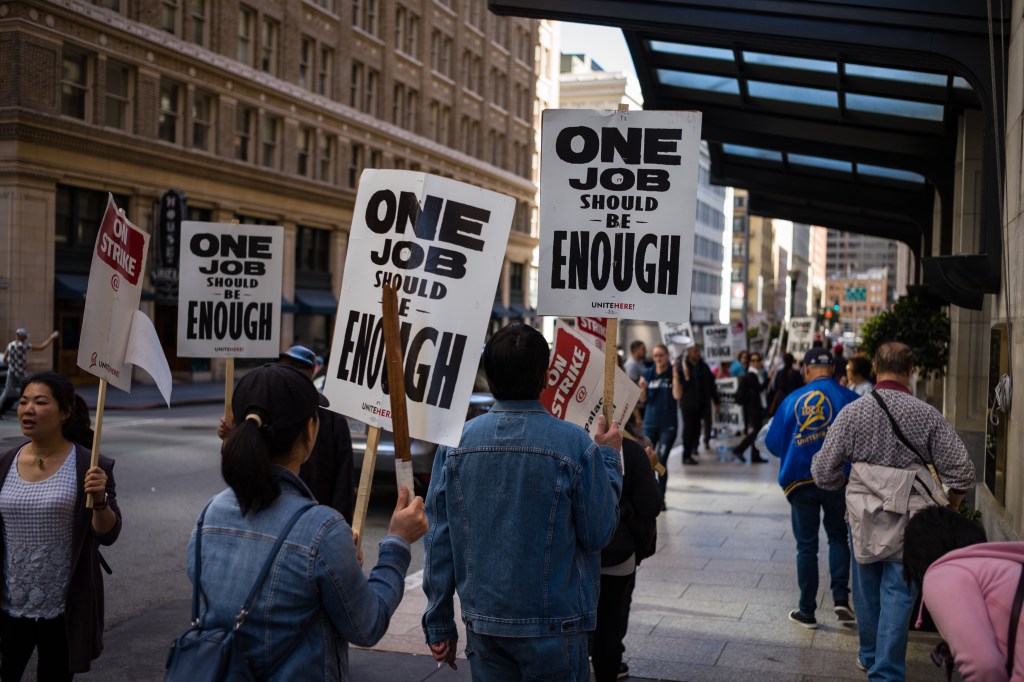
In recent years, labor unions throughout the U.S. have come out in full force through collective strikes against their employers. 2023 was a historic year for labor organizing as 459,000 workers went out on strike to compel companies across a diverse array of industries to grant them greater protections and benefits. While the strikes may have achieved the demands of unionized workers and have the popular support of Americans, there remains pressing concerns within the labor movement over the challenges confronting union organizers today. In the interest of reinvigorating the labor movement and lifting the nation’s unionization rate, many labor advocates have called for the passing of the Protecting the Right to Organize (PRO) Act, which, if passed, would be the most consequential reform to U.S. labor law since the 1940s.
A Historic Year of Strikes
In 2023, for the first time in decades, Hollywood faced two simultaneous major strikes. The Writers Guild of America (WGA), a union representing 11,500 screenwriters, went on strike in early May while the Screen Actors Guild-American Federation of Television and Radio Artists (SAG-AFTRA), representing 160,000 film and TV actors, joined picket lines in July 2023. Strikes halted production on popular shows like “Stranger Things” and “The Handmaid’s Tale” while dealing a multi-billion hit to Southern California’s economy.
The use of generative artificial intelligence was a key issue for both unions as screenwriters demanded guarantees that AI not be used to generate scripts while actors sought protections from their images being used in AI. Through the contracts they negotiated, the WGA prevented AI from being used to write or rewrite scripts while the SAG-AFTRA required that any “digital replica” of actors be made only with their consent. The WGA ended their strike in late September while SAG-AFTRA ended their strike in early November upon reaching tentative agreements with the entertainment studios.
Similarly, in mid-September 2023 and for the first time in the union’s 88-year history, the United Auto Workers (UAW) launched a strike against all “Big Three” U.S. auto manufacturers: Ford, General Motors, and Stellantis. Together, the three companies employ 150,000 UAW members. In announcing the strike the union’s president, Shawn Fein, called for cost-of-living adjustments that can offset the effect of inflation on wages, improvements to pensions, and job security measures like the ability to strike at plants designated for closing. Adding to the historic nature of the strike, President Joe Biden joined a UAW picket line in Detroit, becoming the first sitting president to ever do so.
The contracts between the UAW and the auto companies achieved much of the union’s demands, including pay raises of 25 to 33% over the next four and a half years, cost-of-living adjustments, shorter timelines for employees to obtain top pay and the elimination of a tiered wage system. The system, entrenched in numerous UWA contracts in the past two decades, had historically limited the wages and retirement benefits of newer, younger auto workers despite performing the same jobs at the same locations as their older counterparts.
Much of the strike’s success has been credited to Fein, who strategically ramped up or tamped down worker strikes in auto plants depending on whether the union was satisfied with the negotiation progress with the auto manufacturers. From the start of his mandate as the UAW’s president, Fein has committed to taking a more confrontational approach to negotiations with the auto industry. In announcing the first set of strikes on September 15, 2023, he called on select facilities to go on strike in order to “keep the companies guessing.”
After the UAW had reached tentative agreements with the auto companies in late October and the strikes were called off, Fein invited other unions to strike in tandem with the UAW, calling on other unions to “align your contract expirations with our own” and “that we not only strike, but that we strike together.”
Taken together, these massive and historic strikes illustrate a historic level of strength from the labor movement. According to the Bureau of Labor Statistics, the number of workers involved in “major work stoppages” in 2023 was 459,000, the second highest number in one year since 1986. Public opinion also appears to be warming to labor unions. A Gallup poll conducted in 2023 showed that the vast majority of Americans, 75%, sympathized more with the striking UAW workers than the auto industry. Similarly, 72% and 67% of Americans sympathized more with the striking screenwriters and actors, respectively, than with the TV and film studios. Overall, labor unions have a 67% approval rating as of 2023, which is notably higher than where it was in 2009 at 48%.
Barriers to Unionization
However, despite the large strikes and the warming of public opinion to unions, there has been little change in the percentage of the U.S. population represented by a union. In the year 2023, the unionization rate stayed mostly the same, decreasing by only a tenth of a percent to 11.2% from 2022. Those within the labor movement see this as problematic since they believe that a higher unionization rate would result in higher wages and greater benefits for blue-collar workers across the country. There are a number of barriers that labor advocates argue prevent un-unionized workers from organizing and joining unions.
Among other issues, there is the issue of employers working to dissuade workers from unionizing in the runup to a union election. According to the National Labor Relations Board (NLRB), the independent federal agency responsible for enforcing collective bargaining laws, the first step in voting to form a union is having 30% of employees at a workplace sign petitions that they support joining a union. From there, the NLRB organizes an election in the workplace in which every worker can participate. In a number of union elections, however, organizers have reported employers using “captive audience” meetings in order to dissuade employees from supporting unionization. By threat of firing or demotion, employers compel their workers to attend captive audience meetings in which they hear an anti-union perspective.
Motivated by the historic gains by the UAW in 2023, union organizers at the Mercedes Benz Factory in Tuscaloosa, Alabama organized a union election in May 2024. On election day, however, they failed to obtain a majority of votes in favor of unionizing, a result Union organizers mainly blame on Mercedes’s heavy-handed persuasion tactics. Reportedly, for months, workers started their shifts by attending captive audience meetings in which they watched videos that negatively portrayed unions and received text messages urging them to vote no.
Amazon, the country’s second largest employer, employed similar tactics in the leadup to a union election in March 2022 in a warehouse in Bessemer, Alabama. Amazon management reportedly held 20 meetings per day in the leadup to the election, presenting an explicitly anti-union viewpoint. In these meetings, management argued that the national union the Amazon workers were trying to join “hasn’t delivered for its members” and that they could end up with less wages and benefits by unionizing. The vote failed to reach a majority in favor of unionizing by a slim margin of 120 votes.
Another key issue for labor advocates is the direct and indirect retaliation that large employers have employed against union organizers. Whether through firings, suspensions or threats of either, companies like Starbucks and Amazon have sought to intimidate union organizers and undermine ongoing organizing in a number of their locations.
Since the first Starbucks store voted to unionize in 2021 in Buffalo, New York, over 500 Starbucks stores have joined the Starbucks Workers United union. Starbucks has fired a number of the union’s organizing committee under dubious pretenses. For instance, Starbucks fired one of the union’s first organizers from the Buffalo location, Lexi Rizzo, for tardiness. During her union organizing work, Starbucks management had made her work experience unpleasant as they cited her for dress code violations that she’d previously never encountered and scheduled her for opening and closing shifts. In all, Starbucks Workers United reports that over 200 Starbucks workers involved in union organizing campaigns have been fired by the company. The NLRB, under the Biden Administration, has stepped in to mandate Starbucks to reinstate over 20 Starbucks employees allegedly fired in retaliation for their organizing.
At Amazon, the retaliation has been reportedly just as transparent. As of November 2024, there is only one unionized Amazon warehouse, located in Staten Island, which voted to unionize under the Amazon Labor Union in April 2022. Amazon suspended Connor Spence, one of the founders of the ALU at the Staten Island location, for violating the company’s “off duty access policy” while he was organizing workers to walk out of the job in order to push for greater pay. During his suspension, Spence visited an Amazon facility in Kentucky to help with a union organizing drive there, allegedly resulting in him getting fired. At the Kentucky facility, Amazon management repeatedly told them to shut down their efforts at talking to fellow employees as their managers ordered the removal of tables that were set up to advertise the organizers’ position.
A report from the Economy Policy Institute estimates that, at a minimum, employers spend $433 million per year on consultants that specialize in undermining union organizing. Among a number of tactics, these consultants often advise employers to hold captive audience meetings for their employees and distribute anti-union flyers once any union organizing begins.
A Potential Solution
In order to resolve the array of issues besetting union organizing and the labor movement writ large, labor advocates have been calling for the enactment of the Protecting the Right to Organize (PRO) Act. The PRO Act has been approved twice by the House of Representatives, most recently in March 2021, though the Senate has yet to consider and vote on it due to opposition from Republican senators. The Act prohibits employers from forcing workers to attend captive audience meetings, ending one of the main tools that corporations have employed in order to dampen support for unionization. Additionally, in response to any workers facing retaliation from their employers for their union activity, the act requires the NLRB to obtain a court injunction that would immediately reinstate those workers.
The PRO Act would bar employers from getting involved in setting up union elections, which could help prevent employers from dragging out the election process in order to buy time to dissuade employees from supporting a union. The act would also require disclosure of indirect “persuader” activities by anti-union consultants, essentially mandating greater transparency on the work that these consultants provide to companies like Amazon. Currently, many employers and consultants do not disclose their agreements due to a loophole in the law that essentially allows their compensated consulting work to be deemed as “advice.” With these measures, labor advocates believe that the PRO Act can help level the playing field between the union organizers and the large corporations with the resources to undermine their work.
The White House Factor
Since the start of his presidency, President Biden has voiced support for the PRO Act while Vice President Kamala Harris committed to signing the act into law during her abbreviated presidential campaign. The NLRB under the Biden Administration has issued a number of rulings that have made union organizing easier, including a recent ruling that deemed captive-audience meetings to be unlawful, though it remains subject to legal challenges. But, with the return of President Donald Trump, the future of union organizing is uncertain. Trump’s first-term was marked by opposition to the PRO Act and rollbacks in union organizing protections. However, he has appointed Lori Chavez-DeRemer, one of only three House Republicans who cosponsored the PRO act, as his Secretary of the Department of Labor. Sean O’Brien, the president of the Teamsters Union, one of the largest unions in the country, advocated for Chavez-DeRemer’s nomination. Whether her position as Labor Secretary translates into continued advancement of union organizing rights will remain a closely watched matter by labor advocates.
With union organizing drives succeeding inside large corporations and union leaders willing to shut entire industries down, the labor movement currently has a momentum that could ensure continued progress in worker pay and benefits. The number of Americans that can join a union may depend on the Trump Administration’s labor policy and whether it addresses current barriers to unionization. However, regardless of the Labor Department’s policies or NLRB’s rulings, the labor movement may have to remain waiting on legislation that addresses the most pressing issues confronting union organizing.
Image Credits
Photo by Bastian Greshake Tzovaras, licensed under Attribution-ShareAlike 2.0 Generic (CC BY-SA 2.0). Source: link to original page.
 The Gate

Leave a comment