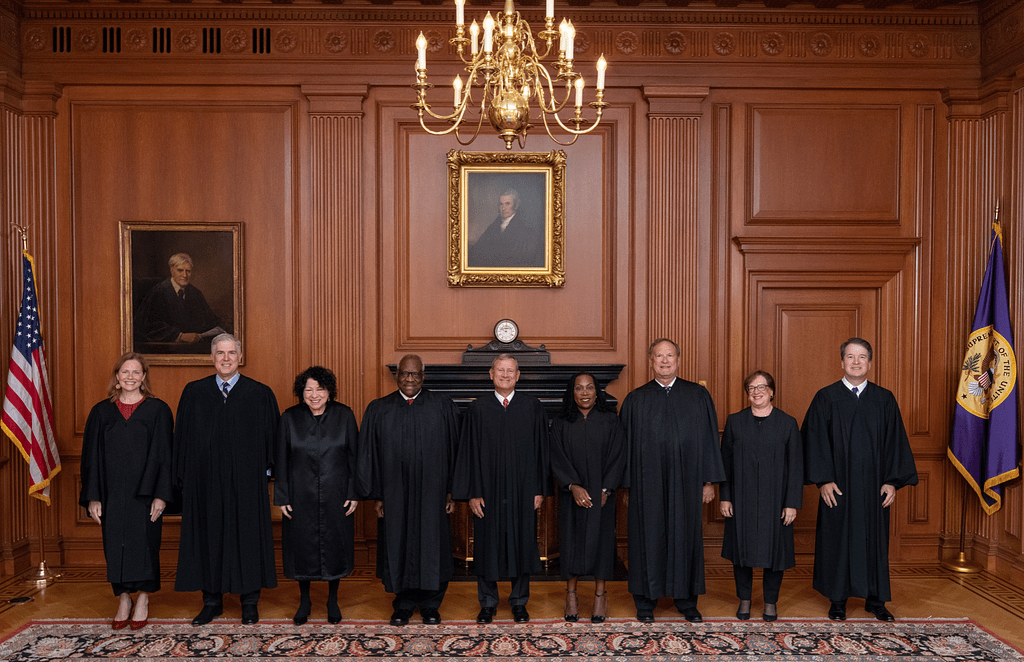
On July 1, 2024, in a 6-3 decision split across ideological lines, the Supreme Court issued a monumental ruling. The Court ruled that the president enjoys absolute immunity from criminal prosecution pertaining to his official duties in office that Congress cannot regulate. The Court’s decision on presidential immunity signals a drastic departure from historical precedent, jeopardizing democratic norms and empowering future presidents to act beyond legal restraint.
Following the 2020 presidential election, Donald Trump engaged in a series of illegal actions to overturn the election results. Trump attempted to leverage the Department of Justice’s power and authority to convince states to replace their legitimate electors with his fraudulent ones. Following the states’ refusals to engage in fraud, he proceeded to pressure his then-vice president Mike Pence to count the fake electors to alter the election results. His attempts to stay in power culminated on January 6, 2021, where he incited a violent mob that stormed the United States Capitol.
Consequently, on August 1, 2023, a grand jury charged Trump with conspiracy to defraud the United States, obstructing an official proceeding and conspiracy to obstruct an official proceeding and conspiracy against rights. In response, Trump pleaded not guilty and argued he was immune from prosecution, as his actions lay in the outer responsibilities of his presidential powers. The DC Circuit Court of Appeals unanimously rejected this claim: “We cannot accept that the office of the Presidency places its former occupants above the law for all time thereafter.” Doing so “would collapse our system of separated powers by placing the President beyond the reach of all three branches,” the ideologically diverse judges wrote. Trump appealed to the Supreme Court.
The Court’s Conservative Turn
Historically, when presidents have attempted to claim absolute immunity, the Supreme Court has firmly rebuked them. Most notably, in the 1974 case Nixon v. United States, President Richard Nixon claimed “executive privilege” permitted him to withhold confidential communications from within the executive branch. Nixon, like Trump, appointed three conservatives to the Court, shifting it ideologically to the right. The Court unanimously rejected this argument of “executive privilege.” Instead, it gave preference to “the fundamental demands of due process of law in the fair administration of justice,” as it wrote in its ruling. The Court did concede, however, that there is a limited executive privilege in areas of military or diplomatic affairs.
The Supreme Court that ruled on Trump v. United States was largely constructed and influenced by Trump himself. Appointing Neil Gorsuch, Brett Kavanaugh and Amy Coney Barett, Trump selected the most Justices by a one-term president since Herbert Hoover. The addition of these Justices marked a turning point for the Court, ensuring a 6-3 conservative super-majority over the previous 5-4 conservative split.
More generally, with Trump’s appointments, the Supreme Court has delivered major conservative wins, giving the Conservative movement far more consequential victories at the Court than through any legislative or executive action. With the 6-3 conservative super-majority, the Court has overturned affirmative action, restricted gun regulations, reversed abortion rights, given the president broad immunity and much more. Arguably, though, none of these cases are as fundamental as Trump v. United States, given how it strikes at the heart of American democracy. This decision alters the meaning and purpose of the Constitution, enormously impacting the way our democracy functions, especially if Trump takes the ruling’s generous latitude to the extreme in his next term. The executive, no longer strictly bound to his Constitutional powers, can push both the law’s and Constitution’s limits.
What the Ruling Says
The current Supreme Court, with its super-majority of six ideologically conservative and three liberal justices, however, went in a drastically different direction. Rather than protecting due process and the fair administration of justice like the 1974 Supreme Court, the Court expanded the president’s immunity. “Under our constitutional structure of separated powers, the nature of Presidential power entitles a former President to absolute immunity from criminal prosecution for actions within his conclusive and preclusive constitutional authority,” the ruling declared. “And he is entitled to at least presumptive immunity from prosecution for all his official acts. There is no immunity for unofficial acts.”
The majority opinion, written by Chief Justice Roberts and joined in full by Justices Thomas, Alito, Gorsuch and Kavanaugh, the ideologically conservative Justices, further expounded on the idea of absolute immunity from criminal prosecution. The majority determined that “this immunity must be absolute” regarding core constitutional powers, such as acting as commander in chief and chief diplomat, granting pardons and reprieves and other powers enumerated in Article II of The Constitution. The president is even absolutely immune from prosecution for his actions that lay within the “‘outer perimeter’ of his official responsibilit[ies],” the majority wrote. More than rejecting historical precedent in this case, the conservative super-majority expanded the president’s constitutional sphere of power to include this vague “outer perimeter.” As the dissenting opinion exemplifies, this ruling dramatically shifted the relationship between the president and American citizens. Previously, the president was beholden to the same laws as every American. Now, the president can exploit the power and trust granted to him by the American people, undermining the balance of accountability and shifting the relationship from one founded on mutual trust.
Justice Sotomayor, joined by Justices Kagan and Jackson — the three ideologically liberal Justices — responded with a fierce dissenting opinion criticizing the majority’s ruling. “Today’s decision to grant former Presidents criminal immunity reshapes the institution of the Presidency. It makes a mockery of the principle, foundational to our Constitution and system of Government, that no man is above the law,” Justice Sotomayor stated at the start of her opinion. “Because our Constitution does not shield a former President from answering for criminal and treasonous acts, I dissent.” Ignoring these strong objections and the lower court’s ruling, the conservative super-majority plowed through their dissent, granting Trump, and all presidents, broad immunity.
Effects and Implications on American Democracy
In broader terms, the Supreme Court’s ruling offers the president great latitude in his powers and essentially legalized all of Trump’s criminal actions following the 2020 presidential election. For example, the ruling permits presidents to ask executive branch officials to violate federal criminal statutes concerning elections, as Trump did in 2020, and grants presumptive immunity for those actions. The ruling permits pursuing political enemies, as there could be no liability for the president who pressures the Department of Justices to prosecute baseless crimes. As long as these actions fall under the president’s “official acts,” there can be no criminal prosecution. “When he uses his official powers in any way, under the majority’s reasoning, he now will be insulated from criminal prosecution,” Justice Sotomayor wrote in her dissenting opinion. “Orders the Navy’s Seal Team 6 to assassinate a political rival? Immune. Organizes a military coup to hold onto power? Immune. Takes a bribe in exchange for a pardon? Immune.”
More than just granting Trump blanket immunity, the Supreme Court prevented Trump’s sentencing from taking place before the presidential election, a huge win for him and his allies. Firstly, by taking his immunity appeal to the Court, Trump froze his criminal case while waiting on the high court’s decision. Secondly, the Court flatly ignored the special counsel’s request in December 2023 to circumvent the normal appeals court process to issue a ruling. Given the fundamental and constitutional questions the case brings, the special counsel sensed the Court would have the final word regardless. The Court took over 6 months to declare a ruling, only to remand the case back to lower courts. In doing so, Trump and the Court deprived Americans of a critical ruling to determine his eligibility before the election. While voters already knew Trump violated New York state law given his conviction on 34 felony counts, they were barred from knowing whether he officially violated federal criminal law. Now that Trump is the President-elect, he can appoint and order his expected loyalist attorney general Pam Bondi to drop all charges against him.
The Power Shift
The chilling picture Justice Sotomayor painted reflects the newfound power imbalance in the federal government. No longer is the president equal to Americans under the law. No longer is the president beholden to the law. By placing the presidency above legal accountability for actions tied to official duties, the Court has undermined the foundational principle that no one is above the law. This decision not only shields Donald Trump from immediate consequences but also highlights the Court’s sidestepping of the Constitution. By eroding its safeguards, the Court risks transforming the presidency into an office insulated from accountability.
Recognizing the dangers of the Supreme Court’s decision, President Biden, along with 29 Democratic senators, proposed a constitutional amendment called the No One is Above the Law Amendment. The amendment aims to combat the Court’s immunity ruling, to ensure no president is immune from criminal prosecution. Constitutional amendments, however, are incredibly difficult to pass. Changing the Constitution requires a two-thirds vote in both houses of Congress or a convention called by 34 states, followed by approval from 38 state legislatures. Given Democrats’ sliding power in Congress and loss of the White House, this amendment is unlikely to pass in the near future.
Ultimately, given the total control Republicans will have over the executive and legislative branches over the next four years, holding a super-majority in the Supreme Court will only further cement conservative dominance across all branches of government.
The image featured in this article is licensed for reuse under the Public Domain Mark 1.0 Universal license. No changes were made to the original image, which was taken by Picryl and can be found here.
 The Gate
Leave a comment