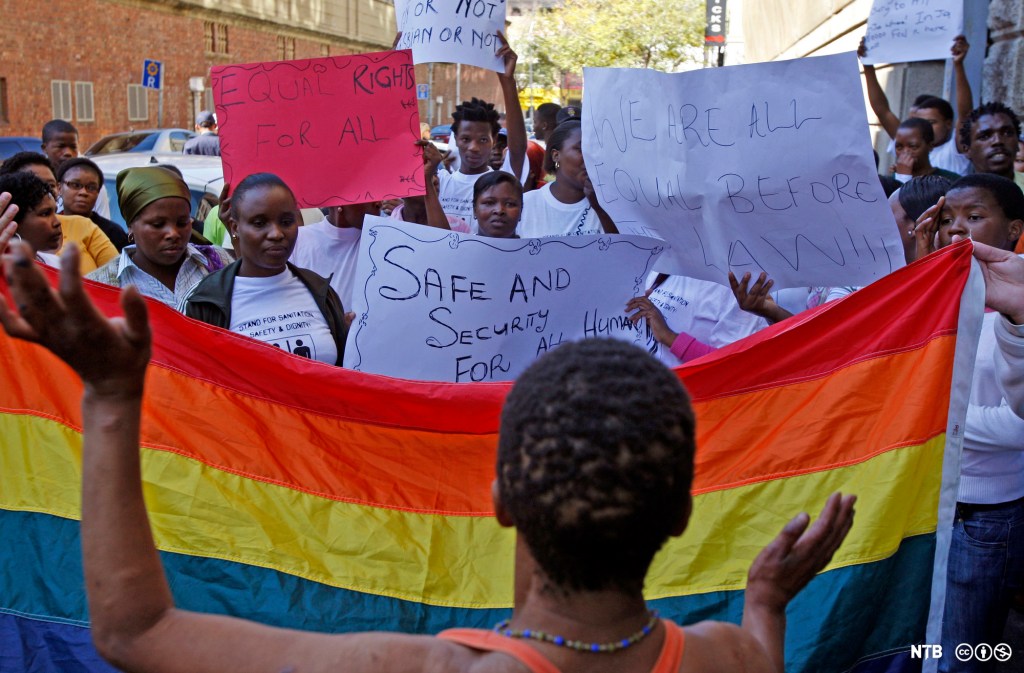
Amidst an era of increased partisan polarity and human rights violations, American liberals — policymakers and voters alike — turn to the nation’s past to remind themselves of America’s enduring progressivism. As left-wing US politicians and Western struggle to adjust to bilateral relationships with the Trump Administration, President Biden and his European allies can applaud themselves for getting one thing right: the legal and social recognition for LGBTQ rights.
Today in Kenya, same-sex relations are legally, socially and religiously prohibited. Homosexual activity itself is punished by up to fourteen years in prison; to attempt affection or affiliation with an LGBTQ sentiment is to submit to intense social exclusion and incarceration. Conversion practices, hate crimes and general violence toward gays permeate Kenya, as does an equally powerful silent stigma. But this overarching legal and social intolerance of homosexuality is not the whole story. Kenyan citizens and history alike describe a much different reality — one that destabilizes our understanding of the Global South’s resurgent conservatism and our role in it.
Despite large social opposition, there are Kenyans like Reverend Godfrey Owino Adera who are tolerant of same sex-relationships. As an Anglican priest, a citizen of Nairobi and a theologian scholar, Reverend Adera’s work spans African theology, sexuality and decolonial analysis. Committed to LGBTQ inclusion in religious and social institutions through a combination of accrued academic perspectives and personal ethics, Reverend Adera describes the status of same-sex tolerance in Nairobi as “simultaneously hostile, contested and rapidly changing.” According to Adera, “public discourse especially in religious spaces, political rhetoric and popular media often frames LGBTQ identities as immoral, foreign or socially dangerous.” He adds that “many LGBTQ people still navigate family rejection, housing discrimination, lack of employment, and periodic public moral panic.” At the same time, though, Adera asserts Nairobi’s growing social nuance. He points out that “Nairobi is also the center of Kenya’s most visible LGBTQ organizing, legal advocacy, academic debate and community building . . . Therefore, what emerges is a dual reality: Nairobi is both one of the most difficult and one of the most hopeful spaces for LGBTQ life in Kenya.”
Recent court victories, including the 2019 Supreme Court ruling in favor of the right to association and the 2023 ruling that secured rights to associate for interest groups, established the judiciary and the constitution as a legitimate safeguard for LGBTQ discussions. But these significant steps have only increased violent public resistance and integrated homophobic dialogue into political campaigns more than ever, plunging Kenya into what Adera calls a “rights paradox.”
Adera reflects that, across Kenya and particularly Nairobi, “visibility and resistance grow together. As queer people become more visible and organized, backlash also becomes more vocal.” Beginning in the 1990s, political campaigns relied on a rhetoric of “militant homophobia,” which academics describe as the forceful political arrest of gay-identifying citizens rather than a more passive, merely institutional homophobia. Since 2015, Nairobi has also seen more murders of gay-rights activists than ever before. Increased citizen participation in LGBTQ spaces thus occurs alongside surges in political and public intolerance.
The reality of LGBTQ discourse in Kenya may surprise those in the West who relegate Kenyan politics to that of a simplistically homophobic, developing nation. Rather than solely representing a large anti-gay majority, Kenyan citizens are enchained to a pendulum of mutual protest and resistance.
The current state of gay rights and their social legitimacy in Kenya is complex, but the Western contempt and frustration for homophobia in these developing nations are surprisingly one-dimensional. Western governments condemn these displays of public violence and legal intolerance along with the Kenyan government’s political defense of institutional homophobia. But this social dissonance between progressive and culturally conservative nations reflects a deeper historical reality of cultural and economic extraction. To understand this social reality, one needs to examine its political and religious origins.
Prior to colonization, same-sex relations and gender fluidity permeated East African societies. 2022 academic literature investigating Gikuyu lesbian relationships or pan-African genderless practices confirm historical facts intentionally erased by colonial force. Through physical, legal and political domination as well as social covenants, Christianity’s profound effect on Kenyan society manifested through not just exploitation and a new religious infrastructure but the strict fundamentalism of Victorian ethics. Religious devoutness, now synonymous with tradition, today restricts domestic dialogue surrounding pre-colonial sexual fluidity. Elected in 2022, Kenyan President William Ruto’s legal justifications for ongoing anti-LGBTQ policy even reference the colonial penal codes directly.
Freed of its colonial dependency but still largely economically and politically subjugated by the West, Kenya adjusted to a new age of religiosity. According to Reverend Adera, deep-seeded political grievances regarding ongoing dependence have now turned into a cultural voice of resistance, often one of fundamentalism that stands in stark opposition to growing liberal advancements in the West. Hostility towards the West and defense of ‘African authenticity’ requires a target board, which Adera describes as manifesting in the framing of LGBTQ rights as “foreign, imported, tied to NGOs, aid, and diplomacy, and symbols of cultural imperialism.”
This political hostility to the West asserts itself in headlines announcing threats of US sanctions and Western politicians’ political statements defending human rights. Following Kenya’s 2023 Family Protection Bill that reinforced same-sex prohibition, Biden faced strong internal criticism for the U.S.-Kenya Strategic Trade and Investment Partnership. Over twenty members of Congress, as well as activist groups and foreign allies, protested a series of trade partnerships between the U.S. and East African countries intolerant of LGBTQ rights. Responding to domestic pressure, Biden’s threat of economic sanctions against Kenya may have been a symbolic gesture at safeguarding human rights, but Kenya’s refusal to budge certainly was not. President Ruto and his party leaders refused to negotiate over their assertions about biblical and Kenyan moral values being against homosexual relations.
Member of Parliament Peter Kaluma, the bill’s figurehead, called the promotion of gay rights a “big industry,” especially across Europe and the United States. As exemplified by Kaluma, the promotion of LGBTQ rights from Western economic powerhouses actually offers anti-LGBTQ Kenyan politicians a language of protest against ongoing Western dependency. Imposing international standards set by the UN, the Western-led campaign for LGBTQ rights threatens colonial covenants forcedly embedded in Kenyan society. Now, contesting LGBTQ rights offers a measure of agency to Kenyans trapped in a reality of ongoing, deeply-embedded and accountability-free neocolonialism.
Adera observes how Kenyan politicians tagging LGBTQ rights as “foreign and imported” reflects an intentional tactic, in which anti-LGBTQ sentiments embody both resistance to the West and galvanization for broader public hostilities. The defense of “Kenyan morality” is entangled in unspoken assertions of national sovereignty, cultural independence and religious identity. According to Adera, these sentiments almost always reach their peak in political campaigns during election cycles, major court cases and economic strain, demonstrating that “hostility toward LGBTQ rights is not only about sexuality” but “also about history, power, dignity and global inequality.”
The image featured in this article is licensed for reuse under the Creative Commons Attribution-Noncommercial 4.0 International Deed. No changed were made to the original image, which was taken by Schalk van Zuydam for AP and can be found here.
 The Gate
Leave a comment