
Zohran Mamdani revolutionized politics, and he did it on Instagram. Mamdani did not just win an election, he nearly doubled total voter turnout since the last mayoral election, and won the most votes in an NYC mayoral election since the 1960s. Throughout his 13 month-long campaign, Mamdani demonstrated what the future of political communications could look like through daily social media posts, collaborations and creative messaging. His unique social media presence earned him millions of followers, hundreds of millions of views and a revolutionary victory.
His social media strategy boils down to three components: production, content and consistency. In his videos, there is constant movement. Mamdani is usually walking around the city, changing locations every sentence. Throughout months of reels, he displayed many famous New York City sites, such as Times Square and the Statue of Liberty, but also lesser known places, like a nursing home in Cobble Hill. Another component of his production was the background music in every video. Most of the music was instrumental and it would intentionally mirror the vibe and message of the video. It added a layer of energy, embellishing a tone of excitement or sadness wherever necessary.
The algorithm likes these kinds of videos. Short, energetic, dynamic, with music and locations that can be linked within the post. Content consumers like familiarity and they like energy, so these reels were perfect.
With regards to content, Mamdani’s face and voice were in every single video. He talked directly into the camera to his audience. People quickly started to recognize Mamdani. His upper cheek dimple was more of a phenomenon than any of Andrew Cuomo’s one-liners.
Mamdani also produced a lot of multilingual content. He posted multiple videos of him speaking exclusively in Spanish, Hindi, Bengali, Urdu and Mandarin with English subtitles. With a couple non-English Instagram reels and TikTok clips reaching over ten million views, he effectively entered many multilingual households in the city and spoke directly to thousands of families.
He also collaborated with other influential Instagram creators in specific reels, for example Congresswoman Alexandria Ocasio-Cortez (D-NY), who has 9.5 million followers of her own. He used a new Instagram feature called “cross-posting,” where the same reel appears on both creators’ pages, as if they both posted it individually. These frequent collaborations with celebrities and other public figures expanded his network of followers and provided him with much higher-profile and diverse recognition than he could get on his own.
According to HypeAuditor, which tracks content creators’ views, reach and engagement, Mamdani had an “excellent” 4.12% engagement rate on Instagram and a “very good” 8.94% engagement rate on TikTok. HypeAuditor described both his Instagram and TikTok reach as “significantly above the average,” adding that his Instagram had “exceptional visibility.”
Mamdani took advantage of his large audience to talk about the issues he wanted to highlight in his campaign. In his videos, he presented his policy ideas using images, clipped videos and statistics he could put on the screen as he spoke about them.
Mamdani was more consistent on Instagram and TikTok than most politicians and even some influencers. He used trends, holidays, and world events as a way to engage with his audience on social media. He made a reel about the 2026 FIFA World Cup to talk about youth sports and affordability and the iconic Mean Girls line “it’s October 3rd” to talk about voter registration deadlines. Mamdani followed the algorithm in order to be a part of it. He participated in trends in order to set them.
Like any good Gen Z pop culture icon, Mamdani went viral. One of the most famous moments from Mamdani’s campaign is when he corrected Andrew Cuomo in the Democratic primary debate, saying “the name is Mamdani. M-A-M-D-A-N-I. You should learn how to say it.” That week, a creator named @astorwalk clipped the sound byte and remixed it with Gwen Stefani’s “Hollaback Girl” and posted it to his Instagram and TikTok. That video has over 300 thousand views on Instagram and 3.7 million views on TikTok. The sound was used almost eight thousand times on Instagram reels and over 18 thousand times on TikTok.
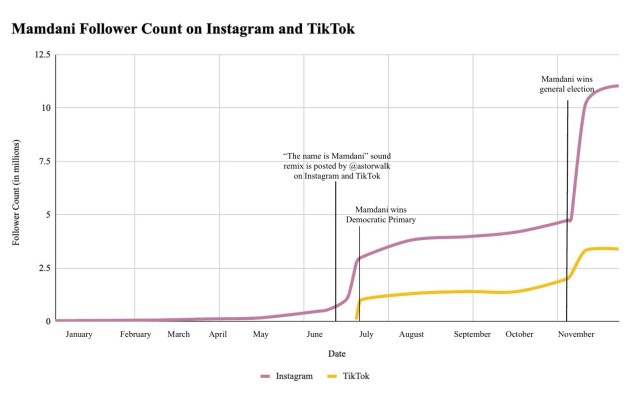
This was not a strategic move by the campaign, but Mamdani’s pre-existing social media presence made this viral moment possible. After the sound became popular, creators could remix the audio with clips they liked of Mamdani that already existed on the internet from his posts. People would show their support by using the sound for their own videos, with captions like “racism should be called out!” and “GET IT RIGHT!!!” Mamdani’s follower count on Instagram and TikTok skyrocketed practically overnight after that initial remix was posted.
Over the course of Mamdani’s campaign, he posted around 300 videos on TikTok and over 1000 reels on Instagram. In addition to producing his own content with his digital team, Mamdani also reposted every single one of his TV appearances to his Instagram and TikTok. Everything from Jon Stewart to his MSNBC appearance went on the grid. The sheer number of posts he was publishing was a key part of his strategy and success. The algorithm responded well to him and he got a lot more views than he would have gotten in TV ads, a popular political media tactic.
Mamdani did invest in TV ads, relatively late in his campaign around April 2025. By then, he had already posted 90 reels, with some of them reaching 10+ million views. The price of creating that kind of visibility through social media is a fraction of the price of a traditional media buy, especially in New York where paid media is expensive.
In Illinois, Congressman Raja Krishnamoorthi spent about half a million dollars a week in media buys for his Senate campaign, and held a significant lead in the polls in the early months because of it. Krishnamoorthi ended 2025 with $15 million, but he would not have necessarily needed that much money if he adopted Mamdani’s social media strategy.
In addition, while Krishnamoorthi may have had hours of media to use, Mamdani could present whatever he wants, for as long as he wants, for no cost at all. He does not have to negotiate with news outlets for advertising time and spend millions of dollars to raise awareness on a certain topic. If Mamdani wants to discuss ranked choice voting in detail or clip videos of Cuomo and President Trump, he can.
Mamdani’s social media campaign also built his volunteer base — his team reported having 46,000 unpaid volunteers across New York City. Those tens of thousands of people translated into monumental voter engagement throughout the campaign. A lot of his volunteers canvassed for him across the city, encouraging people to register, vote, and volunteer.
The growing volunteer base paired with his energetic social media content created an image of Mamdani that was personable and excited yet sincere and committed. “He seems like a real person,” said Cortez Heyworth, a first-year undergraduate student at New York University. “He’s intertwined in the community in a way others aren’t.” This was a widespread sentiment across the youth of New York City. Young people (ages 18-29) ended up being Mamdani’s largest supporter block, with him taking 75% of the youth vote in November.
Mamdani addressed how he thinks about young voters in an interview he did with Jon Stewart. “We talk to young people like we would talk to anyone,” he said. “We’re not patronizing them. We’re not condescending. We’re not hanging a shiny little thing and saying please come follow it.” He also commented broadly on the state of politics and younger voters. “There’s this condescension that we use in the language about young people.” Mamdani bridged that gap with his social media and continues to do so as mayor of New York City.
Instagram and TikTok, if done correctly, are free media over which the candidate has complete control. Rigorous social media strategies that get voters excited have the potential to compete with million-dollar media buys.
While Mamdani’s social media strategy was powerful, it is not necessarily a template for success for all candidates. The social media algorithm can be unforgiving when it comes to promoting content to trending pages. Mamdani’s personal flair contributed greatly to his success on social media, and not every candidate has his particular charisma. He was funny and kind, but also strong and defiant. He worked his social media to highlight those aspects and put his personality on display in a way that connected with constituents.
One example is when he posted the bloopers from his Spanish reels where he falters over a couple of words, laughing afterwards.
With social media, polling numbers are not the only metrics of campaign success. Follower count, views and especially engagement rates can and should also be campaign indicators.
Many publications, including The New York Times and the BBC, gloss over this social media strategy, not addressing the specific and successful tactics that went into this revolutionary win. They focus more on youth voter exit poll statistics and less on how and why youth voters got to the polls in the first place. The BBC attributes Mamdani’s win to the ‘doomscrolling’ Gen Z population but fails to recognize that, if all they do is doomscroll, they would not be volunteering and working for the campaign. There must be something else, something real that speaks to them.
Hillary Clinton, Joe Biden and Kamala Harris all had Instagram and TikTok during their campaigns, but none of them, nor any politician ever, has gone viral the way Mamdani did. Downloading the app and making the account stopped being “cool” or unique ten years ago. To get meaningful impact and a broad audience, candidates need to be much more intentional and consistent about their social media content.
Social media is an untapped resource for any and all political campaigns looking to build their brand and a volunteer base. Dismissing the power of the internet and social media minimizes the specific strategy behind every reel, post and caption that resulted in a win no one predicted and a precedent everyone should watch closely.
Candidates and strategists could capitalize on that resource a lot more. The algorithm can be tracked and used.
The people in politics who understand how they can work social media will be successful. Those who do not, will trap themselves in a world of media buys and newspaper ads that will give them increasingly little in return.
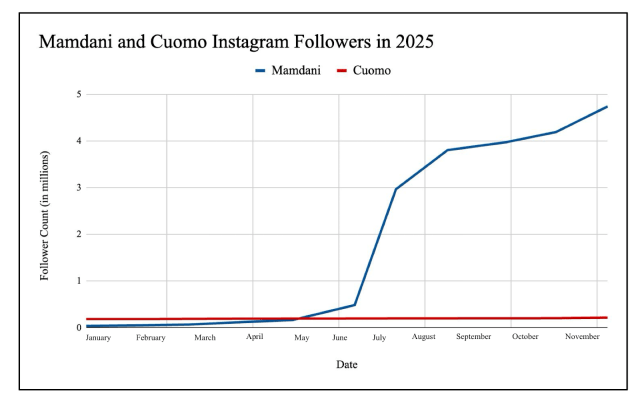
Image from MacroHype, licensed under Attribution-NonCommercial 4.0 International (CC BY-NC 4.0).
 The Gate
Leave a comment