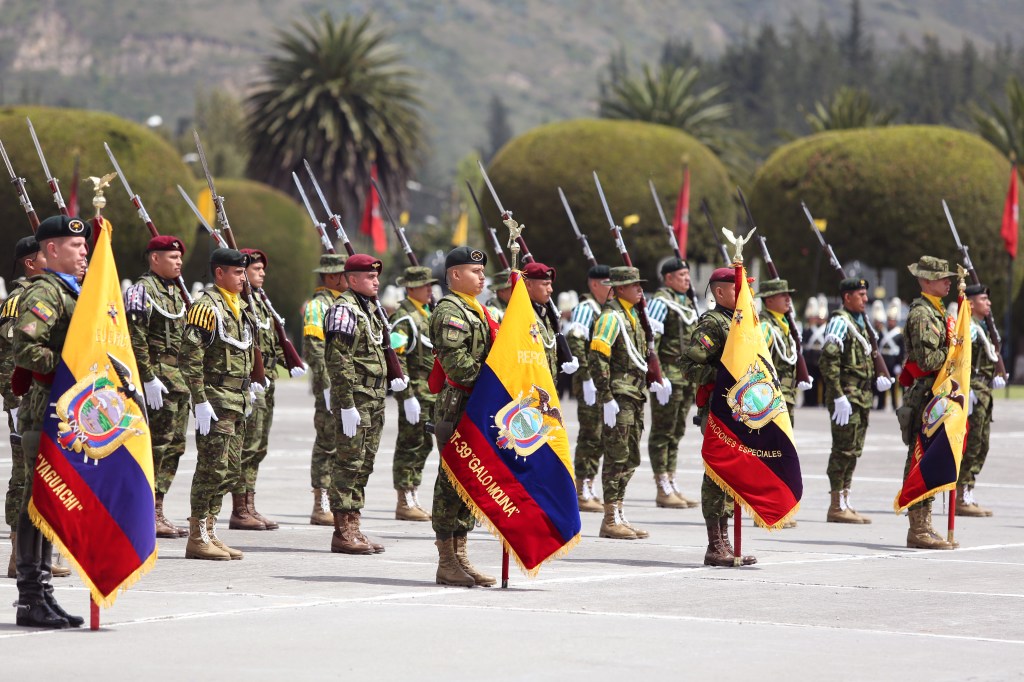
On Nov. 16, Ecuadorians cast their votes for a national referendum that, among other constitutional reforms, proposed eliminating the constitutional ban on “Foreign Military Bases.” As Ecuador endures increasing gang violence and organized crime, the triumph of the “NO” in the referendum signals a decisive shift away from the goals of President Daniel Noboa’s militarization campaign.
Since 2024, Noboa has championed an aggressive crackdown on organized crime, deploying military forces on Ecuador’s gangs and criminal organizations. Noboa has embraced a “Mano Dura” or tough-on-crime measures to confront organized crime.
Since 2024, Noboa has championed a “Mano Dura”, or tough-on-crime crackdown, on organized crime, deploying military forces against Ecuador’s gangs and criminal organizations. The government’s “Plan Fenix,” implemented in 2024, consisted of massive mobilization of military forces and extensive states of exception that suspended constitutional protections and expanded extrajudicial powers. Similarly, the November visit of Kristi Noem, the United States Secretary of Homeland Security, to assess potential military bases, has showcased Noboa’s commitment to position itself as a strategic force for militarization. After a year of the “Plan Fenix” measures, despite a decline in homicides in 2024, Ecuador hit a historical high of 9.216 homicides in 2025, a 30.48% surge.
With the triumph of the “NO” in the referendum, securing 60% of the vote, Ecuadorians decisively demonstrated their opposition to Noboa’s militarized governance. The referendum also indicates a general decline in public confidence in the government. Noboa’s leadership has been questioned amid controversial economic policies, such as the increase in the sales taxes and the elimination of diesel subsidies, as well as escalating crime and abuses of power during the militarization campaign.
Ecuador’s militarization has generated international concerns over human rights abuses and violations of international law. Human rights organizations have documented cases of extrajudicial executions, enforced disappearances and torture. The Malvinas case exposed the violent detention of four minors, all between 11 and 15 years old, and the eventual identification of their charred remains, showing signs of violence. This, among other cases, has demonstrated the consequences of militarization to Ecuadorians.
Jose Guevara Bermudez, an international law and human rights expert specializing on Mexico’s war on drugs, said “The Inter-American Court of Human Rights authorizes, under international law, the short-term involvement of military forces in public security, as long as there exist oversight mechanisms.” Guevara Bermudez suggested that “citizen oversight mechanisms… should be implemented to supervise the involvement of military forces,” ensuring accountability and compliance to international legal standards.
However, for Santiago Cabrera, militarization is an ineffective measure to Ecuador’s crisis. Cabrera, a professor of sociology at the Universidad de las Fuerzas Armadas , believes that “security can not be addressed only by fighting fire with fire, but by creating the necessary economic, social and cultural conditions to diminish the levels fo violence,” highlighting that militarization is incapable of addressing the source of violence in Ecuador. Cabrera explains that high levels of poverty motivate individuals to engage in organized crime to secure subsistence. According to Cabrera, Ecuador has “60,000 to 70,000 organized crime members nationwide — many of them aged 18 to 25” while “1.5 million youth that age live in poverty.” For Cabrera, militarization would “hit them hard and kill them all, but in a few weeks they would be replaced.”
Ecuador’s economic conditions fuel criminal activities and militarization fails to tackle widespread poverty driving gang affiliation. Instead of militarization, Cabrera argues that the government must prioritize a “comprehensive youth policy” that includes “incentives for companies that incorporate young workers” and ensures that university education addresses the root causes of organized crime.
Militarization is not unprecedented in Latin America. Since 2022, El Salvador President Nayib Bukele’s “Mano Dura” has gained traction across the region. This example has incentivized other Latin American governments to implement these measures, such as in Honduras and Guatemala. However, Colombia and Mexico have progressively transitioned away from militarization and towards social development measures, such as expanded education, healthcare and employment, in their efforts to combat organized crime.
The Ecuadorians’ decision to vote NO in the referendum signals a shift away from militarization towards addressing the root causes of organized crime.
The imaged featured in this article is licensed for reuse under Wikimedia Commons and is Public Domain under the Mark 1.0 Universal Deed. No changes were made to the original image, which was taken by Carlos Silva/Presidencia de la República and can be found here.
 The Gate
Leave a comment