
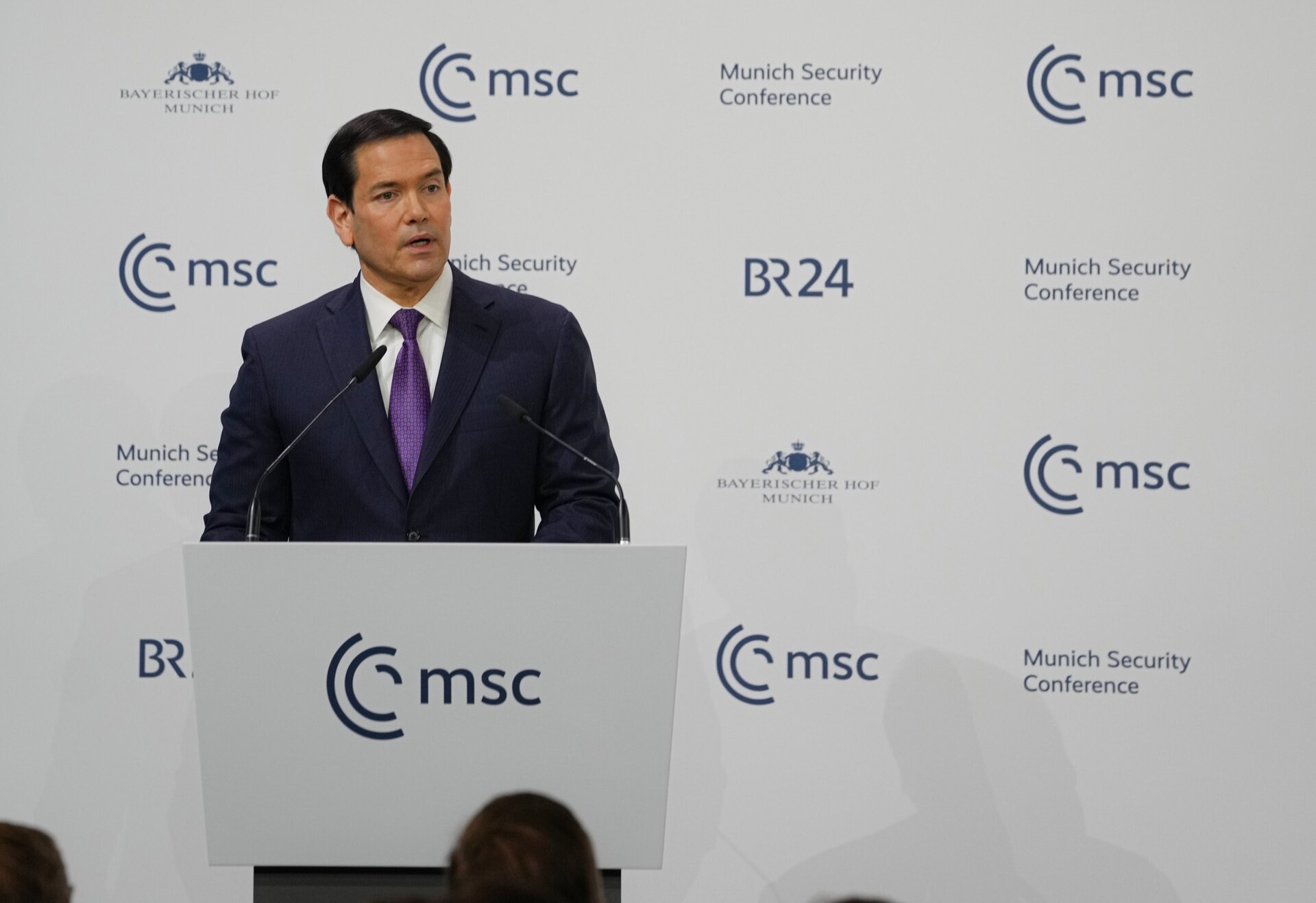
A Master’s Degree in Hypocrisy: Marco Rubio’s Ridiculous Rhetoric
I’m a fan of Bret Stephens, and I think his column this week on studying Western Civilizations that praised Secretary of State Marco Rubio’s speech in Munich has a lot of merit.
Too many American universities are not interested in the Classics. Too many students have not read Plato and Aristotle, Rousseau and Locke. A 2020 study conducted by OpenSyllabus compiled the most commonly assigned books across the top public colleges — and I wasn’t super impressed. On that list: Frankenstein, The Communist Manifesto, Beloved and three textbooks, all important reads but also part of many AP English curricula in high school. I’d also refer you to Rose Horowitch’s piece in The Atlantic on college students’ reading capacities for further indication that college students aren’t reading Western thought enough. Point taken Mr. Stephens: we should be teaching more Western Civilization studies.
But I think Stephens failed to capture some of what Rubio said. And I, for one, think Rubio skipped a few days of Western Civ.
I noticed two central issues with Rubio’s speech: (1) his foreign policy posture is actively misaligned with the outward ambitions of the Trump administration; and (2) Rubio’s depiction of Western civilization is astoundingly superficial and undermines his core argument.
I don’t have the energy nor the desire to devote too much time to deconstructing the hypocrisy of the Trump Administration — foreign policy or otherwise. Still, Rubio’s combination of both liberal internationalist rhetoric and more protectionist posture seems odd. And I don’t really understand how Rubio’s emphasis on an interlinked, united coalition squares with the tariffs and actively hostile engagements between the U.S. and its European counterparts. But I’m not a foreign policy expert, and, unlike most of the President’s leading officials, Rubio actually is an expert in his field.
What I am, though, is a history major. And on behalf of the discipline, I feel disrespected by Rubio’s very generous retelling of the history of Western civilization. At risk of sounding like a run-of-the-mill liberal college student, Rubio left out (read: intentionally omitted) a great deal.
By that I don’t mean that Rubio should have been overly critical of the West in his speech. Stephens is right: the West has shaped the world, for the better in many ways. The Western intellectual tradition does encourage curiosity, intense thought, and probing criticism.
Rubio, however, might have done good to use some of those ideas in his speech. Sure, he spent time lauding the unity and collaboration between Europe and the United States during the Cold War, a time in which, as Rubio described, “thousands of years of Western civilization hung in the balance.”
But the Western values Rubio so ardently extols — what Stephens characterizes as a tradition interested in “a deeper understanding of the world” that prioritizes questions over answers — are completely absent from his speech.
As an aside, it’s odd to me that this speech implies that the Second World War – you know, Nazism and global domination – didn’t truly challenge that civilization, but I’ll even give him the benefit of the doubt. Though I think that omission of fairly significant history does illuminate an actual problem with Rubio’s laudatory appeal to the West: weaponizing pride.
Rubio’s appeal to be “unapologetic in our heritage” with “every reason to be proud of [our] history” is distinctly anti-Western. As used by Rubio, it calls for a complete and intentional lack of self-criticism, curiosity and reflection. Those are the values of the West – if there is such a thing.
On its face, that rhetoric is merely a cultural appeal to unity. Yet, this notion of unwavering pride in history is precisely the language with which the Trump Administration has framed their distortion of history. Rubio claimed that Western civilization had “every reason to be proud of its history.”
Trump’s policies around museums, of course, reflect that unapologetic pride in American history — evidenced by the forced removal of a slavery exhibit at Independence Hall (only reinstated due to judicial order). Pride isn’t supposed to be perfection; part of pride is owning that heritage in its entirety.
Rubio’s speech demonstrates the hypocrisy of this rhetoric. In charting the centuries-long relationship between Europe and the United States, Rubio detailed European “adventure into the great unknown.” He discussed Columbus’ introduction of “Christianity to the Americas.” He established that the “frontier w[as] shaped by Scots-Irish” people. He continued, crediting “German farmers and craftsmen” for “transforming empty plains into a global agricultural powerhouse.”
Finally, and most ridiculous to me, Rubio said: “our expansion into the interior followed the footsteps of French fur traders and explorers whose names, by the way, still adorn the street signs and towns’ names all across the Mississippi Valley.” That is so egregious that Merriam-Webster is using it as an example for its definition of ‘whitewashing.’
I recognize the rhetorical value and intent of this narrative; Rubio is speaking to Europeans about the partnership between themselves and a seemingly retreating United States. His audience consists of all the above countries. And I’m not here to sound like another college student pushing for narratives of history that are devoid of context and neglect nuance. But, for a speech so focused on reverence for our history, Rubio makes three central omissions: slaves, indigenous people and Chinese laborers.
Again, I realize none of those groups were in attendance. But those groups are not just relevant to Americans; the European nations present in Munich contributed their fair share to Native dispossession and slavery. And ordinarily I would begrudgingly reduce their exclusion to merely a rhetorical choice based on the makeup of the audience. This administration — its representatives and its actions — has made that impossible through its fundamental prejudice.
Appreciating Western values does not require ignoring the imperfections of the West. In fact, the very Enlightenment spirit at the center of the West insists that we not do so.
Chinese immigrants were foundational in building the infrastructure of the American rail system; they were the same Chinese people who Congress banned from immigrating in 1882. That influx of Chinese immigrants to the West was a direct byproduct of the Opium Wars, which saw the British (the West) coerce China into forced trade agreements and the annexation of Hong Kong.
African chattel slavery, a practice nearly all of Europe (see: Britain, France, Belgium, among others) engaged in until the mid-1800s, was instrumental in the maintenance of European global dominance for centuries. And Native Americans were systematically removed, relocated, and massacred along the path apparently charted by the “footsteps of French fur traders” along the Mississippi.
Rubio’s speech insists that the West should no longer feel obligated to “atone for the purported sins of past generations.” For an individual, I sort of get it. Society has become prone to addressing past privilege and prejudice through policy measures that alter conditions on innocent people born to favorable status. Obviously, there is room for a much broader, complicated discussion around proper redress for those systemic inequalities in another article. But even if you take a skeptical approach to policies like affirmative action and calls for reparations, countries are clearly not the same.
The European world still greatly benefits, even if less explicitly, from over a century of colonial control. While Keir Starmer didn’t colonize Hong Kong, it seems very dangerous to absolve countries completely of past actions — many of which have shaped the world.
Towards the end of Rubio’s speech, he encouraged Western allies who are “proud of their culture and of their heritage, who understand that we are heirs to the same great and noble civilization.”
“Heirs to the same great and noble civilization?” Rubio’s speech is straight out of the 1890s. That same rhetoric justified American imperialism in the Spanish-American War, fueled by a great providentialist quest for civilization.
The dangerous rhetoric does not stop there. In this speech, Rubio alludes to the power of European immigration into the United States. He charts a narrative of English, Irish, German and French involvement in the evolution of America. Yet he simultaneously condemns the migration of the present as “threatening the cohesion of our societies, [and] the continuity of our culture.”
Sure, conditions for immigration aren’t the same now as they were in prior centuries. There are fewer resources to go around; immigration structure and law is far more formalized today. But, notably, Rubio’s speech never uses the word “illegal” to differentiate. He says the quiet part out loud: that migration was good; this migration isn’t. In portraying the migration of old as integrative and productive and the migration of new as a threat to Western culture, this speech, at least implicitly, empowers the racialized conception of “good” and “bad” immigration.
Stephens is right: “Western,” Enlightenment values should be central to any rigorous education. Questioning our beliefs, reconciling with our logical flaws, interrogating the fundamental principles of life — those are the ends of learning. At its best, an education in Western civilization should be a live intellectual battle between ideas and philosophies.
Marco Rubio’s speech does none of that. Rather than employ Western values to, as Aristotle instructed, take steps to truly know ourselves — the origin of wisdom, one of the West’s highest virtues — Rubio’s words reflect a West unconcerned with its striped past, uninterested in probing contradictions.
That’s hardly the West at all. And if Marco Rubio had gone to his Western Civ classes, he might know that.
The image featured in this article is a work of the U.S. federal government, and accordingly is in the public domain. The original photo was taken by an employee of the U.S. Department of State in an official capacity and can be found here.
