The No Kings Protests are a promising sign for unions proposing a 2028 general strike amid political opposition and institutional challenges.
In October 2023, United Auto Workers president Shawn Fain announced plans for a general strike in 2028 by inviting unions in other industries to participate. Thus far, Fain’s proposal has been heeded by the American Federation of Teachers and the Chicago Teachers Union, among others. The most recent wave of general strikes in the United States occurred in 1946 and culminated in the Taft-Hartley Act curtailing unions’ autonomy. The act outlaws unions from striking in support of each other and permits the president to cease strikes for an 80-day cooling-off period of negotiations. However, by aligning contract expirations for May 1, 2028, workers can circumvent the no-strike clauses written into most contracts. In accordance with the anti-union rhetoric following the 1946 strikes, a 2028 general strike runs the risk of providing the Trump administration more fodder to weaponize the legal system against unions.
The United Auto Workers are building off of a successful 2023 strike in which they secured numerous benefits from General Motors, Ford and Stellantis. Other localized strikes in recent years have also yielded positive outcomes for organized labor, including the Chicago Teachers Union’s 2012 walkout, a movement opposed to the use of standardized test results in determining educators’ wages. The Teachers Union succeeded on most of their demands despite the dissent of then-mayor Rahm Emanuel. However, the prospect of getting workers across many industries to cease operations at once is unprecedented in recent times.
Fain has acknowledged that thorough coordination and planning are imperative to distinguish a successful general strike from futile movements of the past. The long lead-up to 2028 gives Fain and other officials atop the strike more leeway to prepare for such a large-scale protest. Unions have begun organizing local demonstrations on their own, including several on May 1, 2025, to build the capacity for a general strike. These protests also serve as venues for future strike captains to practice for 2028. Other unions have taken to the streets to fight for a litany of causes related to the Trump administration.
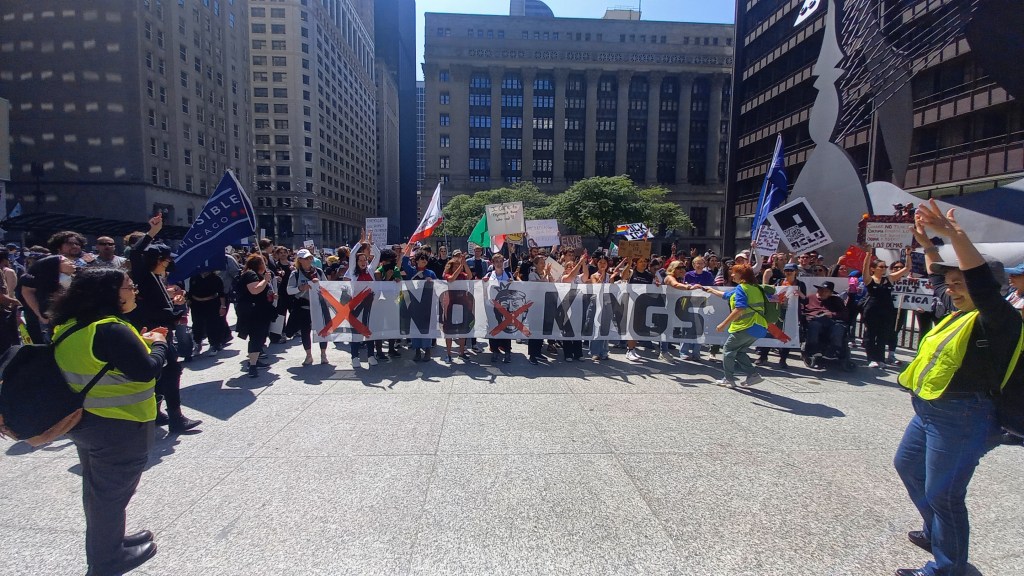
On October 18, 2025, No Kings Protests were staged across the country, drawing millions of Americans concerned about President Donald Trump’s abuses of power and infringements on the rule of law. Local organizers included the Service Employees International Union and the American Federation of Teachers, unions representing healthcare workers and educators, respectively. Union leaders cited several widespread grievances among their members, including hostile ICE raids, inflation and unaffordable healthcare and housing. By participating in the No Kings Protests, unions have been able to test mobilization efforts and work alongside the influential coalitions behind No Kings.
Labor leaders aim to recruit rank-and-file members to form the pillars of the movement. Unlike heads of past general strikes, the United Auto Workers and allied unions have social media at their disposal to amplify their message. Many unions participating in the No Kings Protests spread the word to their members on online platforms. One post on X by the Service International Employees Union, receiving 13,000 likes, commemorated the escalating turnout of the No Kings Protests. However, countermessaging against both the demonstrations and organized labor itself— including from voices in the Trump administration and Congress — has also proved rampant.
Prior to the No Kings Protests, Speaker Mike Johnson labeled them as the “Hate America Rally,” and suggested that participants would consist of “the pro-Hamas wing” and “the Antifa people.” Attorney General Pam Bondi claimed that No Kings protesters were bribed to participate and that the Department of Justice would “find and charge all of those people who are causing this chaos.” A 2028 general strike gives the Trump administration and its congressional allies a similar opportunity to portray striking workers as unruly dissidents, which could dissuade union members from attending the strike, even those sympathetic to the cause.
The Trump administration has taken substantial measures to undermine federal unions, issuing a series of executive orders between March and August 2025 prohibiting collective bargaining rights for more than one million federal workers. Collective bargaining, a key advantage of organized labor, allows workers to negotiate for better salaries, overtime pay, longer paid leave and more humane safety conditions. The Trump administration has overseen mass personnel cuts, laying off more than 50,000 federal workers in the first six months. Trump also terminated officials from the National Labor Relations Board, leaving only one member — rendering the board incapable of reaching a quorum. The board has historically served as an intermediary between the federal government and labor unions, investigating charges of wrongdoing and unfair labor practices.
The recent conclusion of the longest ever government shutdown means that back pay is set to be distributed to compensate for pay stoppages and layoffs of furloughed workers will be reversed. However, Trump was evasive when asked in October if he would denounce an Office of Management and Budget memo arguing for the denial of back pay for furloughed employees. Some union leaders contended that ending the shutdown sooner would warrant concessions on welfare programs. On October 27, Everett Kelly, president of the American Federal Government Employees union, called on Congress to pass the Republican-backed continuing resolution allowing for the expiration of Obamacare subsidies. Other unions took to the courts in an effort to prevent the firing of federal workers. On October 28, a San Francisco district judge issued an injunction preventing layoffs. However, more than 4,000 federal employees had already been terminated prior to the injunction.
Although Trump’s second-term approval rating is at an all-time low as of late November, he still holds sway over many in the working class. According to exit polls from the 2024 presidential election, Trump received 52% of votes cast by Americans earning between $30,000 and $49,999 in yearly income. Trump’s agenda of issuing tax cuts for the wealthy and undermining social welfare programs has had negative repercussions for union members, but supporters cite his no tax on tips policy and continuous messaging on economic issues. Of exit poll respondents who selected the economy as the focal point of the 2024 election, 81% voted for Trump. In order to mobilize the sizable bloc of working class Trump supporters in their ranks, union leaders will need to convince members that vying for benefits is worth defying the president.
Given the Trump administration’s dismantling of union protections, previous strikes have necessarily taken a defensive stance, advocating for stripped rights to be reinstated. However, the critical mass of people behind a general strike allows unions to go a step further and advocate for the expansion or restructuring of social welfare programs. In announcing that they would partake in the general strike, the American Federation of Teachers stated that “members and the broader society would benefit from national healthcare…debt forgiveness, [and] free college and child care for all.” Randi Weingarten, the president of the American Federation of Teachers, wrote back in 2019 that “there’s no reason government-sponsored health care can’t be one big part of [Democratic presidential candidates’] vision for America’s future.”
Under an administration that has repeatedly undermined social welfare programs, such visionary goals might seem inconceivable. At the same time, the very prospect of a general strike seems implausible; decades have passed since the previous one. The United Auto Workers undoubtedly have challenges to overcome, but they need look no further than last October for a model of high turnout and effective organizing. The No Kings Protests drew a crowd of nearly 7 million Americans, including many of the union members who Fain will hope to recruit.
Thus far, the tangible impact of demonstrations against the second Trump administration has been limited, but perhaps the traction of Fain’s movement will surpass the tipping point. According to research by political scientist Dr. Erica Chenoweth, at least 3.5% of the population must organize against the government to optimize the likelihood of success. This principle suggests that about 12 million workers would have to strike in 2028. Since the United Auto Workers only have 400,000 members, Fain will need to recruit more allies and convince workers that their individual participation will exert influence on corporations and the Trump administration, which is complicated by Trump’s strong backing among the working-class. Nevertheless — if the general strike goes to plan — Fain and his allies will possess more power to extract benefits for workers than any organized labor coalition for nearly a century.
The image featured in this article is licensed for reuse under the CC0 1.0 Universal Deed. No changes were made to the original image, which was taken by Wikimedia Commons and can be found here.
 The Gate

Leave a comment