Are ‘Foreign Agents’ Charges Convincing? Hungary’s New Opposition Suggests Otherwise
Hungarian Prime Minister Viktor Orbán appears to face a perpetual uphill battle against “the empire” of what he calls “liberal opinion-dictatorship.” From the impending disaster of Western liberalism, he vocally defends Hungary’s children, the nation and its Christian identity. As Orbán again warned in his year-ending speech in March, the danger specifically lies in “false-civil society” and “bought-off journalists,” who operate in Budapest, “serving foreign interests in plain sight.”
In his fourth consecutive term as Prime Minister, the dichotomy is clearer than ever. Orbán, and he alone, represents the Hungarian nation while anyone in opposition to his political party, FIDESZ, is necessarily the hostile envoy of Western liberalism. Or, as he puts it, Orbán knows “that the truth, unlike in Brussels, is on our side,” Brussels here representing the capital of Western liberal overreach. In even plainer words “the nation cannot be in opposition.” FIDESZ, of course, is the nation.
Orbán is not alone. The ‘foreign-agents’ charge has been tried and tested by populist leaders on the blueprint of Russia’s “foreign agents” law introduced in 2012 and continually utilized to cement Putin’s rule. The law, and others like it, targets, monitors and sanctions civil society organizations, critics and independent media, progressively forcing them out of the public sphere. Although FIDESZ made efforts to introduce similar legislation, their most direct step came on May 14, when they too proposed a draft based on the Russian model.
While much of Orbán’s starkly nationalist image lives in rhetoric, it upholds his political power for the fifteenth year and counting. Though it may seem exaggerated and outlandish, the charge of representing dangerous ‘foreign’ interests is the bedrock of FIDESZ propaganda that successfully discredited any viable opposition to Orbán for 15 years. Since their first electoral victory in 2010, FIDESZ governs with a two-thirds majority in the Hungarian Parliament, resecuring its supermajority every four years that no opposition party, until recently, was able to break.
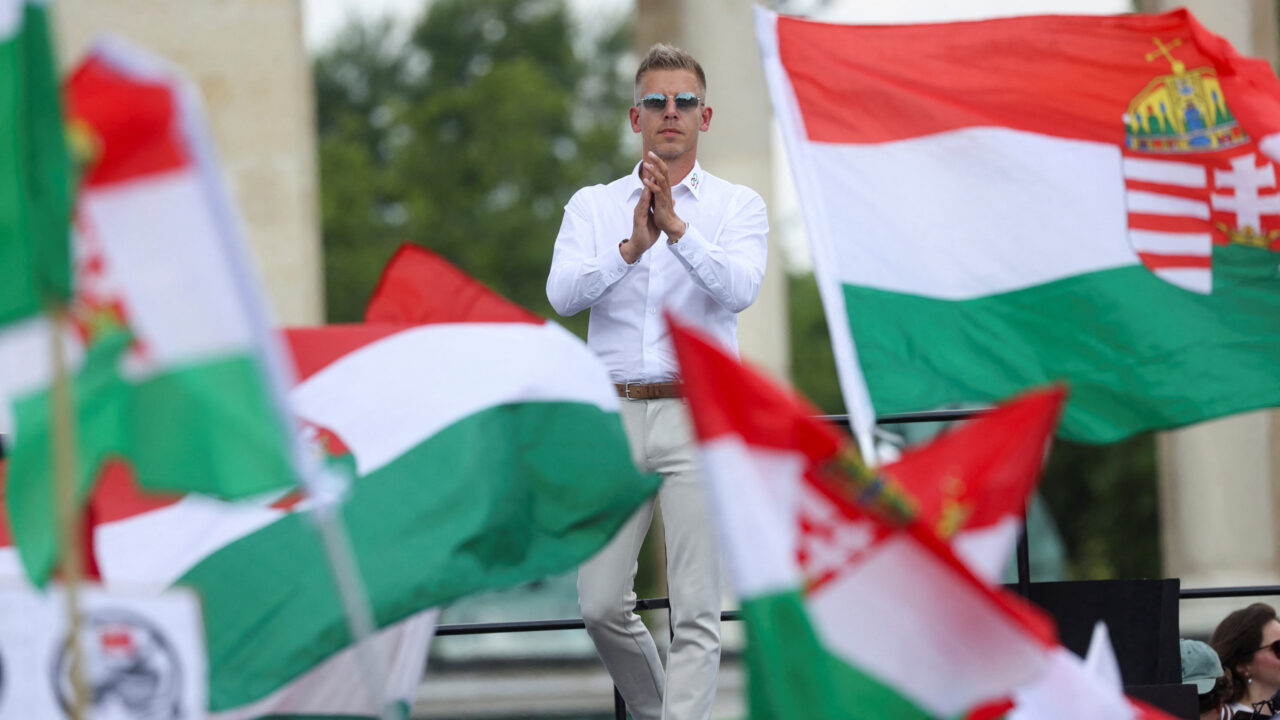
For the first time in 15 years, however, Orbán has a challenger who seems to emerge untouched from the charge of treason against the nation. Péter Magyar’s Tisza party, merely one year after its founding, is supported by 34% of the Hungarian population, a striking lead over FIDESZ’s 28% support. Tisza has a 21-point program. Most crucially, Péter Magyar highlights the most glaring issues at the center of Hungarians’ everyday lives. He promises to focus funding on education and healthcare, ban propaganda and bring EU funds back to Hungary. Notably, rather than distancing himself, Magyar also challenges Orbán’s talking points, vowing to introduce “real” reform to protect children, support medium and small businesses instead of multinational organizations and raise retirement and family benefits.
So why is it that Orbán’s propaganda apparatus fails again and again to entrap Péter Magyar?
It is possible that Magyar’s indisputable embrace of Hungarian nationalism and unwavering attention to Orbán’s dishonesty simply makes such claims implausible. Beyond pertinent policy priorities, Magyar has been touring the country since April of 2024, speaking to voters in 185 towns by June 5, 2024. In a Facebook Live speech he delivered over Facebook Live on New Year’s Eve, Magyar spoke individually to the people he met over the past year. He called attention to their concerns about the impossible cost of living, the appalling state of Hungarian orphanages and the dysfunctional state healthcare system. Importantly, he addressed Orbán directly, accusing his government of stealing, rather than supporting, the country. He spoke only to urgent, everyday issues and blamed FIDSZ’s leadership, which after 15 years of governing, Orbán could say little to refute.
Alternatively, Péter Magyar’s identity as a former FIDESZ ally not only lends him credibility as a disillusioned patriot but categorically distinguishes him from the long-established and discredited opposition. He first appeared on the political scene when he announced his withdrawal from three state-owned corporations, hours after his ex-wife Judit Varga resigned from Minister of Justice amidst a major government scandal. In his announcement, Magyar spoke harshly about the facade of nationalism projected by FIDESZ that hides rampant government corruption, a view that still remains at the core of his message. Being an undeniable former government insider, the charge of representing “foreign interests,” and being “George Soros’ (…) agents,” a charge that has easily stuck to past opposition figures, is both completely implausible and a failure of messaging from FIDESZ.
When the opposition refuses to be painted as foreign agents, Orbán’s own logical fallacy threatens to slip through. It is not simply “foreign influence” that he fights against, but that of the liberal empire. Donald Trump, for instance, as Orbán puts it, is a “fellow warrior” alongside whom Hungary as a nation has “well-played [its] part in changing the world.” Orbán’s words are always intentionally nationalistic and aim to establish Hungary as an equal amongst allies, but his rhetoric does little to mask the international nature of his Christian-nationalist struggle. He refers repeatedly to “the patriots,” his right-wing conservative allies across the EU, whom he appears in constant public dialogue with, not to mention his unwavering focus on “conquering Brussels.” So, when the opposition cannot be made foreign, the longstanding exclusively international focal point of Orbán’s rhetoric threatens to betray him.
Perhaps most importantly, Péter Magyar refuses to engage. Nowhere is this more apparent than in Orbán’s most recent move to ban Budapest Pride, the center of attention in his year-ending speech. Amidst a frenzy of media attention and sustained protests from opposition parties, Tisza maintains that the move is nothing but a “smokescreen” to divert attention from the poor quality of life of Hungarians and divide the finally united opposition. Though Magyar made clear that the right to assembly would be protected under his government, no Tisza representative has taken a stance on the ban, leaving government propaganda no basis for attack. Whatever the exact reason, it would seem that Péter Magyar has found a space between government-coopted patriotism and the unmasking of hypocrisy that resonates even with former FIDESZ voters, as many of them turn to Tisza. But even those currently protesting for the protection of Budapest Pride prioritize the bigger picture of national sovereignty as they are adamant that the ban serves simply to strip the fundamental right of assembly. Why Magyar, after 15 years of failed attempts by the old opposition, is succeeding in building a movement that truly spans the nation may not be simple to explain, though his strategic communication and stark commitment to nationalism may be a hint. It is clear that the spotlight on Orbán’s crimes and failures is one that resonates deeply with the Hungarian people attesting to the instability of the “foreign agents” charge amidst the erosion of people’s everyday quality of life. Whether Péter Magyar can indeed win an election against the regime Orbán meticulously built remains to be seen, and is far from certain. But his startling rise seems to be a semblance of hope, revealing the fragility of Hungary’s populist rule.
The image featured in this article was created by Bernadett Szabo in 2024 and can be accessed in its original form here.