
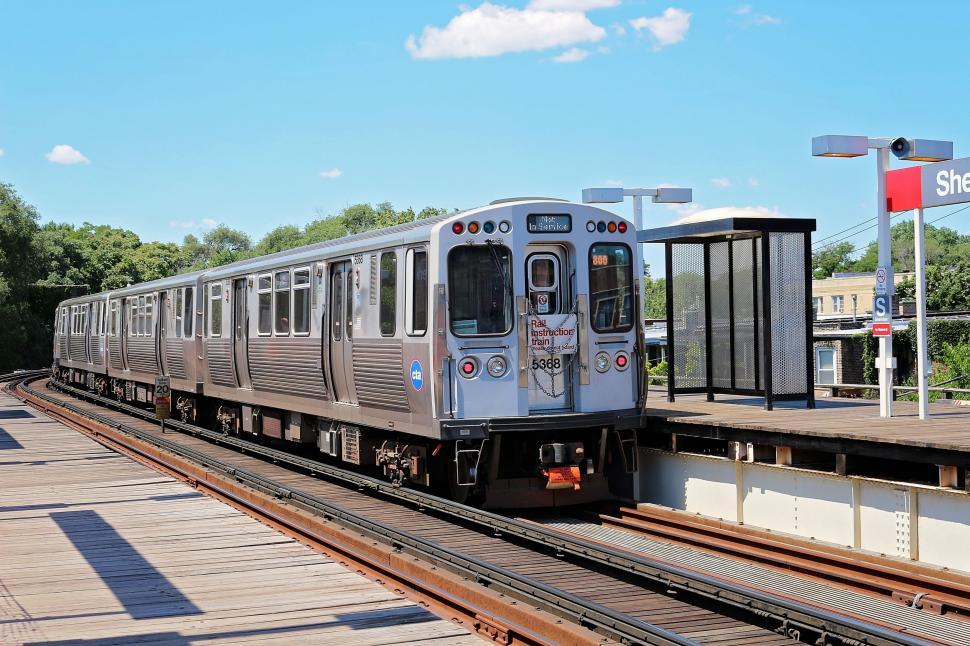
The CTA’s Red Line Extension Project Needs More Than Good Construction to Be Successful
The Chicago Transit Authority (CTA) is at a critical juncture. Ridership has only recovered to two-thirds of pre-pandemic levels. Violent crime on the system continues to be high. And the agency is hurtling toward a fiscal cliff of around $730 million annually when federal pandemic-relief funding runs out in early 2026. The Red Line Extension Project (RLE), fifty years in the making with an eye-popping budget of $5.6 billion, is expected to start construction at the end of this year.
The RLE, first proposed by Major Richard Daley in 1969, will extend the CTA’s Red Line five and a half miles further South. When the extension, which is projected to be completed in 2030, opens, the Red Line will directly connect people living as far South as 130th Street to the CTA’s train system. The extension expects to save far South Side commuters to the Loop up to thirty minutes in transit time.
Massive infrastructure projects like the RLE are most effective when they extend already successful systems. Without additional changes and improvements to the CTA, the system will be larger, but still unsafe and financially struggling. As the RLE is being constructed, the CTA will have to focus heavily on rebuilding its ridership, finances and system safety. Only with these structural changes will the RLE be most effective.
Chicago’s public transportation, namely the CTA and Metra systems, are critical to the city’s functioning. Around 25% of Chicago’s workforce commutes using public transportation, at least in part. Though CTA ridership numbers are hovering around 65% of their pre-pandemic levels, almost one million rides are taken on CTA bus and train lines every weekday.
In addition to lower ridership, the CTA has seen an increase in violent crime on its system since 2020. While the level of crime on the CTA has remained rather consistent over the last 25 years violent crime on the system has been much higher since the pandemic. In fact, violent crime on CTA systems has nearly doubled between 2019 and 2024.
The CTA emphasizes that safety is its foremost priority. Indeed, the agency has invested heavily in safety measures, particularly in the last five years, as violent crime rates on the system have increased. The CTA’s budget for security services has steadily increased in recent years, and the agency’s 2024 security services budget was $65.2 million. Much of the CTA’s safety funds go toward employing security personnel. The CTA partners with the Chicago Police Department (CPD) to provide officers to monitor its stations, buses and trains. CPD also provides K-9 units to several stations. In addition to its partnership with CPD, the CTA contracts around 300 unarmed security guards for its 145 stations.
But more money for safety measures does not necessarily mean a safer system. Though the increased security presence at CTA stations is noticeable—CTA train riders will now encounter both yellow-vested unarmed security guards and CPD K-9 units at about half of the stations—Illinois lawmakers have called into question the effectiveness of the increased security presence. In 2023, Alderman Brendan Riley expressed disappointment with the CTA on X after a video was shared of a security guard smoking on the CTA platform. State Senator Ram Villivalam, who chairs the Senate Transportation Assembly, suggested that CTA safety spending could be better coordinated.
Increasing the security presence on its systems is not the only change the CTA has recently made. In August of 2024, the CTA began using the technology system ZeroEyes to detect brandished firearms on its systems. The technology uses the CTA’s camera networks and computer vision to detect firearms on the system and alert law enforcement. ZeroEyes obtained a 12-month, $200,000 contract, and the technology will be reviewed in August 2025 for a possible contract extension.
But, even with the CTA’s considerable investment into safety on its systems, major crimes still occur, threatening the safety of the entire system. In September, a quadruple homicide on the Blue Line prompted many lawmakers to voice their concerns about safety on Illinois public transit. State Representative Eva-Dina Delgado, who used to work for the CTA, argued that increased investment in CTA safety did not necessarily mean that the Authority would see better results. Improved safety, she said, is “not always connected to how much money you’re spending, but it is connected to the effectiveness” of the initiatives.
Effective investment, particularly in safety initiatives, is paramount for the CTA as it faces its impending fiscal cliff at the beginning of next year. If public transportation is unsafe, or perceived as unsafe, ridership will continue to decrease, further hurting the system by reducing fare revenue. A lack of funds and ridership will result in reduced schedules, which will erode the effectiveness of public transportation in Chicago. Expensive, major extension projects, like the RLE, are both less useful and less justifiable on such a stunted system.
The future is not utterly bleak, though. The CTA will continue to adapt the use of safety personnel—police and privately contracted—on its systems. Hopefully, the impending review of ZeroEyes will find the technology useful. The authority is also continuing to improve the safety of train stations by installing additional security cameras and improving the lighting.
And, the CTA is hardly alone in dealing with the issues plaguing its system. Senator Villivalam and Illinois State Representative Kam Buckner are sponsoring the Metropolitan Mobility Authority Act, which would merge Chicago’s three transit entities: the CTA, Metra, and Pace. The bill proposes to improve the coordination of Chicago’s public transportation and improve usability. By making the system more accessible, Chicago lawmakers hope to increase ridership.
Chicago is not the only city facing public transportation safety and revenue issues. After a string of violent crimes on New York’s subway system (MTA) earlier this year—including a woman being set on fire—New York’s Governor, Kathy Hochul, majorly increased police presence on the MTA. The MTA also faces a large budget deficit as federal relief funding from the pandemic runs out in the next year. Like the CTA, the MTA is also completing expensive extension projects, such as Phase 2 of the Second Avenue Subway. Concerns with safe and effective public transportation are nationwide and universally critical.
The effective implementation of the RLE and similar projects is critical for the future health of cities. As people are increasingly less likely to move to city centers and instead settle in suburban areas or even further flung “exurbs,” public transportation that reaches ever-further outside city centers is becoming more necessary. To prevent even longer car-commutes for workers and the further congestion of cities, public transportation extension projects must be robustly supported. This support starts with ensuring our public transportation systems are safe for all users. For the six billion dollar RLE to be as successful as possible, the CTA will have to continue to look into how to invest more effectively in system safety.
The image featured in this article is licensed for reuse under the Attribution-ShareAlike 2.0 Generic license. No changes were made to the original image, which was taken by Unsplash and can be found here.