This January marks the inauguration of the 47th president of the United States of America Donald J. Trump. As soon as our president was handed a pen, a flurry of executive orders came from his desk with the topics ranging from granting clemency to Jan. 6 defendants to an attempt to remove birthright citizenship. Alongside executive orders holding tangible impact several others only served to change the names and terminology such as federally recognizing two genders or the renaming of Mount Denali. These executive orders from Trump come accompanied with an abundance of proposed legislation and rhetoric from the far-right attempting to control the narrative around progressive social issues. These actions seem to be a herald of the new cultural agenda of the far-right. As Donald Trump exclaimed, “There’s never been anything like it!” and indeed this new approach seems to have no comparison in American history. But this narrative isn’t particularly correct; the truth is Trump and the modern far-right’s current policies and rhetoric have all been borrowed from America’s past. From Great Depression era deportation drives to 2003’s renaming of the French Fry, nothing here is being pioneered. Trump has decided to stoke a cultural fire, and to accomplish that purpose, he is invoking the American nationalist movements of yesterday.
The War on Woke
As “First Friend” Elon Musk beautifully phrased, there is an ongoing battle between the American right and the Woke mind virus. This sentiment is shared by several of America’s right wing with Florida Governor Ronald DeSantis and Vivek Ramaswamy penning the book Woke Inc.:Inside Corporate America’s Social Justice Scam. If you’re confused about what the word “Woke” means, you’re not alone. Originally “Woke” was a term used by civil rights leaders to describe those who were aware of social injustices. Today, the term is most often used as a pejorative by the American right to denounce progressive social movements. This has culminated in attacks against LGBT groups and DEI initiatives, and even resulted in several national monuments being renamed. Essentially, the right’s war on woke is an attack on progressive cultural values and a crusade hoping to bring back America’s glorious, pre-woke past.It’s clear that the right is attempting to turn back the cultural clock to combat “woke ideology”.
The Language of Nationalism
In his first weeks as President, Trump has already renamed several national monuments and even, the Gulf of Mexico. Why is the Gulf of Mexico being renamed? Why is Mount Denali being renamed McKinley? In doing so, Trump is adhering to a well-worn playbook. Whenever America wants to stoke a nationalist fire, we start playing funny with names. For example, after France condemned George Bush’s 2003 invasion of Iraq, a tsunami of Francophobia surged through Washington. French fries became Freedom Fries. French Mustard was forced to release a statement “The only thing French about French’s Mustard is the name.” This trend of renaming the foreign cultural items also occurred during WW1. Several German names including sauerkraut and German Measles were renamed “liberty cabbage” and “liberty measles”. When America enters a period of cultural warfare, the first shots are usually fired at the English language. So when Donald Trump renames the Gulf of Mexico and Mount Denali, he is legislating yet another attack in the vicious American cultural war.
The War on the Woke Classroom
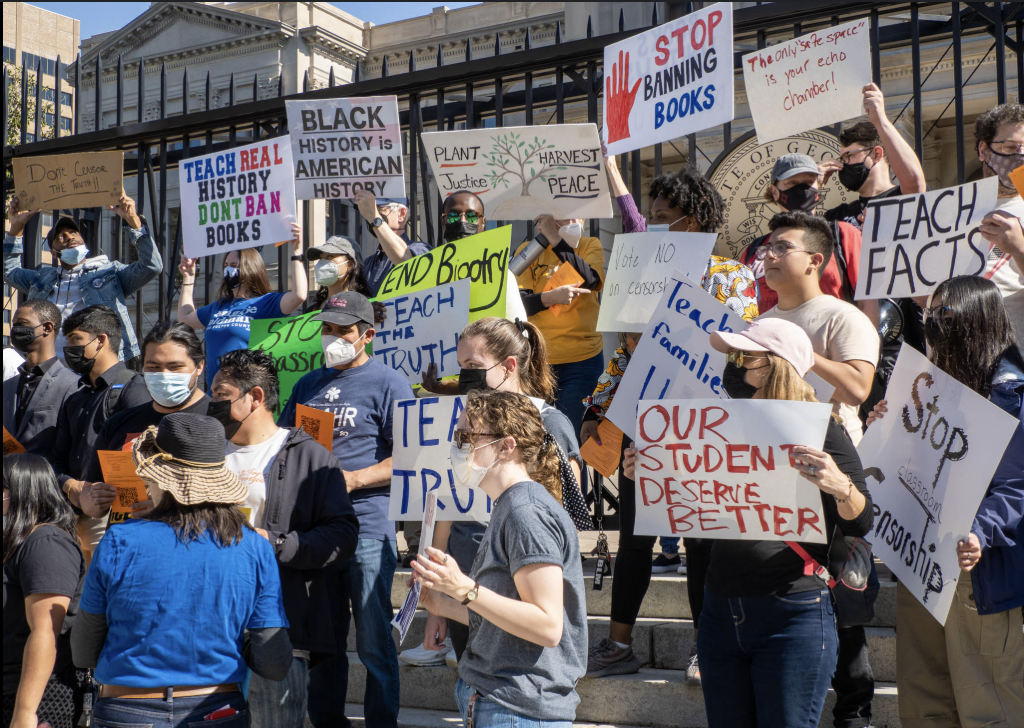
The right has opened up another front in the culture war: the classroom. Fall 2023 has seen a record number of book bannings, with “woke” books coming under especially heavy fire. Educational gag orders have been placed on ostensibly “liberal” subjects, like race and LGBTQ issues. Many on the right argue exposure to these ideas violates religious freedoms, citing religious protections. Just like renaming monuments, the right has attacked education before. Book bannings are as American as apple pie. During the 1950s, the government cracked down hard on anything with even the faintest aroma of communism or leftism. Classic titles like, John Steinbeck’s Grapes of Wrath, or Ray Bradbury’s Fahrenheit 451, were censored or removed from school and library shelves. Illinois alone banned more than 400 titles. During the Satanic Panic of the 1980s, the roleplaying game Dungeons and Dragons was deemed “occult” and accused of encouraging “violence and self harm”. As recently as 2001-2002 JK Rowling’s Harry Potter was among the most banned books. Even today school boards in Texas have considered limiting the teaching of evolution. Historically schools are some of the first places that are targeted when the right wing has sought to stunt cultural progress.
Anti-Immigration becoming the Norm
Another worrying cultural shift within the right wing is the dehumanization and deportation of immigrants. Although anti-immigrant sentiment was one of the foundations of Trump’s first two campaigns, he has ramped it up a notch this time around. Donald Trump’s 2024 campaign claimed Haitian migrants in Springfield were eating cats and dogs and suggested that undocumented immigrants were “poisoning the blood of our country”. This rhetoric has opened the legislative floodgates. Republicans are now attempting to end birthright citizenship and protection for immigrants and waves of deportations. Beyond that, the right has begun to adopt these terms in their political messaging and campaign ads. Trumpist politicians are toeing the party line, attacking illegal immigrants as “invaders.” Naturally, the Democrats are the brains behind the entire operation — Kari Lake and Ted Cruz apparently believe the Biden Administration intentionally unleashed a “Bidenvasion”. There’s a clear theme here: the right wants to convince voters that we don’t just have an immigration problem but are under attack. Republicans asserted that foreign governments, the Democrats, the mainstream media, and, surely, Joe Biden opened the back door and let in our enemies. As usual this rhetoric isn’t new; it goes all the way back to the Chinese Exclusion Act of 1870. In response to growing railroad-induced Chinese immigration, anti-immigrant sentiment skyrocketed. Like today, many Americans believed they were facing a sophisticated, foreign assault against the very fabric of their country. The San Francisco Chronicle famously declared, “THE CHINESE INVASION: They are Coming! 900,000 Strong.” Across the country, anti-Chinese violence increased as roving bands of racists took it upon themselves to defend American identity. Congress followed suit with the Chinese Exclusion Act, which prohibited any further immigration from China. Although modern anti-Chinese xenophobia has an element of great power conflict, the xenophobic language used yesterday still hangs on.
Mexican immigrants have been specifically targeted in the not-so-distant past, a fact that echoes in the present moment. The Great Depression sparked vicious anti-Mexican sentiment. Presidents Hoover and Roosevelt removed 2 million people from California — many of them U.S. citizens. After the Second World War, President Truman launched “Operation Wetback” and deported 1 million people, declaring mass immigration was “virtually an invasion.” Doesn’t that sound familiar? In fact, besides borrowing the “invasion” terminology, Donald Trump has expressed direct public support for these “Wetback” deportation efforts stating, “Moved them way south; they never came back.” If one thing is clear, the modern xenophobic push by the right is by no means an original movement; the tactics and terminology are all borrowed from the xenophobes of yesteryear.
Ramifications
The rampant xenophobia among the American right isn’t a unique product of our time. It is a natural, American reaction to runaway progressivism. What Donald Trump and other right wing legislators are doing and what they’ve accomplished is scary, and it does have negative ramifications on America as a whole. In just his first few months, President Trump has ramped up “the war on woke” and used his executive orders to reshape federal government language and policy. Even before Trump’s presidency, the right was caught up in an enormous fiesta of book burning and anti-immigrant sentiment. The Florida state legislature passed the infamous “Don’t Say Gay” bill and then sat back to watch the homophobic tide roll in. Fear of an invasion by Hispanic immigrants has motivated at least one mass shooting.
However, if you’re looking for some hope, historically these movements always sputter out. Nobody in the US calls sauerkraut “freedom cabbage” and french fries are still, at least in name, French. The book bannings were all repealed at some point and Harry Potter is still the best selling book series in history. The removal of Mexican immigrants in the 1930s “reduced employment and occupational downgrading for US natives” and did little to prevent illegal immigration from rising again in the future. Although executive orders and legislation attempt to remove the progressive elements of our American culture and put the “woke” back to sleep, historical precedent stands against them. So expect more of this for the next four years, but remember that the progressive values of yesterday are mainstream today.
Image licensed under Attribution-ShareAlike 2.0 Generic (CC BY-SA 2.0)
 The Gate
Leave a comment