
The Tories Can’t Reclaim the Right
“The hustings are over, the bunting is down, the mad hysteria is at an end.” Blackadder’s take on 18th-century democracy — a spectacle typically decided by “three rather mingy cows, a dachshund named Colin, a hen in its late forties…and one voter”—is still hardly distinguishable from a Tory leadership election in the United Kingdom.
Following Labour’s landslide victory in the July 2024 general election, which reduced the Conservatives to a historic low of 121 seats, Prime Minister Rishi Sunak resigned. This prompted yet another party leadership contest.
Despite 14 years of consecutive Conservative rule, the party cycled through five leaders, none of whom managed to satisfy both the public and their parliamentary colleagues.
Keeping the caucus happy goes hand-in-hand with polling and public opinion. Conservatives in marginal seats, when pressured, are quick to abandon their preference for gradual change and will topple anything they can, even pushing for rule changes to remove leaders regularly. This inevitably happened to Boris Johnson, who was unceremoniously deposed in 2022 for transforming Downing Street into a frat house during COVID lockdowns. His short-lived successor, Liz Truss, was also met with opposition. Voters did not appreciate her valiant efforts to tank the pound, jack up mortgage costs, and send the gilt market into freefall with a mini-budget that ghosted the advice of the Tory-made Office for Budget Responsibility (OBR). Within weeks, Truss dragged the Conservatives from a 12-point polling deficit behind Labour to a historic 36 points.
British politicians have often pointed fingers at the so-called “blob” or “deep state” embedded within government to excuse their failures. Liz Truss, in true ex-Liberal Democrat revolutionary fashion, deflected blame for her economic illiteracy onto the Bank of England.
While government inefficiency is undoubtedly a factor, failures in leadership are equally symptomatic of politicians’ disinterest in leading. In a recent interview, Dominic Cummings, Boris Johnson’s former Downing Street Chief of Staff, described the dysfunction within government, citing his former boss’s astonishment at the idea that he could reject proposals from the Civil Service. Cummings also revealed that Nadhim Zahawi, while serving as a cabinet minister, admitted to him that he had not read a legislative proposal before putting it to a parliamentary vote—a proposal that would have undone much of his party’s previous reforms. The baffling nature of cabinet meetings themselves, which consist largely of scripted statements drafted by civil servants, underpins the superficiality of decision-making at the highest levels of government, where genuine debate and critical analysis are often absent.
Criticisms of the system may be well-founded, but they do not excuse the fact that the Conservative Party’s constitution has propelled defeatist and talentless individuals into its leadership. Prior to 1998, the party limited leadership selection to its parliamentary caucus, either through informal consultations or, since 1965, a series of confidential ballots. However, this changed under William Hague, who introduced reforms giving the broader membership the final say on the party’s leader. Under this system, the caucus narrows the field to two candidates, but the ultimate decision rests with a membership base far removed from the complexities of parliamentary dynamics and electoral strategy.
Traditionally, the parliamentary party’s split between moderate One Nation conservatives and hardline Thatcherites has yielded two finalists representing those opposing factions. The party membership, holding the deciding vote, predominantly consists of its most stereotypically reliable base—voters who often favour the candidate most devoted to emulating Thatcher in rhetoric and appearance.
This certainly allowed Truss to win against Sunak in 2022, as tax-cutting slogans and awkward photo-ops of one wearing a bearskin hat in Red Square are what apparently qualifies one to be leader.
The recent election of Kemi Badenoch on November 2, 2024 as the newest Conservative leader was no different. Her platform of “Renewal” offered not a single policy, confirmed her clear disinterest in becoming Prime Minister and featured a vague promise of “unity.” Her quick wit has certainly been praised by the usual suspects—right-wing tabloids who will gladly celebrate her mere presence, as long as their board members continue to receive peerages. Moreover, her shadow cabinet reshuffle marked the noticeable exit of prominent centre-right figures like James Cleverly, former Shadow Home Secretary and Jeremy Hunt, former Shadow Chancellor. Both had publicly ruled out serving under Badenoch or her opponent, Robert Jenrick, whom she appointed as Shadow Justice Secretary.
By limiting the choice of leader to a narrow demographic, the Tories are inherently disinclined to win the support of independents and center-leaning voters who actually determine the results of general elections. The Liberal Democrats picked up 64 seats in centrist Tory areas in the last general election, while Nigel Farage’s Reform UK won five seats and drew in disaffected right-wing voters, often costing the Tories crucial wins.
Of course, it’s entirely reasonable for a party to seek to energize its base, and campaigns naturally lean toward crafting a narrative that resonates rather than delving into the dull mechanics of policy implementation. However, the dilemma arises when the politicians most skilled at this type of performative politics prove to be proficient only at that. They excel at telling people what they want to hear but consistently fall short when it comes to delivering on those promises.
Badenoch’s leadership thus far has been emblematic of this dilemma. Reports of her instructing her cabinet not to expect policies for the next two years, combined with a reliance on empty gestures like a performative vote on grooming gangs tied to unrelated legislation, suggest an absence of real ambition or direction.
One could interpret Badenoch’s approach as a counter strategy to her predecessor Sunak’s failed attempt to “out-reform” Reform by courting the right with a conscription plan while simultaneously pursuing more left-leaning policies, such as a smoking ban. This contradictory balancing act ultimately backfired, managing to alienate both sides and leaving Sunak without a solid base of support.
But abstaining from decision-making is not some masterstroke to win back support—it’s a white flag of surrender, one that both voters and Tory Members of Parliament (MPs) recognize as a sign of weakness. Far from demonstrating leadership, it only highlights an unwillingness to confront the hard choices needed to rebuild the party’s credibility.
Reform has by no means real long-term viability, operating more as a de facto company directly owned by Nigel Farage and the party’s chairman, Richard Tice, who bankrolled the majority of its activities. With its minimal presence in the House of Commons, the party retains its role as little more than a political commentator—there to react to events rather than offer a concrete, sustainable alternative.
Badenoch, as Leader of the Opposition, mistakenly sees this equally as her job. She has been quick to deride Prime Minister Sir Keir Starmer and Foreign Secretary David Lammy as “student politicians” or call the PM “a lawyer, not a leader.” That may gain her some tributes in the form of TikTok edits, but beyond that it’s baffling that she trusts her present leadership is succeeding at peeling back support from Starmer’s Labour.
Despite the perception of Labour’s unshakable dominance, with a supermajority of 411/650 seats, there are cracks in its foundation — internal revolts and self-inflicted wounds — that can be exploited by the Opposition. Starmer’s disgruntled socialist ex-boss, Jeremy Corbyn, has pinched a few of his left-wing members to form an anti-Israel faction, a backbencher has assaulted his own constituent for enquiring about his views, and 52 MPs abstained on a controversial government motion to cut winter fuel payments.
The PM’s own frontbench has faced personal criticism for using party funds to expand Lady Starmer’s wardrobe and to buy VIP tickets to Taylor Swift concerts. Policy-wise, they have been admonished for prosecuting citizens for online posts, imposing VAT on private schools, and promising to abolish the House of Lords while simultaneously planning to stack it with their own people.
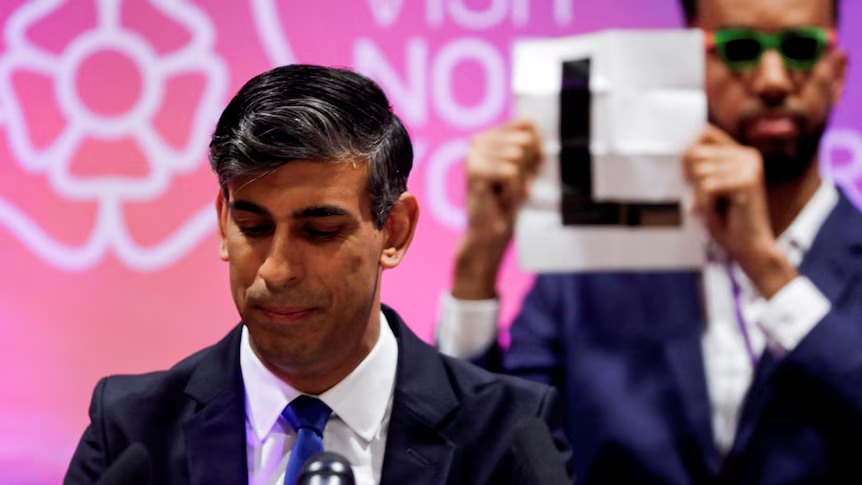
In his last speech as Tory leader, Rishi Sunak hit out at Labour’s new Budget, which sees the Treasury crank up taxes by a whopping £40 billion to tackle an illusory £22 billion black-hole in the public finances, which the OBR has claimed there is no proof of even existing.
Since his appointment in July, Starmer’s approval ratings have dropped 49 points. If recent polling is correct, nine senior cabinet ministers could lose their seats to independents and others in the next election.
And yet, despite these circumstances, Badenoch’s Conservatives have seen such a significant drop in polling that Reform is now on the verge of being more popular than both the Tories and Labour.
With no clear path for the Tories to regain power in sight, the only viable solution may be the coronation of a new leader by the parliamentary party—a scenario that ultimately led Rishi Sunak to Downing Street. Ironically, some now speculate that Sunak could be called upon again to lead, should the party find itself in desperate need of stability and a shift in direction. Whatever happens, the Conservative Party faces a critical crossroads, and only a decisive, unified leadership can chart a path back to relevance.
Image from Reuters, Temilade Adelaja.