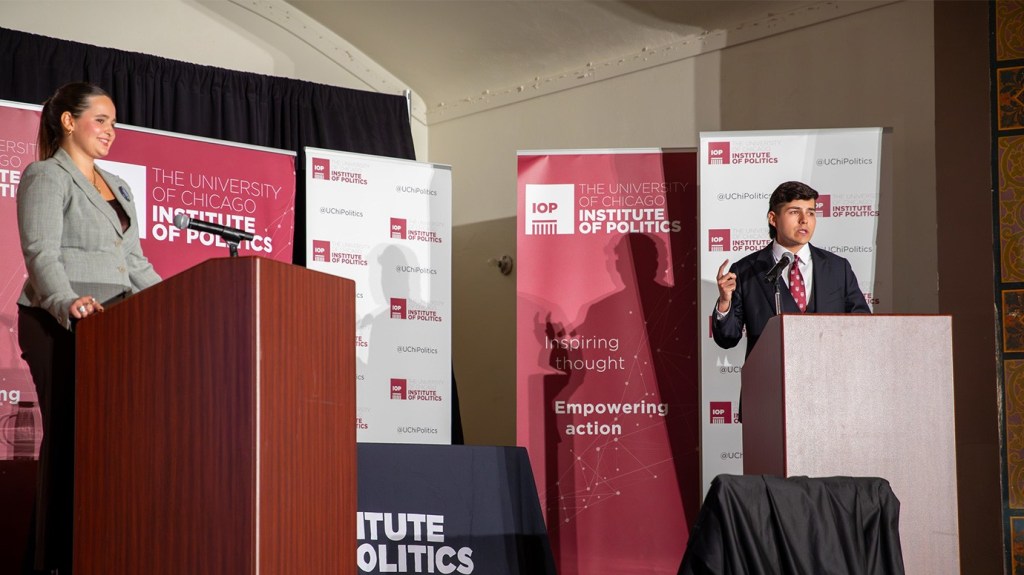
When the debates for the Presidency are characterized by personal attacks and vitriol, it is hard to expect arguments across the dinner table to be any better. The results of the 2024 election may be clear, but the polarization of our society certainly remains. To get insight into what makes a good political debate, I asked Kate Davis, one of the co-presidents of UC Dems, and Christopher Philips, the president of College Republicans, about debating in America. The two are no strangers to debates on political issues having met on the debate stage shortly before the election themselves to discuss what policies are best suited for young voters. Throughout both interviews, it became clear that they were divided on major issues.
The first major division was about dissatisfaction with the media. In reference to the mainstream media, Philips stated “everyone knows they’re biased,” mirroring the 69% of Americans with not very much trust in the media. Trust in the media impacts people’s view on fact checking, both regarding its necessity and its bias within the context of a national debate. On that topic, Philips stated that, “What [the media] calls fact checking is actually biased argumentation for one side.”
Davis held a different opinion, stating that “People conducting [debates] have a responsibility to at least correct egregious lies since they are broadcasting it to the public.” The difference between the two views on fact checking means any political debate starts before the first question is even asked. Whether or not fact checking should be allowed and what constitutes fact checking reached its way into both the Presidential and Vice-Presidential debates with JD Vance, the Republican Vice-President elect, stating “the rules were you guys weren’t going to fact check.”
The next major point of division was about harsh rhetoric in the current political climate. Philips stated that “I see a trend towards hate, a trend towards vitriol from Harris.” Philips then went on to comment “She will yell she will get angry. I saw a video, it looked like Mussolini to be honest,” in reference to Harris rallies. Philips heavily blamed the Democratic Party for the trend of hate and harsh rhetoric within the political climate.
Davis disagreed with this characterization, saying that even in the wake of an “awful” assassination attempt, Trump “swayed from the messaging of issues and unity and went on to be his old nasty self.” Davis viewed this divide and political vitriol as harmful to the American people stating that “people are just tired of the hostility and at the end of the day most Americans just don’t really give a shit. They just want to be able to pay for their groceries, send their kids to a nice school, live in a home that they can afford, and have a job that gives them a fair salary and wage. Their needs are not crazy. And a lot of Americans are tired of not having those needs met.” She went on to explain that the divisive language can cause people to “want to turn off the TV and disengage.”
Philips spoke about how US political parties have another divide, that of gender. He said that “the Democratic party really is a party with an aversion to not just super macho men but really men with even a basic level of masculinity.” He attributed this to “the ideological excess that has been promoted by the Democrats in regards to frankly anti-masculine attitudes. You just don’t have a place for men, especially young men, in your party anymore.” Philips contrasted this view of the Democratic party with JD Vance, who he said had a “mission to bring people into the fold,” and targeted female voters who “probably view [Trump] as someone who is not for them.”
Another divide also formed while talking to Philips and Davis, specifically about who is more undemocratic. Philips stated that Harris’ policies are “socialist and communist policies in disguise.” Davis instead said “most democracies have shown throughout history there is a limit, there is a ticking clock. That we’re doing this sounds kind of cheesy, but there is the grand American experiment of trying to have a functioning democracy and in many ways we are a model for the rest of the world, and it really really scares me both Trump and Vance continuously say that they will not except the results of the election if they do not win.”
Debate culture in America is full of division. Divisions on the role of media, where hate is found, gender, and what is considered democratic. When policy leaders are deeply divided it is expected that their divisions will seep into the lives of everyday Americans. Philips’ and Davis’s points of view demonstrate how split people in America currently are. This divide can be found on the Presidential debate stage all the way to the dinner table where families face a divided America.
The image used in this article belongs to the UChicago Institute of Politics
 The Gate
Leave a comment