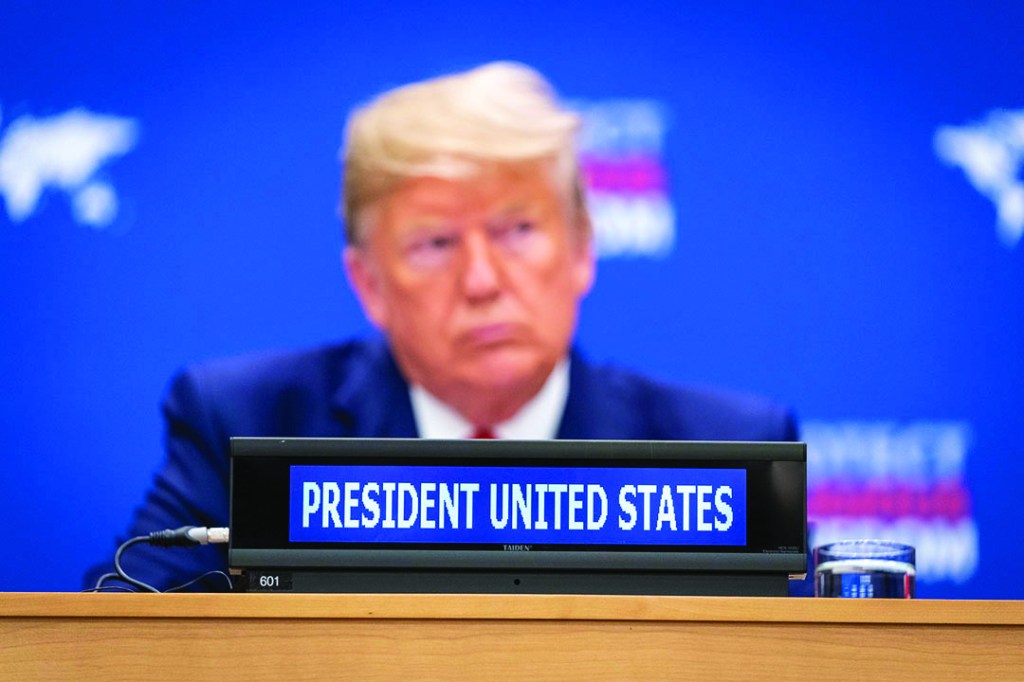
Almost a decade after his first fateful candidacy, President-elect Donald Trump has seldom left the headlines. Indeed, many young Americans entering the political arena for the first time can barely remember a Republican Party before Trump. Walk onto any college campus — how many students would recognize Reform, Prosperity, and Peace before Make America Great Again?
Trump was reelected for a second term in November with 312 electoral votes, meaning he won’t exit the political scene until at least 2028. Many Americans are left, then, wondering what the future holds for the Republican party. Will it ever be the party of Reagan again? Or will it forever be centered around the “MAGA” coalition that has delivered Trump the spotlight for the eighth year running?
“Pre-Trump” Republicanism
Before Trump’s 2016 campaign, moderate fiscal conservatives like John McCain and Mitt Romney were the leaders of the Republican Party. As self-proclaimed champions of ‘common sense,’ Republicans presented themselves as steadfast advocates for the working class, returning to a more ‘traditional’ way of life in response to the rapidly changing 21st century.
The economy, like today, remained a top issue for voters in the early 2000s. Both McCain’s 2008 campaign and Romney’s 2012 campaign advocated for limited government intervention in the economy, believing that environmental or societal regulations like those Democrats proposed would pose an undue burden to businesses. Rather, they supported giving businesses the freedom to innovate and compete; this, in their view, would naturally lead to more socially optimal practices without lowering profits.
Issues such as same-sex marriage, gun rights and abortion access emerged to the forefront of the political conversation as the 21st century took shape, and Republicans campaigned on conservative stances on each of those issues. They strived to pass the Defense of Marriage Act, which would classify marriage as a union between a man and a woman, largely opposed new restrictions on gun ownership and pushed to outlaw abortion except for in cases of rape, incest, and life of the mother.
Republican voters were also overwhelmingly white voters without a college degree, representing 68% of the Republican coalition in 1996. The ‘Religious Right,’ made up of largely white evangelical voters, also represented a large part of the base and was the main voice behind socially conservative stances concerning gay marriage and abortion. A rural-urban divide was also present: by 2010, almost 57% of rural voters leaned Republican.
What stands out from this era of American politics, far more than tax policies or voter demographics, is the attitude with which the candidates treated each other. Following the 2024 Biden-Trump presidential debate, where taunts and vitriol were exchanged without a second thought, a resurgence of clips of the 2008 and 2012 dominated social media platforms like TikTok and Instagram. Americans shared clips of Romney congratulating Barack Obama on his 20th wedding anniversary and of McCain defending Obama’s character from an audience member by calling him a “decent family man” that he “just happens to have disagreements with,” an almost alien statement in today’s political climate.
Trump’s (New?) Republican Party
At first glance, the 2024 Republican Platform appears to represent a continuation of Republican ideals of the past. The document is titled “a return to common sense,” and it focuses on many of the same issues that the 2008 and 2012 platforms did — lower taxes, fewer regulations on business and peace through strength that puts American objectives first.
Some stark contrasts quickly emerge, however. Immediately obvious is a sharp departure from that professional, unifying attitude that conservatives of the early 2000s championed. Throughout the 2024 Republican platform, most faults in the system are attributed to the “Democrats,” the “Radical Left” or “Leftwing propaganda,” instead of simply the “current Administration” as mentioned by Romney’s platform. Evidently, this inflammatory rhetoric is being weaved into the core fabric of the Republican Party, not just an extremist extension of a more moderate base.
Many of the same issues present in both the old and the new platforms have become similarly intensified. In 2024, Republicans again advocated for limited government intervention in business but phrased it as an “end [to the] Democrats’ regulatory onslaught” where they will “DRILL, BABY, DRILL” until the U.S. becomes “energy dominant” — same ideas, but written with incendiary language designed to spark opposition.
Immigration and the border have been the main social issues of Trump’s 2024 campaign. Audience members at the RNC could be seen wielding signs that said “Mass Deportation Now!,” and the 2024 platform pledges to “keep foreign Christian-hating Communists, Marxists, and Socialists out of America” — a stark contrast to the 2012 platform that claims that immigrants’ “industry and commitment to American values strengthens our economy” and “enriches our culture.” Republicans have traditionally campaigned on strong and secure borders, but absent was this overtly nationalistic sense of ‘othering’ that seems to be central to the MAGA argument.
The Next Great Party Restructuring
Are these changes evidence that America is undergoing another ‘Great Party Restructuring’ like that of the 1960s and 70s? In stark contrast to our conception of the two parties today, liberalism was ascribed to Republicans and conservatism to Democrats throughout the 20th century. In the face of the controversy of the civil rights movement, however, liberal Democrats joined with liberal Republicans to forge a new identity around combating social injustice, while opponents to desegregation formed a coalition around economic issues more pressing to white, working-class voters. The former became the new Democratic Party, while the latter constituted the new Republican party.
What is most noteworthy about current changes in party loyalty is that they are not shifting around any specific issue like segregation or civil rights. Instead, they’re shifting around Trump himself. Harris spent most of her albeit short 2024 campaign targeting moderate Republicans, trying to be the voice of “common sense” reminiscent of McCain and Romney. In some ways, it worked. She snagged endorsements from prominent Republicans such as Liz Cheney and Adam Kinzinger, and an outspoken minority of ‘never Trump’ Republicans advocated for defeating Trump as the only way to protect the integrity of the Republican Party. Will Democrats pull away more of this coalition in 2026 and 2028, creating new party identities around support or opposition to MAGAism?
Trump, on the other hand, was able to siphon away Black and Latino voters that usually swing Democratic, perhaps representing a more racially diverse Republican party than America has ever seen before. His 2024 coalition was again overwhelmingly white and rural, but he received 43% of the Latino vote and 16% of the Black vote. Perhaps this shift is a blip in an otherwise stable party demographic, but it could also be a signal that voters are tired of identity politics and are coalescing around different issues than those of the 1960s and 70s.
Is there any desire to go back to the status quo? Christopher Phillips, president of UChicago’s College Republicans, thinks that the number of Republicans who want to return to a pre-Trump party is quite small. He views Cheney and Kinzinger as “traitors” to a party that is overwhelmingly in the Trump camp and predicts future frontrunners of the party to be figures like Florida Governor Ron Desantis or Vice President-Elect JD Vance, overtly MAGA figures. Phillips goes as far as to claim that, with Trump’s victory in November, the party will remain Trump’s party “for at least 20 years.”
On this crucial precipice in the immediate aftermath of the election, Americans are now grappling with the fateful choice to give Donald Trump another four years in the White House. On both sides of the aisle, voters recognize the immense impact Trump has had on the American political scene and the indisputable fact that his messaging will reverberate throughout American culture for years to come. Are we heading towards a future where the Republican Party as we know it prevails, and the moderate Republican base once again takes the reins? Or is that old guard defeated for good, clearing the way for Trump, his allies, and his heirs to define American politics in the 21st century? The answer to that question remains anxiously unclear.
The image featured in this article is licensed for reuse under the CC0 1.0 Universal license. No changes were made to the original image, which was taken by rawpixel.com and can be found here.
 The Gate
Leave a comment