
Refugee Integration in Berlin: A Nation at Odds with Itself
This article was originally written by: Alexandra C. Price
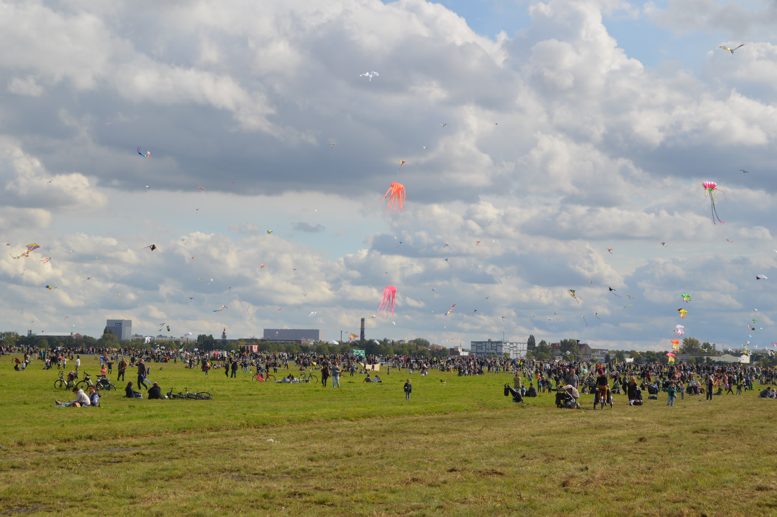
Walking onto the Tempelhofer Feld, it is easy to understand why the park has become one of Berlin’s most beloved green spaces. Teens speed down the former runways of the abandoned airport on skateboards and bicycles, couples picnic on the wide field, and high above—where airplanes once rose into the sky—kites soar in their place. Today, a kite festival has brought Berliners out of their respective neighborhoods and to the historic landscape of Tempelhof.
But
amidst all the revelry, Tempelhof also serves as the backdrop for an
increasingly contentious social debate: how to integrate the hundreds of
thousands of refugees who have arrived in Germany since 2015, when Chancellor
Angela Merkel opened German borders to refugees of the Syrian Civil War. That
year, the distinction of “largest refugee camp in Germany” was added to
Tempelhof’s extensive repertoire, raising the question: how did the Tempelhofer
Feld’s role as a communal green space in Berlin contribute—or detract—from its
effectiveness as a refugee shelter? And, more importantly, what does the
refugee experience in Tempelhof reveal about the success of so-called Willkommenskultur, or “welcoming
culture,” and “integration” in Berlin—or even in Germany as a whole?
–––
Rewind
to 2015, when the word Willkommenskultur
first started dominating Germany’s political and social discourse. The world
gazed in awe at the second German “wonder” as people lined up at train
stations, handing out teddy bears and holding posters reading, “Welcome
Refugees!” Polls at the time showed that Germans overwhelmingly supported
Merkel’s decision to let in more refugees, with a stunning 96 percent
claiming that “all those fleeing war or violence are entitled to asylum.” This
was all in sharp contrast to images from other parts of Europe, such as the
razor wire fence hastily built by Hungary
along its border with Serbia in September 2015. Germans suddenly appeared more
progressive than ever before, willing to “open their gates and
their hearts” to those in need.
The
worldwide awe inspired by Germany’s Willkommenskultur
was due, in part, to the darker chapters of the country’s history. Before
2015, Germany’s attitude towards refugees was far less welcoming than many of
its European neighbors. While countries such as France and Great Britain
have—albeit at times begrudgingly—accepted immigrants into their societies,
Germany has followed an altogether different approach: that of Gastarbeiter or “guest workers.” This
program is most closely connected to the wave of Turkish immigrants who came to
Germany in the 1950s to escape economic instability and satisfy a labor
shortage in war-devastated Europe. As Gastarbeiter,
the Turkish workers were expected to work for relatively low wages, saving
the money to support their families back home. However, it was widely expected
that the workers would return to Turkey after a few years. In making this deal
with the Turkish Gastarbeiter, the
Germans never viewed themselves as an Einwanderungsland,
or “land of immigration.” There was no talk of “integration”—it simply wasn’t
relevant. Only recently have many Germans begun to realize the extent to which
Turkish families have become and will continue to be a part of German society.
Until a few years ago, notions of “integration,” “new Germans,” and Germany as Einwanderungsland were almost
non-existent.
So
what caused the sudden change in public opinion? And, perhaps more importantly,
did this change last?
–––
Fast-forward
to early 2016. Just after the rise of Willkommenskultur,
eight Syrian refugees arrived in Germany, among them twenty-year-old Ali. Back
in Syria, Ali had begun his studies at a university in Damascus, but was forced
to leave the country due to the threat of being drafted into the war. After a
few months in Turkey, the group decided to hazard the harrowing journey across
the Aegean Sea to Greece in an attempt to make it to Germany, where they
dreamed of finding homes and building new lives.
Upon
arriving in Germany, Ali was first sent to the Sozialamt, or Social Service, to begin the bureaucratic process of
integration. The program dictated by the Sozialamt
was straightforward and uncompromising: each refugee received 135 euros
(approximately $150) per month and a placement in a refugee shelter, where he
would stay while his asylum application was processed. Ali and four of his
friends were sent to Tempelhof.
“There
were eight of us in one room, and we could only eat three times a day,” Ali
recalled. “And you can only take a shower twice a week, and to get there you
had to take a bus . . . there were no showers [in Tempelhof] when I was there.”

A gate separating the Tempelhof
airport from the public field.
The
conditions in the halls quickly became a topic of controversy in the media. In
particular, the camp’s barriers and fences isolated the refugees and made it
extremely difficult for them to learn German or interact with the outside
world. But the problems with refugee arrival and accommodation in Germany go
much deeper, pervading the refugee experience both inside and outside of the
camps.
One
of the most serious and frustrating issues is how long the first step of the
integration process can take—most refugees sit in a shelter with nothing to do
for nine months to a year before they receive an official allowance to stay
and, with that, the right to work. Then, even after refugees have received
their allowance, they still need to find work or schooling and a place to live,
the latter of which can be extremely difficult due to systemic racism in the
already-sparse Berlin housing market. Most refugees who have succeeded in
finding both work and an apartment did so only with the help of German friends
and volunteers, who both act as liaisons between refugees and landlords and
help with the language learning process. Ali’s experience reflects many of
these factors.
“[For
nine months] I didn’t do anything. But I’ve noticed that I’m more practical
than many of the other [refugees]. I have friends who still only speak a few
words of German.”
In
Ali’s case, learning German was only possible once he left the loud, chaotic
environment of the Tempelhof shelter and wandered the neighborhood, eventually
coming across an American library where he could check out books and study. It
was at this library that Ali met a young German student who has since helped
him significantly with his German and navigating the housing market.
Sam
Jourieh, a Syrian migrant who came to Germany in 2011, had a similar
experience: he was “quickly integrated” into society after learning German with
a German woman’s help over the course of just a few months. Together, they
would go to cafés where Sam could just talk, and she would listen—something
often impossible for new refugees in Germany, especially those who are stuck in
shelters for extended periods of time. Without her help, Sam doubts that he
would have been able to make the progress that he did.
Today,
Sam works with refugees through multiple projects, including teaching karate
and interpreting for refugees who still haven’t mastered German. In these
positions, he tries to pass his experience on to the people he meets, but finds
that similar challenges plague the majority of refugees: the length of time
that bureaucratic processes take and the poor conditions in many refugee homes.
“The
state wasn’t prepared at all [for the influx of refugees],” Sam said,
reflecting on his experiences. “They just took people in. They were always ten
steps behind the problem Without the people who were carrying signs, the state
wouldn’t have made it.”
–––
In
downtown Berlin, a long, imposing brick building houses the Senate Department
for Work, Integration, and Social Issues. Inside, Elke Breitenbach, the head
senator of the department, sits at a table in her spacious office analyzing
numbers. She works and speaks with an intensity that makes her passion
evident—a passion which, according to her, the other Senate members have as
well. The problems that still exist surrounding integration in Berlin aren’t
due to a lack of trying, she says, but rather indicate the complexity and
difficulty of the tasks set before the city’s government.
“The
politicians and administration couldn’t solve the problem, even though everyone
was truly giving it their all,” Breitenbach said. “For Berlin I can speak more
concretely and say that we’ve truly had a political failure.”
Indeed,
many factors have made politicians’ jobs harder, especially in Berlin. By far
the most serious and pervasive issue is Berlin’s housing crisis, which reached
a climax with the influx of thousands of refugees into the city. According to a
2017 study from the research institute Regiokontext, Berlin would need to have
seventy-seven thousand more apartments than currently available in order to
“relieve the already tense housing market” in the city. Unfortunately, the
crisis seems set to get worse before it gets better as the population of Berlin
continues to grow at a rate of sixty thousand people per year.
Solving
the housing crisis and providing affordable living space for all Berliners, including the refugees,
is at the top of Breitenbach’s to-do list. The first step in her plan to secure
better living conditions for refugees is to clear out all of the emergency
refugee shelters in Berlin, including Tempelhof. In pursuing this goal, the
Senate has seen some success over the past year: in March 2017, there were
nineteen thousand people living in one of the precarious shelters, while in
September, that number was down to nine thousand. At Tempelhof, only a couple
hundred residents remain.
Once
the refugees have left the shelters, however, they need to have somewhere else
to go—this is where other intricacies of Berlin’s bureaucracy can present a
challenge to lawmakers. The relocation plan for most refugees is to move into Gemeinschaftsunterkünfte, community
shelters, or Modularunterkünfte, modular shelters, two other types of refugee
housing with higher standards than the emergency shelters. Gemeinschaftsunterkünfte, for example, have kitchens, whereas
emergency shelters do not. Modularunterkünfte
are normal houses, except that they generally contain rooms rather than
full apartments, making the shelter more like a college dorm than a home. All
of the shelters are fenced-in to protect refugees from right-wing violence.
Creating all of these shelters, however, is a bureaucratic nightmare. Finding
locations, hiring a provider and following guidelines during construction such
as fire safety and water regulations all combine to make it a daunting task.

An alley between the controversial Tempohomes, which are being built in the open space near the airport.
One
new construction project that has caused controversy among Berliners is the
replacement for the emergency shelter in the Tempelhof airport hangars:
so-called “Tempohomes” that are being built right
outside the airport, on the outer boundaries of the Tempelhofer Feld. Opponents
claim that the construction of
these Tempohomes intrudes on the
shared green space of the field. They cite a 2014 law, written in response to government
plans to build new apartments and small office buildings along the border of
the Tempelhofer Feld. The law was passed by a popular referendum and forbid any
construction projects on the field with the intention of preserving the green
space for future generations. Now, many are criticizing the move to build the Temphomes in front of the airport as an
infringement of this popular referendum, despite an agreement limiting the Tempohomes’ lifespan to just two years. According to the
compromise, all of the homes must be removed by December 31, 2019.
While
this agreement may seem to solve the problem, many still argue that the price
of the project is too high and that the homes will turn into a Containerdorf, or “container-village,”
which will simply isolate the refugees more and transform into a ghetto.
While
Breitenbach and her party initially opposed the Tempohomes, Breitenbach sees them now as the better of two evils.
“If we didn’t have this housing crisis, then I would’ve [acted differently],”
she said. “But we’re in the situation right now where we can either leave these
people in emergency shelters and precarious shelters, or we can move them into
the Tempohomes. I’ll be glad when we
can pull the people out of there.”
Regardless
of controversy, while the Senate continues to work on how to better address
housing issues in Berlin, the Tempohomes
will stay, both in Tempelhof and in other parts of Berlin. The Senate will also
continue working on several others issues, such as a Participation and
Integration Law that would give minorities, including refugees, more say in
their communities. But the work that’s going on in the Senate could take months
or even years to complete. In the meantime, many refugees, such as Sam and Ali,
continue to rely primarily on the support of German volunteers for integration.
Breitenbach recognizes their efforts, and is grateful. “If we hadn’t had this
civil society, this activist civil society, then we would’ve gone under,”
Breitenbach reflected. “The civil society came over social media, out of
nowhere, without bureaucracy, and they got it all together.”
–––
“So
when it all started with the wave of refugees, a lot of people started to
think, what can I do?”
Ulla,
a German retiree who now volunteers as part of a project to help refugees,
remembered the early days of Willkommenskultur
as days filled with hope and overwhelming willingness to help. She also
recalled the somewhat chaotic nature of those days, as good-willed Germans
scoured newspapers and advertisements around the city for ways to get involved.
“[I
knew] that it had to be something that I enjoy doing, but I didn’t know what I
could do. Then I read a report about the opening of a library here [in the
Tempelhof Hangars], and I knew immediately that that was what I wanted to do. I
could imagine myself working here,” Ulla reflected with a smile. “But it was
hard!” she added, “I came three different times, because I knew I really wanted
to help out here, and I thought, I’ll just go . . . but it takes a while to
find, right?”
The
Tempelhofer Feld has encountered such issues since its inception as a refugee
shelter. While the park is a large, welcoming, open space, the airport feels
angled, imposing and closed-off. To get to the hangars, one must leave the park
and go to the part of the airport that borders the street, enter through one of
the few openings in the surrounding gate, walk through the tunnel in the outer
wall that leads to the airport, and then pass through security to get anywhere
near the areas where the refugees live. On the one hand, the security concerns
are rational—right-wing violence against refugees is not unprecedented in
Germany, with over 3,500 violent
crimes
being committed against refugee homes in 2016 alone. On the other hand,
however, fences meant to protect also isolate, making it even more difficult for refugees to interact
with the outside world. Looking back on his time in Tempelhof, Ali recalled the
time he wanted to invite his friend from the library over to visit, and she
wasn’t allowed inside. The only ones allowed in, at least in the beginning,
were volunteers and security guards. Besides that, “the only people who really
knew [what it was like inside] were the refugees,” Ali explained.
It
was to solve this very problem that the idea for the Begegnungscafe and Asylothek came
about. The Begegnungscafe, or “Encounters Cafe,” is an informal cafe/lounge environment built within one of
the unused hangars in the airport. In the words of Kathrin
Gerstmeir, one of the founding members of the cafe, the space was intended to be
“a place where encounters can take place . . . where refugees, Berliner and
volunteers have the opportunity to come together, get to know one another and
get rid of their fear of contact [with one another].”
Along
with hosting multiple weekly workshops such as a bicycle repair club and a
sewing club, the cafe was meant to be a place where any sort of community event
could take place, or where people could simply sit, drink coffee together and
get to know each other. In other words, the Begegnungscafe
hoped to finally bring the outside world into Tempelhof. The Asylothek was inspired by a project of the same name in Nuremberg, which combines
the German words for “asylum” (Asyl) and “library” (Bibliothek). The small
library opened up in the same space as the Begegnungscafe
and was meant to be a “place of learning” where refugees could go to
practice their German, read books about Germany and Berlin, and even borrow
books in their native languages.

Ulla (far left) with other volunteers
and refugees in the Asylothek.
Ulla
has volunteered in the Asylothek since
May 2016. In the past year and a half of her work there, the Asylothek has gone from being a library
to being a communal space and, more than anything, a network of friends.
Initially, refugees living in Tempelhof would come to the library to practice
their German and to get assistance on German language homework. After a while
though, they came for the friends they met—Ulla is just one of many volunteers
at the library, and many are students around the same age as the refugees. They
joke around together, share advice for the various stages of “integration,”
practice German, and occasionally go out on excursions together, such as a
recent trip to Potsdam in August.
However,
while volunteers have been responsible for the majority of integration “success
stories,” their side of the story is not exclusively positive. Just like the
refugees and government agencies, volunteers frequently have to put up with
long bureaucratic processes that turn some away from getting involved at all.
On the other end of the spectrum, volunteers who become extremely involved with
refugees are often faced with depressing realities of the refugee experience
that aren’t often known to the public. Ulla described one such case of a
refugee who she worked with and became quite close with: “I like him a lot. But
he comes from Iraq and is only ‘tolerated,’ which means that he has no right to
stay. And he doesn’t want to do anything anymore . . . it’s horrible, but I can
understand it.” As a volunteer, watching a person you’re working with lose
motivation to keep trying is a depressing and demoralizing experience, as Ulla
expressed. But that doesn’t stop her from describing the work as a success
overall.
“Sometimes
I’m depressed, thinking that it’s not doing anything . . . but then I think
hey, maybe a little,” Ulla said. “I think if we help one or two people, then
that’s already a lot.”
Not
everyone is wholly uncritical about the wave of volunteers. Mohammed Jouni, a
thirty-one-year-old former refugee from Lebanon who works at the BBZ, the Consultation and Care Center for
Young Refugees and Migrants, expressed concern at volunteers’ lack of expertise
and tendency to take on more than they can handle.
Looking
back to 2015, Mohammed believes that there definitely was a sort of Willkommenskultur present in German
society. “There were a lot of people who went to the train stations, gave out
bread, teddy bears and clothes. That was . . . I think that for a lot of
people, that was honest. They weren’t acting or playing, they truly had the
feeling that they could change something now, and for the helpers who had been
working on this for years, that was . . . wow,” he said. “The people just
opened the borders and refugees came through. People claimed their freedom of
movement. And that was truly a euphoric feeling.”
At
the same time, however, Mohammed and his colleagues were critical of German
attitudes surrounding Willkommenskultur,
particularly the sense of moral superiority which the practice seemed to
engender. Furthermore, it is important to note that Willkommenskultur in this form was a relatively short-lived
phenomenon. “I think that many who helped back then are still helping today.
Many others just left—for them, this was a high.”
Mohammad’s
criticism isn’t meant to imply that volunteers’ work isn’t helping—rather, it’s
meant to point out some weaknesses of relying on a non-professional, voluntary
group to do the heavy work of integration. One such weakness is that, in
contrast to more formal organizations like the BBZ and the Sozialamt, volunteers generally lack connections in the field of
social work. Another weakness is that volunteer work is not obligatory—which
means someone can theoretically step out at any time.
“I
don’t want people to make decisions about my life because they’re nice, or for
them to make me dependent on them, especially because once I’m dependent, a
volunteer can say bye and leave, even though I need him. An official can’t do
that.”
In
order to solve some of these problems within volunteering, the BBZ holds
volunteer training sessions where people can come to learn about the various
resources that they have at their disposal, to learn more about the
bureaucratic process for refugees, and to get support that they can lean on
throughout their work. The BBZ and the volunteers both bring certain strengths
to the table: the BBZ has organization, connections and expertise, while the
volunteers are personable and can befriend the refugees as well as advise them.
According to Mohammed, both will be made stronger the more they work together.
–––
Zoom
back out to where we started—the Tempelhofer Feld. Today, a grill party is taking place, organized by
interkular, an NGO focused on the
integration of young refugees in German society. This particular event is meant
to bring a group of refugees together with a group of lawyers who work on
refugee rights, with the goal of bringing the two groups into communication.
And, of course, to have fun, eat food, and have a beer or two.
The
grill party is a part of interkular’s larger
efforts to turn the unique landscape of the Tempelhofer Feld into an inclusive
space where Willkommenskultur is
second nature. In pursuit of this goal, they frequently organize events such as
grill parties, movie screenings, and intramural sports on and around the
Tempelhofer Feld. In all of their work, interkular
is focused on the question of how different groups in a society or a community
come together. Or, as Dr. Dominik Haubrich, one of the co-founders of interkular, put it: “the question of how
integration actually becomes possible.”
Like
most groups operating in the field of integration, interkular has had some successes and some failures—they’ve hired
many migrants to become part of their staff, helped a handful of refugees find
housing, work and, education, and through the many events that they organize,
they’ve created a small community in Tempelhof that is welcoming and diverse.
In Haubrich’s eyes, the two biggest challenges that face the organization
moving forward are funding, which they need to further expand their projects,
and awareness, or Bewusstsein. By this, Haubrich refers to
an awareness that integration is not just a process of getting a refugee set up
in a new apartment or at a new job, although those are important factors.
Instead, it must become a more multifaceted process, with people from all
different sectors working on it at the same time. Furthermore, it needs to be
made more natural. For Haubrich and interkular,
“natural” integration simply looks like normal, everyday life—you go to an
event, hit it off with someone, that person introduces you to an employer, and
so on. The idea is to create spaces where natural processes like these can
occur without being forced. This, of course, takes a long time to develop and
to grow, but Haubrich is optimistic about the future of interkular.
Interkular is only one non-profit working in a
small corner of Berlin, but many of the successes and challenges that they face
reflect the general situation in the city as a whole. In the past several
years, the phenomenon of “integration” has evolved significantly through the
stages of initial Willkommenskultur, reactionary
anti-refugee violence, bureaucratic difficulties, and the small successes that
have taken place mostly on individual and community levels. While government
agencies try to solve the larger problems of workplace integration and
shortages in housing, various projects across the city work to bring volunteers
and refugees together. From interkular to
the Asylothek, from conversation
clubs for children to art centers for Muslim women, the offerings across
Berlin’s capital seem to be boundless. Over the past two years, Willkommenskultur has gone from a hazy
ideal chanted at train stations to a social process that is both flawed and
complex. Change has proven to be painfully slow at times, especially for refugees
for whom life seems to have come to a halt, but despite the challenges, Willkommenskultur has shown that it
won’t simply fade away.
It is
still too soon, however, to call integration a success—in fact, ever deeming
integration a success or failure may prove impossible simply due to the complex
nature of integration as a social phenomenon. When can a person ever be called
“fully integrated” into a society, and what does it even mean to be “fully
integrated”? To such questions, Breitenbach says simply, “We can say that
integration is successful when we don’t need the word ‘integration’ anymore.”
Haubrich of interkular agrees,
adding:
“Integration is impossible to measure. Integration is
only measurable when it’s not working. Then you can measure it. And when
integration isn’t working, the next question is, okay, what comes next then?
Then you’re probably going to have conflict. You’ll have terror or parallel
societies. You’ll have all of this stigmatization. That’s part of the challenge
here. That’s also the beautiful part of it all. You can’t just say why you get
along well with one person and not with another. But that’s what it’s about
really—to somehow or another make people comfortable.”
–––
Germany’s
parliamentary elections on September 24 acted as a litmus test to see where the
nation stands today on this issue, two years after the initial wave of
refugees. The German people stunned many onlookers and analysts from around the
globe with their overwhelming support of an anti-immigrant, pro-nationalist,
right-wing party, the AFD. The party received 13.5 percent of the vote, outperforming even the most
partisan of predictions on their side and making them the third-most popular
party in the country. Slogans on the AFD’s campaign posters were not shy in
announcing controversial positions. One poster showed a pregnant woman and
read, “‘New Germans? We’ll make them
ourselves.” Another read, “Burqas? We
like bikinis.” All were stamped with the AFD catchphrase: “Trau dich Deutschland!”, or “Germany, stand up for yourself!” which
calls upon Germany to reclaim and defend its cultural identity.

Campaign posters. Top: “Decidedly
against right-wing hate campaigns. The Left.” Bottom: “We must put integration
into action, not sit it out. Choose Green.”

Vandalized AFD poster in Neukolln, a
diverse neighborhood in Berlin. It reads: “‘Colorful diversity’? We have that
already.” Crossed out and illegible is the AFD slogan, “Have courage, Germany!”
The poster shows various ‘traditional’ stereotypes of German women.
This
is a sentiment that has become increasingly widespread in the West as a whole
over the past few years—the idea of “defending Western civilization” against
outside influences that threaten to corrupt or destroy it. This debate has been
reflected in European and American elections over the past few years with mixed
results. The triumph of Donald Trump in the United States, as well as the
initial strength of Marine Le Pen’s anti-immigration campaign in France, led
many to believe that after an initial wave of sympathy for refugees, populism
and nationalism would resurge and triumph in Europe and the United States.
Others held up the defeat of right-wing parties in France and the Netherlands
as a sign that the mentality in the West was indeed changing, and that the West
would refuse to succumb to anti-immigrant rhetoric.
Germany’s
election is less clear in its lessons. While the AFD received a surprising
amount of seats—a result which will no doubt affect policies regarding refugees
in the country—Angela Merkel and her party still retain a firm grip on power.
Furthermore, many of the other minority parties, while they didn’t receive as
large of percentages as the AFD, put out strong pro-refugee slogans during
their campaign, including, “We must put integration into action, not sit it
out.” Rather than revealing a unified Germany or indicating the clear victory
of one side of this debate, the German election showed a nation at odds with
itself. More than anything, the German election has shown that the question of
integration is still a dynamic one, one that is still in the process of being
decided.
In the
meantime, however, the testimony of Germans involved in integration at various
levels shows that a sort of “awareness” for Willkommenskultur
is starting to develop in Germany. Only time can tell whether it will triumph or
fail—and with it, the idea of multiculturalism as a whole.