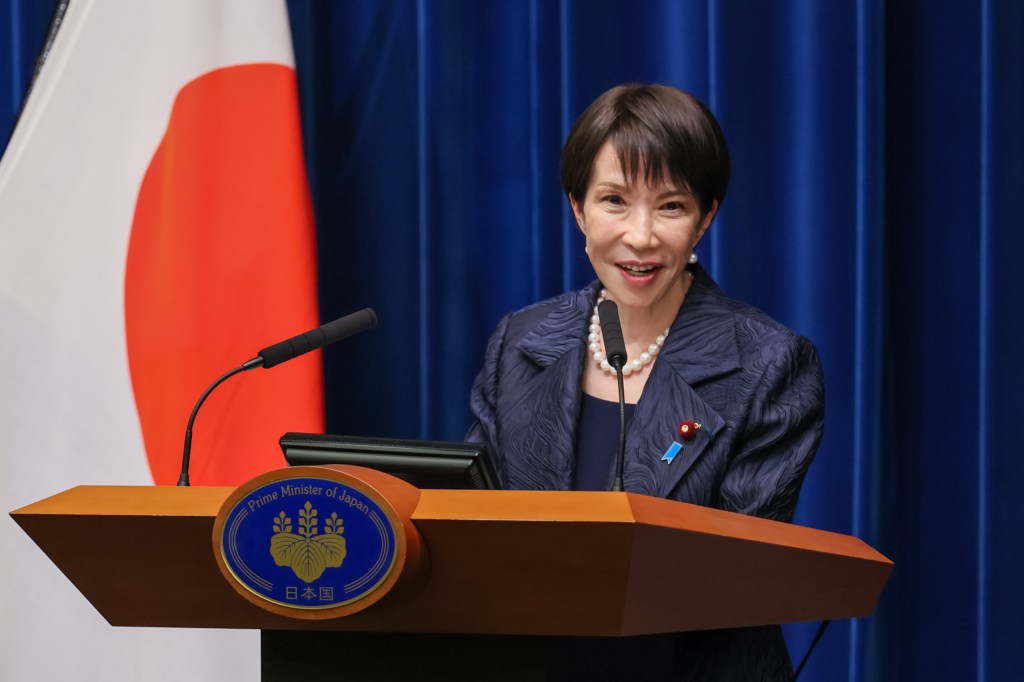
Since her election as Japan’s first female prime minister on October 21, 2025, Takaichi Sanae has cultivated a reputation as Japan’s “Iron Lady,” paying homage to her role model, Margaret Thatcher. Takaichi rose to leadership in the historically dominant Liberal Democratic Party (LDP) on a platform of hawkish foreign policy stances, particularly with regards to the Taiwan Strait. In order to execute this platform and effectively combat China, Takaichi intends to bolster the security relationship with the United States and forge a strong relationship with President Donald Trump.
Already, there are some indicators of success in that regard, as President Trump declared the start of “a new golden age” in the U.S.-Japan alliance following their meeting on October 28. However, there are also several daunting obstacles that may threaten this supposed golden age, from Japan’s declining economy to the unpredictability of American leadership. To get a Japanese perspective on whether or not Takaichi’s lofty goals are truly in Japan’s best interests, The Gate spoke with Sugita Yoneyuki, a Japanese political scientist with expertise in U.S.-Japan relations, who explained his reservations about Takaichi’s U.S.-centric approach.
From Pacifism to Posturing
Within her first month in office, Takaichi’s uncompromising foreign policy stances had already begun to generate consequences on the global stage. Most notably, by publicly implying that Tokyo might respond militarily to a Chinese attack on Taiwan, Takaichi provoked a heated exchange with numerous Chinese officials. This eventually prompted the Chinese Consul General in Osaka, Xue Jian, to comment online that, “the filthy head that recklessly sticks itself in must be cut off,” which Japanese officials interpreted as a direct threat against Takaichi.
This incident highlights Takaichi’s uniquely hawkish positions. This is in particular contrast to her immediate predecessor, Ishiba Shigeru, who toed the line with China in order to maintain a “strategic mutually beneficial relationship.” As Ishiba’s successor, Takaichi’s increased willingness to butt heads with Beijing over Taiwan is a clear complication for U.S.-Japan relations. For the United States, supporting Takaichi’s at-times antagonistic rhetoric risks inflaming tensions with China and upsetting a delicate economic balance, while publicly disagreeing with her stance would endanger the very “golden age” that Trump and Takaichi claim to seek. Thus, President Trump took an uncharacteristically conciliatory stance during this dispute, reportedly urging Takaichi in private to de-escalate.
Beyond such isolated incidents of increased hostility, Takaichi’s position as a China hawk reflects a broader trend in her foreign policy goals. According to Professor Sugita, Takaichi’s chief aims are to “promptly increase defense spending, revise Article 9 of the Constitution, and aim for Japan to pursue a more proactive defense policy,” all of which can be directly tied to her desire to combat China. The issue of constitutional revisions is particularly salient for U.S-Japan relations.
Article 9 of the Japanese Constitution — which bears U.S. influence from the post-World War II occupation — indefinitely renounces the Japanese right to declare or threaten war and prohibits Japan from establishing a standing military. Historically, Japanese politicians have leveraged this “pacifist clause” of the new Constitution to avoid taking a more active stance during the Cold War. In particular, under the so-called “Yoshida Doctrine,” named for Prime Minister Yoshida Shigeru, Article 9 enabled Japan to prioritize its economic growth by leaving military defense largely in the hands of the United States.Although members of the LDP have long called for Article 9 revisions, Professor Sugita explains that, by abandoning the Yoshida Doctrine, actually achieving such revisions “would represent a sharp departure from the extremely pragmatic and highly regarded U.S. alliance policy that Japan has pursued since the end of World War II.” If Japan were to lose the shield of Article 9, it would become much harder to stay uninvolved in the United States’ global disputes in the future, a change which could last well beyond Takaichi’s time in office. Granted, such constitutional revision would be a political challenge, as it requires a two-thirds majority in both houses of the legislature and might be halted by the narrower margins in the upper house. However, even absent constitutional amendment, Sugita argues that Takaichi’s defense policy presents “a concern that defense spending could be increased continuously in a manner that capitulates to American pressure.”
New Coalitions and Landslide Victories
Given the current political dominance of Takaichi’s hawkish faction, there are minimal guardrails preventing the prime minister from accomplishing her foreign policy goals. In particular, this is a product of both the LDP’s new coalition partner and the results of the recent legislative election. First, Takaichi’s selection as party leader of the Liberal Democratic Party in early October triggered the dissolution of the 26 year coalition between the LDP and the more moderate Komeitō. This forced Takaichi to form a new coalition with the libertarian Japan Innovation Party (Nippon Ishin).
When asked about this shift in Japan’s ruling coalition, Professor Sugita emphasized that Komeitō had previously served as “a counterbalance restraining the Liberal Democratic Party’s hawkish line.” According to Sugita, “with that restraining force removed and a coalition government now formed with the Japan Innovation Party, it is anticipated that the hawkish faction of the LDP, led by Takaichi, will come to the fore.”However, at the start of her term, the narrow majority of Takaichi’s coalition limited her political ambitions, prompting her to take a risky gamble. On January 23 of this year, she dissolved the Lower House of the Diet, Japan’s national legislature, and announced a snap election to be held on February 8. In this election, Takaichi secured a historic two-thirds majority for the LDP in the Lower House, giving her the authority to both overrule the Upper House on key legislation and even propose constitutional amendments. As a result, the political constraints preventing Takaichi from implementing her hawkish policies towards China have been all but eliminated. This makes it all the more relevant to consider whether those foreign policy aims will truly serve Japan’s best interests.
The “Golden Age:” Downsides and Doubters
The cornerstone of Takaichi’s foreign policy centers on U.S.-Japan relations. In the early days of her administration, commentators speculated that Takaichi would be able to forge a strong bond with President Trump, due to both her hawkish China policy and their mutually close relationships with the late prime minister, Abe Shinzo. As Professor Sugita explained, “Prime Minister Sanae Takaichi and U.S. President Donald Trump agreed to boost the Japan-U.S. alliance and aim for a new golden age. Both leaders think alike when it comes to things like boosting the military and being firm with China.”
However, Sugita also expressed caution about what a stronger alliance with the United States would require from Japan. He argued that, “Japan should be prepared for the possibility that the U.S. will request additional increases in defense expenditures in the future. They also have to set up supply chains for important minerals without China and put more money into AI, semiconductors and defense in the U.S., all while dealing with tariff problems.”
This concern about American pressure to increase defense spending traces back to the rising influence of China in the Pacific, and, for Sugita, underscores the flaws in Takaichi’s defense policy. He stated that, “as China acquires a third aircraft carrier and strengthens its latest weaponry, the United States has significantly heightened its vigilance. Consequently, this has translated into pressure on Japan and South Korea to increase their defense spending.”
Consequently, Sugita argues that Japan should be less concerned with combating China and more with resisting United States pressures. For Sugita, maintaining the Yoshida Doctrine is the ideal course for Japan, which “should turn the U.S.-created Article 9 to [Japan’s] advantage and postpone American demands for increased defense spending as much as possible.” This faith in the Yoshida Doctrine appears to stem in part from Sugita’s lack of faith in American loyalty to Japan, particularly under President Trump.
According to Sugita, “Japan should coldly understand the reality that Trump, who champions ‘America First,’ will only cooperate to the extent that his own nation’s interests are guaranteed. For this very reason, while cooperating with the United States, Japan should also pursue, as a hedge, free trade initiatives such as [the Comprehensive and Progressive Agreement for Trans-Pacific Partnership] and devote greater effort to economic cooperation with China.” To this end, Sugita argues that “Japan should…contemplate reducing the relative importance placed on Japan-U.S. economic coordination.”Though this position is hardly a dominant one within Japanese politics, it does reflect a larger trend in Japanese public opinion, as recent public polling reveals a declining faith in America under Trump. Such polling focuses primarily on the security relationship between the United States and Japan, but, as Professor Sugita’s response indicates, there are also significant economic concerns that may drive the future of U.S.-Japan relations.
Sanaenomics: Responsible or Risky?
When asked about potential areas for friction between Prime Minister Takaichi and President Trump, Professor Sugita’s response focused heavily on issues of economic policy. According to Sugita, “by presenting a $55 billion investment in the United States, a rapid increase in defense spending, and an expansion of agricultural imports from the U.S., Takaichi was able to conclude her first talks with Trump with relatively few ripples. However, this should be viewed as the calm before the storm.”
Sugita’s conviction that a storm is looming seems to come from both a doubt in Takaichi’s ability to fulfill her promises, due to economic constraints, and a fear of the methods she might need to use in order to do so. Professor Sugita later stated that, to comply with Trump’s calls for increased investment, Takaichi “would have to rely on deficit-issued government bonds,” which he claims have “far too many negative factors for Japan’s future.” As Japan’s population continues to age and social security deficits continue to grow, the reliance on government bonds is only going to increase, making it all the more pressing to ask whether or not the costly U.S.-Japan alliance truly serves Japan’s best interests.
The issue of government bonds came up repeatedly throughout the course of our conversation. As Sugita had explained earlier in the interview, “Japan’s outstanding government bond issuance stands at approximately 1,173.5 trillion yen (as of the end of December 2024),” equivalent to roughly 7.5 trillion USD, and continues to increase. According to Sugita, “this amounts to roughly twice the level of nominal GDP, making Japan’s debt-to-GDP ratio one of the highest among developed nations.” Considering this, even if Takaichi is able to fulfill her promises to the United States by relying on government bonds, doing so may not be the best choice for Japan’s future if it also contributes to worsening an already serious debt problem.
The Future of U.S.-Japan Relations
To end our conversation, I asked Professor Sugita what he envisioned as a best-case scenario for U.S.-Japan relations, and what it might take to achieve that aim. According to Sugita, despite Takaichi’s lofty aims for “a new golden age of the Japan-U.S. alliance,” achieving that goal would require an ideal situation in which “the Japanese economy develops miraculously, tax revenues grow beyond expectations, Takaichi’s ‘responsible expansionary fiscal policy’ is implemented without becoming overly dependent on deficit-issued government bonds, and commitments made to the United States can be fulfilled in a phased manner.”
“A more plausible scenario,” Sugita stressed, “would be one in which tax revenues do not grow as much as anticipated, deficit-issued bonds spike dramatically, the United States accuses Japan of ‘failure to fulfill promises,’ threatens to impose even higher tariff rates, and Japan finds itself in a deadlock situation with no way out.” Though only time will tell whether the future skews towards Takaichi’s optimistic vision or Sugita’s cynical outlook, it is important for American readers to acknowledge that, despite Takaichi’s recent electoral victories, Japan is not a monolith. There are still vocal doubts within Japan — like Professor Sugita’s — about Takaichi’s attempts to strengthen the U.S.-Japan alliance and what this will mean for Japan’s future.
Image from Cabinet Secretariat, licensed under Creative Commons Attribution License 4.0 International.
 The Gate
.jpg)
Leave a comment