Part II – The Suburban Trade and Concepts of a Plan
In the previous installment, which included interviews with Karmyn Seaberg, Chair of the Randall County Democratic Party; Sonya Letson, Chair of the Armstrong County Democratic Party; Chelsea Streeter, Chair of the Wichita County Democratic Party; Sean Birkenfeld, Chair of the Panhandle Democrats; and Kendal Scudder, Chair of the Texas State Democratic Party. This guide traced how rural decline did not begin with ideological revolt but with institutional withdrawal. County chairs went unfilled, precinct systems dissolved, state-level support receded, and year-round representation disappeared. As local presence thinned, voters were left without visible intermediaries, and participation began to feel inconsequential. What followed was predictable: once the party stopped functioning as a local institution, its identity was defined from the outside.
Step Three: Trade Rural Regions for Suburbs (Then Lose Both)
Where local representation disappears, political identity tends to be defined externally. Organizers did not describe voters simply drifting away from politics. They described voters concluding that the Democratic Party no longer spoke in a language rooted in their lives or addressed problems as they experienced them.
That strategic tolerance for loss was not implicit; leaders articulated it openly. In 2016, Senate Democratic leader Chuck Schumer summarized the prevailing logic bluntly: “for every blue-collar Democrat we lose in western Pennsylvania, we will pick up two moderate Republicans in the suburbs in Philadelphia.” Hillary Clinton would go on to win the national popular vote while losing the presidency, and it was easy to treat Donald Trump’s victory as a structural accident rather than a strategic failure. David Shor, a prominent data analyst known for data-driven research on voter behavior and campaign strategy, recently described Trump’s first win as “a weird quirk of our electoral system,” and calls to abolish the Electoral College gained traction. But the result was not a quirk. It reflected a constitutional system designed to reward geographically distributed coalitions across states rather than a single numerically dominant national majority. A strategy that treated losses in place-based constituencies as acceptable tradeoffs ran directly into an electoral system built to penalize them.
In places where the party was absent year-round, Democratic identity ceased to be shaped by relationships, local leadership and practical problem-solving. Instead, it became defined through national media, opposition framing and high-salience symbolic conflict. With no local intermediaries to translate priorities or contextualize disagreements, the national brand did not just shape perceptions — it set the entry conditions for political conversation. Before a local organizer can talk about schools, taxes or roads, they often have to address what voters think “Democrats” mean.
This is where national perception gaps move from being theoretical to shaping real-world outcomes. Post-election polling summarized in Deciding to Win suggests that while many voters identify the economy as a top priority, fewer believe it ranks among the Democratic Party’s own top concerns; the perceived emphasis shifts toward issues associated with national conflict. In rural North Texas, the practical effect is not only that voters think Democrats care about different things: without a sustained local presence, national narratives become the default frame of interpretation. The party does not arrive as a locally rooted institution at all; it arrives already filtered through national disputes.
Seaberg pointed to the slogan “defund the police” as an example of the mechanism she described. Her point is not simply that the phrase was unpopular. It is that a national slogan — often detached from local organizers’ actual beliefs — became something rural Democrats had to answer for before they could talk about anything else. In a community where the party lacks a durable local presence, that national brand functions like a gate, shaping which conversations can happen in the first place.
Step Four: Make Your Own Label Toxic
In an environment defined by institutional absence and nationalized political branding, partisan identity can become the barrier before policy even enters the conversation. Organizers described discussions that proceeded easily until the word “Democrat” surfaced. Agreement on schools, healthcare, wages or infrastructure often remained intact, but the label itself triggered withdrawal. In Wichita County, Streeter described the moment plainly: “When I say I’m a Democrat, people tense up like I just said something taboo.” The reaction was not about policy details. It was about what the label had come to signify.
County chairs and regional Democratic leaders pointed to conservative media and national political narratives in framing Democratic identity as culturally suspect or morally illegitimate. But they emphasized that those narratives gained traction where local Democratic presence had already receded. Without visible representation or trusted intermediaries, national framing moved unchallenged, turning partisan affiliation into shorthand for moral alignment rather than a starting point for conversation.
Identifying publicly as a Democrat carried social costs in churches, workplaces and family networks. The result was not loud confrontation but silence. Even residents who shared many of the party’s stated goals avoided public identification, calculating that the personal consequences outweighed the benefits of engagement.
Rural county chairs also described a parallel dynamic operating inside the party, shaped less by local experience than by national narratives. Seaberg said that in Amarillo, the problem was not that local Democrats embraced controversial national slogans, but that voters encountered those slogans repeatedly through media before ever encountering a local Democrat. “You can get a news feed from anywhere in the country now,” she said. “Depending on where you get your news, you can hear 20 times a day about the evil that the Democratic Party has done,” often without knowing many Democrats personally to contradict that framing. She pointed to policing as a clear example. “No, nobody ever here in this community in Amarillo, no Democrat ever suggested or thought about defunding the police,” she said. “We’re very law enforcement-oriented here. We support our police.” Yet once the phrase circulated nationally, local Democrats found themselves forced to answer for it. In that environment, questioning how the national language landed in Amarillo was often interpreted as a lack of commitment rather than an effort to describe conditions on the ground.
That internal moralization is not simply a minor cultural irritant; it is organizationally destructive. Treating strategic feedback as moral deviation breaks the feedback loop that any institution needs to adapt. It discourages honest feedback inside the party while discouraging open disagreement outside it. Over time, this dynamic did more than silence rural organizers outwardly; by removing people with lived experience in places like North Texas from regular participation in party deliberation, it narrowed the internal conversations through which Democratic priorities and language were formed, allowing ideological shifts to emerge because of absence rather than persuasion.
Step Five: Offer Concepts of a Plan When They Ask for Solutions
The nationalization of politics across the country also narrowed the space available for local leaders to develop policy on their own terms. Organizers described spending significant time responding to narratives introduced at the national level, often before conversations could turn to local concerns. Letson characterized the dynamic as a constant drain on capacity: local leaders were left “cleaning up messes we didn’t make,” with time and attention diverted toward clarification and defense rather than development.
That is not simply an unfortunate side effect of polarization. It is a failure of institutional design. If the party’s national brand predictably generates controversies that local organizers must answer for, then leaving volunteers to manage those controversies without support is a choice. It pushes scarce local capacity toward reputational triage rather than governance work.
The limits of this arrangement become clearest when conversations turn to material concerns. Rising property taxes affect a large share of Texas voters: with 62.3% of households owning their homes, increases driven by rising property values and the structure of local finance reach far beyond a simple partisan story. One county chair described a 24% increase in her own tax bill in a single year. Asked how Democrats should respond, she answered candidly: “honestly, I cannot answer that question.” The issue was immediate and personal. Her response reflected not indifference, but a shortage of tools.
That shortage is also structural. Rural county chairs are often volunteers or part-time organizers. They are expected to build turnout operations, recruit candidates, manage internal conflict and serve as community-facing representatives. But many are not equipped — because the party has not equipped them — to translate complex local problems into credible policy proposals. In Texas, property taxes alone require fluency in appraisal practices, rate-setting, school finance and local government budgeting. Without technical support, even well-intentioned organizers default to what is scalable: values talk, broad narrative framing and comparisons.
Republican leaders centered a simple, repeated message focused on tax relief. Democrats, by contrast, often responded at the level of narrative rather than mechanism. In practice, the problem was not only missing institutional support but limited policy capacity on the ground. Chelsea Streeter, chair of the Wichita County Democratic Party, described inheriting a local organization that was not dead, “but it was stagnant.” Much of the routine work of party-building fell to older, retired volunteers, while younger supporters gravitated toward rallies and protests. “We do get a lot of young people at protests,” she said. “But when it comes down to actually building something and getting to a meeting where the real work happens,” participation thinned. The result was an organization more visible in moments of symbolic energy than in sustained policy development. Many of the organizers who stepped in had been shaped by national issue priorities, leaving them more comfortable repeating familiar critiques than engaging the problems local voters raised most urgently.
That perception was not limited to party insiders. A Wichita County voter I approached at random in a local supermarket, speaking on background and with no connection to party leadership, put it more bluntly: Democrats “say things that make them feel good. They shame and demonize people that disagree on a single… issue like I killed a… kid instead of actually fixing problems… they are just like MAGA… all politicians are the [same].” Asked about property taxes, Scudder reframed the issue comparatively, telling voters, “all Democrats have to do is ask people when their taxes were higher. Were they higher now, or were they higher 30 years ago?” The comparison sidestepped the mechanics of Texas’s property tax system, where burdens are driven largely by appraisal growth and local finance decisions rather than partisan history. It should also be noted that most of the people paying property taxes when a Democrat held statewide office are no longer alive. It sounded like an argument, not a solution. In other words, Democrats only have concepts of a plan.
This pattern reflects the deeper policy failure the property tax episode points toward. It is not merely that messaging is weak. It is that the party lacks a durable policy-development pipeline accessible to rural organizers — a set of shared mechanisms, local issue toolkits and technical expertise that can be deployed county by county. In many places, Democrats have messaging professionals but not institutional designers; they have slogans, but not the ability to govern. They can rebut attacks but cannot consistently offer a concrete alternative on the problems voters raise.
In communities where politics is evaluated through immediate material conditions, reframing rarely counters a simple message delivered consistently. Where institutions are thin or nonexistent, policy capacity lags behind what voters are prioritizing and the party becomes easier to dismiss not because every belief is rejected, but because competence is not demonstrated.
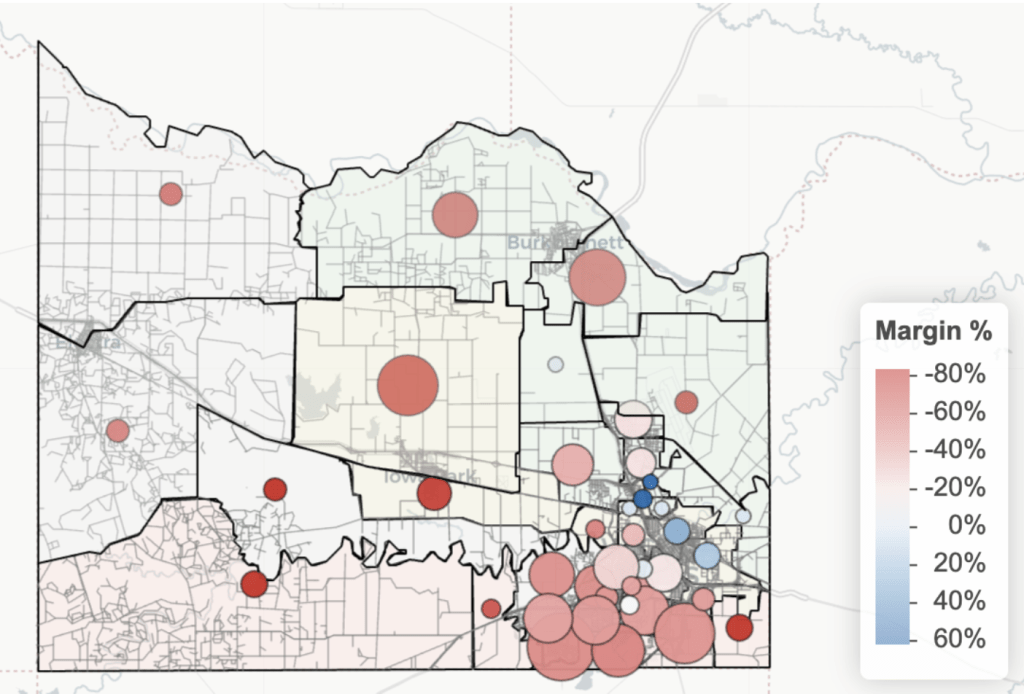
Map by Jonathan Booker.
 The Gate
Leave a comment