
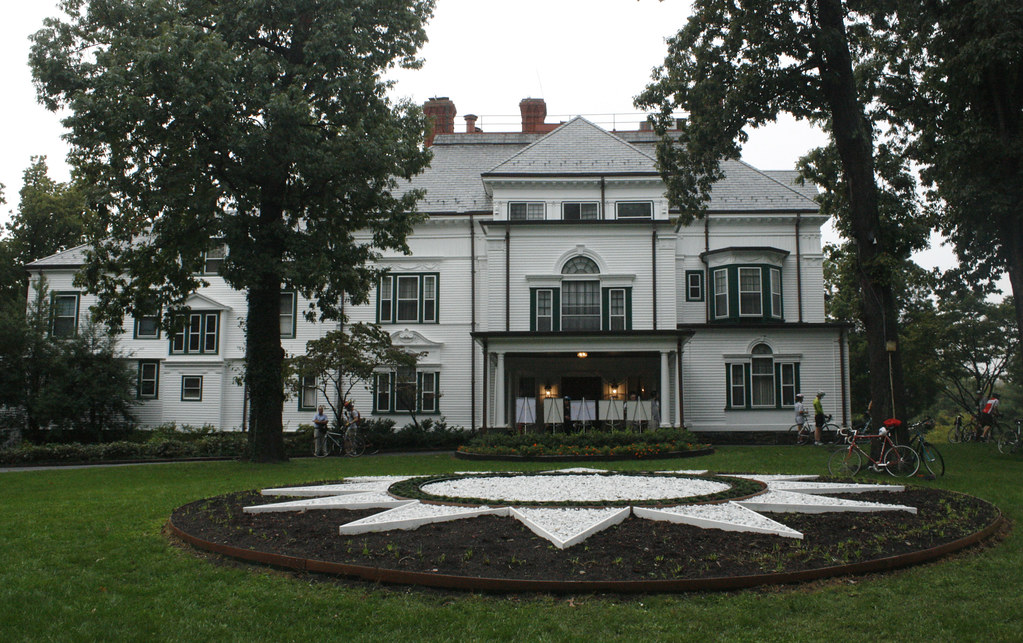
Not Quite an Embassy: Taiwan’s Lavish Estate in the US Capital
Nested between two towering oak trees in scenic Northwest Washington lies one of D.C.’s finest properties. The aptly named Twin Oaks Estate is a 26-room English Georgian Renaissance-style mansion registered as a National Historic Site. The largest privately owned estate in the United States capital and occupying land just larger than the White House compound, Twin Oaks belongs to the Taiwanese government, or the Republic of China (ROC).
A small island off the coast of Mainland China, Taiwan has garnered significant recent attention from the U.S.. According to a 2023 Chicago Council Survey, two-thirds (65%) of Americans support a strong U.S.-Taiwan security relationship and 62% support arming Taiwan in the event of a Mainland Chinese invasion. In line with this, U.S. administrations for decades have responded to rising tensions between Beijing and Taipei with consistently increased military aid to Taiwan. The 2023 defense budget included record high allocations to Taiwan, with an unprecedented $10 billion to finance weapons in Taipei and a nearly 10% increase in funding from the year before. Although Donald Trump provided decisive military support in line with this trend during his first term, he has warned in his second term that Taiwan needs to “pay us for defense.” However, the extent to which President Trump’s transactional rhetoric will affect future U.S. funding to Taiwan has yet to be seen.
Why does the fate of this small island matter so much to the American people, winning bipartisan support for strengthened security ties and arms sales as well as legally protected ownership of D.C.’s most lavish estate?
Former Assistant Secretary of Defense Ely Ratner attributes the geopolitical significance of Taiwan to its location “at a critical node within the first island chain,” connecting the region from the Japanese archipelago all the way to the Philippines and South China Sea. Thus, Taiwan acts as a physical link to a network of vital U.S. allies in the region, a determining factor in the scope of the U.S. and China’s competing military influence in the Indo-Pacific.
Taiwan is also responsible for over 60% of semiconductor and over 90% of high-end chip manufacturing globally. These products act as essential components of all technological products ranging from smartphones to electric vehicles to missiles, spotlighting Taiwan’s crucial position in international supply chains and security.
Deemed the small democracy’s “silicon shield,” Taiwan’s industrial dominance in tech manufacturing has spurred a tug-of-war over Taiwan talent. China and the US are racing against each other, both investing dozens of billions of dollars into domestic chip manufacturing, while China poaches highly-skilled Taiwanese engineers to advance this lucrative work. The Biden Administration also passed the CHIPS and Science Act in fall of 2022 to revive manufacturing in the US. In line with this, the US partnered with TSMC (Taiwan’s leading chip production company) to build a production plant in Arizona, aiming to create thousands of American jobs and transform the US into a producer of 20% of the world’s most sophisticated chips by 2030. However, President Trump has claimed that Taiwan “stole our chip business,” indicating a more hostile approach to decreasing US dependence on foreign tech.
Furthermore, Taiwan is a rare beacon of democratic values in Asia, remaining steadfast despite democratic institutions around the world facing attacks. Taiwan’s most recent presidential election of Lai Ching-te, a Democratic Progressive Party candidate supportive of Taiwan’s self-governance, exemplifies Taiwan’s ability to protect its free elections against Mainland Chinese influence.
As a result of Taiwan’s geopolitical significance, Congress passed the Taiwan Relations Act in 1979, cementing the United States’ commitment to strong cultural and economic ties with the island. This came just three months after the One-China Policy severed formal diplomatic relations. Yet even as the One-China Policy cost Taiwan its embassy in the US, it allowed for Taiwan’s repurchase of the Twin Oaks property. Once acting as the official residence of Taiwan’s ambassadors to the US, the estate now acts as the venue for the Taipei Economic and Cultural Representative Office (TECRO)’s many banquets. At these banquets, TECRO engages in unofficial diplomacy, welcoming elite political figures including American presidents and members of congress subject to meticulous restrictions to avoid disrupting the delicate status quo of U.S.-China relations. Indeed, most Taiwanese people support the preservation of this status quo over risky declarations of formal independence that could provoke a Chinese invasion.
Given Taiwan’s geographical military relevance, technology supply chain influence and commitment to democratic values, the majority of Americans support bolstering a strong, defensive, unofficial relationship with the island. Thus, Taiwan remains carefully balanced in U.S. foreign policy, possessing TECRO and D.C.’s grandest mansion, no embassy and all the world’s attention.
Image from David King, licensed under Attribution 2.0 Generic.