
A Hint to the Future of Populism? Continuing Protests in Serbia
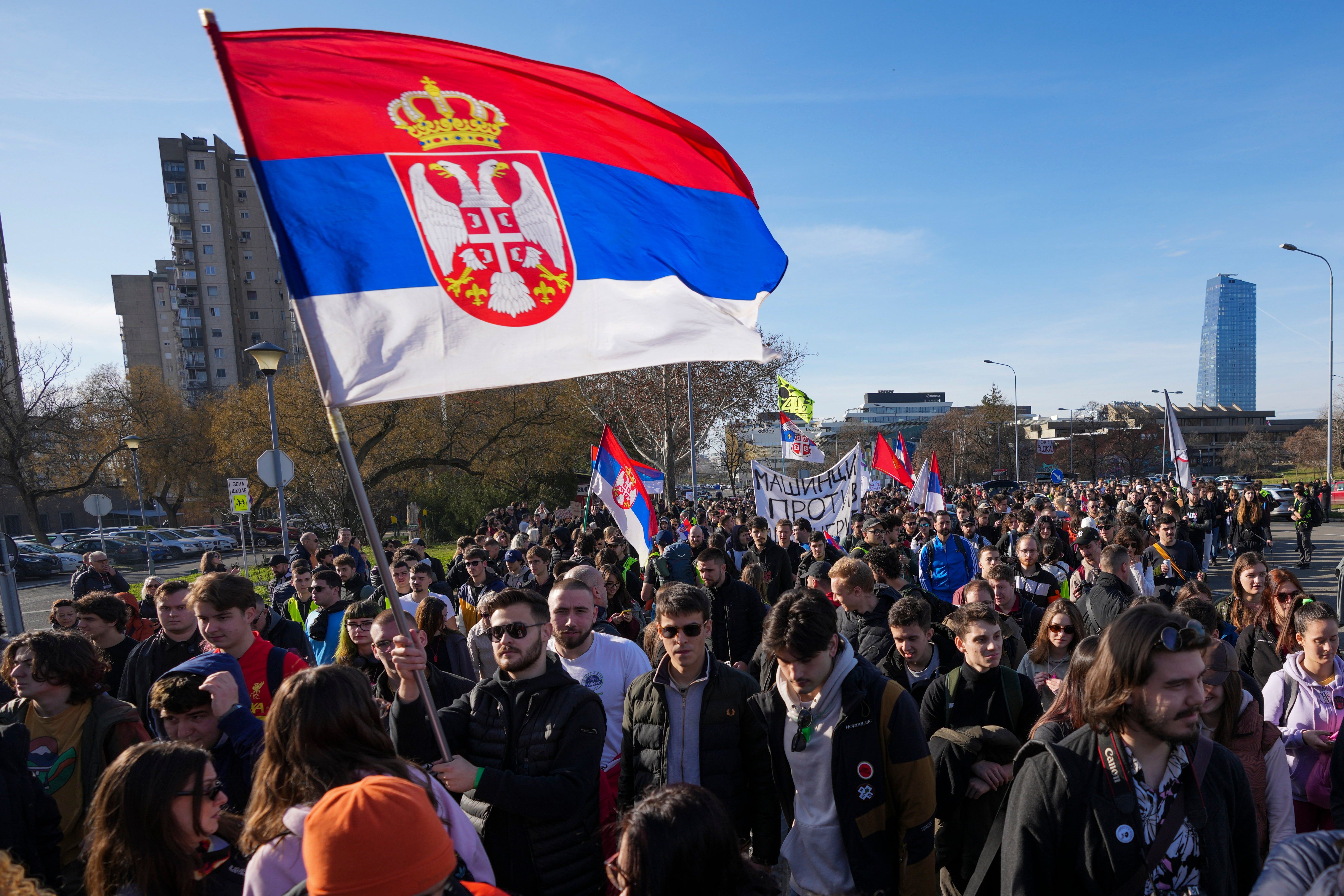
Four months after the November 1st collapse of a train station canopy killing 15 people in Novi Sad, university students in Serbia continue anti-government protests. On Saturday, February 15th, students marched nearly 140 kilometers to the city of Kragujevac from the capital Belgrade. Joined by wide segments of the Serbian population, they blockaded a main road for 15 hours and 15 minutes to honor the 15 victims. Since the fall, the demonstrations grew to encompass teachers, lawyers and farmers, who came out to support students. The protests now include nearly 2/3 of the population, making them the largest since those that toppled Milosevic’s regime in 2000.
Given the station’s recent renovation through a Serb-Chinese partnership, protesters blame the collapse on government corruption and mismanagement. They demand justice to the officials responsible, the publication of documents relating to the accident, the release of students arrested during protests and an increase of the higher education budget.
Initial anger over the collapse prompted the resignations of the minister of construction, transport and infrastructure and the minister for internal and external trade. Then on January 28th, Prime Minister Milos Vucevic resigned, after five students were attacked and a young woman was hospitalized in Novi Sad overnight. While they attest to the movement’s widespread resonance across Serbia, the resignations have not satisfied the protesters’ demand for accountability as they rally against President Aleksander Vucic’s illiberal regime.
Since November, students have led and organized the protests without input from opposition parties. University students have occupied campus buildings, led roadblocks and held a 15-minute daily vigil in honor of the 15 victims every Friday since November 1st. Notably, Serbia’s Bar Association began a 30-day strike on February 3rd in support of student protests, attesting to the widespread resistance. Teachers also suspended work in many schools and classes have not been held.
President Vucic was quick to renounce the demonstrations and accuse protesters of being foreign agents with intent to overthrow the government. However, the persistence of widespread support for students forced his reconsideration of a number of promises. After denying the student’s demand that documents relevant to the railway station’s construction be released, he ultimately assented by directing the request to the prosecutor’s office. Though he rejected the possibility of a transitional government, Vucic acknowledged on January 28th that his party had 10 days to decide whether to hold early parliamentary elections following the prime minister’s resignation. This decision, however, was never made.
Most crucially, the past months saw a drastic turn in the media’s coverage of protests. Control of the media has formed a core pillar of Vucic’s power, dating back to his role as information minister for former president Milosevic. Today, press freedom in Serbia ranks 98th of 180 countries, its lowest ever, with most networks controlled by the government and independent journalists under direct threat. Therefore, it marks a pronounced shift in the media landscape that the state-owned Radio Television of Serbia (RTS) turned from merely ignoring protests to opening a program with protesters, showing drone footage of crowds blockading bridges in Novi Sad.It is undeniable that Aleksander Vucic stands beside Viktor Orbán and Robert Fico, among the ranks of the illiberal populist leaders of Central and Eastern Europe who in many ways preceded the current wave of right-wing politics. President since 2017, Vucic served as Prime Minister of Serbia from 2014, amassing significant influence as co-founder of the ruling SNS party. For now, Vucic remains firmly in power, but the challenge is clear. One cannot help but wonder if Serbia student protesters are a testament to the dysfunctionality and disastrous consequences of a decade of populist-authoritarian governance. Is collapse inevitable?
The image featured in this article is copyrighted by the Associated Press and created by Darko Vojinovic. All rights are reserved and the image can be accessed here.