
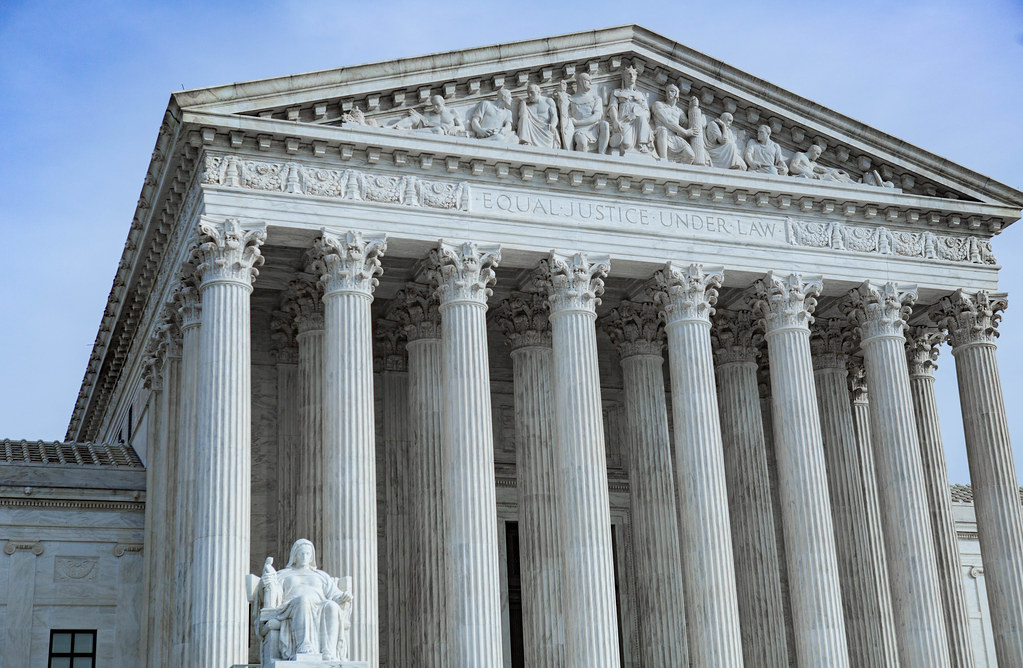
The Supreme Court Case Nobody’s Talking About
In 2018, C-SPAN conducted a poll testing Americans’ knowledge of the Supreme Court (SCOTUS). The results, unsurprisingly, were underwhelming: 52% could not name a single justice on the highest court in the land. Despite this statistic, 91% agreed that SCOTUS has an impact on their daily lives. That disparity is perplexing.
Given the lack of knowledge surrounding the Court, it is expected that the average American is uninformed about the latest decisions on the docket. Sure, most people are aware of the Dobbs decision (2022); but take a case like Citizens United v. FEC (2010), reviled by academics across the country. Citizens United equated speech with money, granting First Amendment protection for campaign donations. Under that standard, SCOTUS decided contribution limits on corporations were deemed unconstitutional. The ruling gave way to record campaign contributions and the creation of independent expenditure committees (commonly known as Super PACs) and dark money groups.
For Super PACs, there are no contribution limits, as these committees are not allowed to cooperate with a candidate or campaign. Super PACs run attacks advertisements and get involved in ways that avoid direct conversations with the people they are created to support.
Even that small restriction on their power has come into question recently with the creation of “red-boxing.” This technique, employed by political campaigns, publicly expresses the desires of the campaign, allowing for a Super PAC to do as the campaign pleases without cooperation. This has manifested itself in Super PACs running ads with verbatim phrases from campaign websites. In the 2022 House races, Rep. Kurt Schrader posted a rebuke of his opponent with three quoted lines. In a shocking twist, a Super PAC supporting him aired an ad with those exact same words.
Despite these complications, there is at least some transparency — the donors to Super PACs have to identify themselves. Dark money does not even require that meager barrier. Instead, dark money is funneled into elections largely through a type of non-profit organization called a 501(c)(4). So long as politics is not the primary purpose of the group (49.9% is legally fine), these organizations can donate as much money as they want to Super PACs. However, given the 501(c)(4) is a non-profit “social welfare” organization, it – unlike even Super PACs – is not required to disclose its donors. In other words, individuals can contribute hundreds of millions of dollars to the political process through these groups without the American people knowing who they are.
As a result of Citizens United, the 2024 Presidential Election saw Super PACs spend $2.7 billion. Spending in 2004 between Kerry and Bush, prior to Citizens United, never reached more than $700 million (still an egregious amount). Americans, whether they know the rules as they stand or not, do have consensus on campaign finance: 72% believe there should be limits on spending. Still, even a case like Citizens United, which is well-documented in intellectual circles, is not at the center of mind for most Americans.
There was another decision handed down last June that I have not heard discussed even within the more tapped-in communities, yet introduces some grim consequences: Snyder v. United States. Released with a host of other decisions, including the widely-covered Relentless case overturning the standards established in Chevron (1984), Snyder v. United States deals with the legal distinction between bribery and gratuity.
The Mayor of Portage, Indiana, James Synder, was convicted in 2016 of bribery, after having accepted $13,000 from a garbage truck company with which he collaborated to deliver new trucks to Portage. Synder directed two contracts worth upwards of $1.1 million to the truck company Great Lakes Peterbilt. And less than a month later, Synder wound up with money sent from Peterbilt.
Bribery? I think so.
However, there is a complication: there is no evidence of a quid pro quo; that is, Synder did not explicitly agree to do business with Peterbilt on the condition he got the money. If you think that sounds a bit flimsy, you’re not alone.
But the chronological problem changes the case: given Synder received the money after the deal, and did not directly coordinate with Peterbilt to award them the contract, did he really commit bribery?
According to the United States Supreme Court, no. The bribery statute Synder of which Synder was convicted, 18 U.S. Code § 666, covers exchanges in line with quid pro quos. Synder’s payment came “after an official act as a reward or token of appreciation,” making it a “gratuity” according to the majority decision written by Justice Kavanaugh. The distinction the Court draws is that federal law is not in play here. According to their interpretation of the statute, where bribes are firmly illegal, “§666 leaves it to state and local governments to regulate gratuities to state and local officials.”
The Court delegates the gratuities restrictions to state and local officials, narrowing the purview of the bribery law. Kavanaugh’s opinion makes the ruling seem like an innocuous close reading that re-interprets a few words to reach a different conclusion. However, this decision opens the floodgates as far as corruption is concerned: in past convictions, in ongoing investigations, and in the future of prosecuting these types of cases.
In fact, the effects began to take hold here in Chicago, where former Illinois House Speaker and longest-tenured state official in United States history Mike Madigan was recently convicted. After 24 years as Speaker, and nearly 40 in Illinois politics, Madigan’s reputation as an extremely effective legislator and under-the-radar leader of Illinois politics crashed and burned. Madigan was indicted on 22 counts relating to federal racketeering, bribery, attempted extortion, and wire fraud.
Among the charges is the allegation that Madigan sought favors, including jobs and money, for his allies, friends, and family from ComEd, one of the largest utility companies in the U.S. headquartered in Chicago. He also tried to help former Alderman Danny Solis — who served as a double agent with the FBI — secure a position following his retirement. Secret recordings reveal Madigan’s plan to impose his will in order to help his then-friend. Another component of Madigan’s trial, though, revolves around a Chicago corruption staple: using government posts to redirect business to his property tax firm.
Beyond the scope of Madigan’s corruption, his relevance to this decision is substantial. Madigan’s trial, originally scheduled for last April, was pushed back to October in anticipation of the Synder ruling. Now, the show has gone on — but still, Madigan’s lawyers were certainly aware of ways to argue Madigan’s charges in a different light following the Court’s decision. And even though their efforts failed, as Madigan was convicted, Synder played a role in the defense.
And while the biblical levels of scandal in Illinois could fill a book, Synder’s relevance extends far outside the Midwest. In fact, disgraced Mayor of New York Eric Adams, who faced criminal charges pertaining to bribery and corruption, used Synder as part of his defense. Adams’ charges were dropped at the demand of Trump’s DOJ in the first month of his administration, leading to resignations from four deputy mayors and calls for the mayor’s resignation.
While still in court, though, Adams’ team cited another high-profile decision regarding the same bribery statute: McDonnell (2016). Both issued by the Roberts Court, McDonnell tightened the bribery standard to exclude meetings and events from the designation of “official act,” allowing McDonnell’s very sketchy behavior to pass the narrower bribery designation. By this new reading, McDonnell’s agreement to allow independent testing for a medical product while receiving financial help to get out of hardships from the company did not meet the stricter designation.
Whether Adams’ team would have been able to persuade the courts that McDonnell’s reclassification of official acts and Synder’s alteration of the meaning of bribery should lead to the mayor’s exoneration matters little – they never even had to. But Adams’ allegedly accepted around $100,000 from the Turkish government in exchange for favors. And the mere fact that Synder could have contributed to his defense says enough about the danger behind the Court’s decision.
More broadly, Synder seems to open the floodgates for future government corruption. I know I’m not winning a Peabody for saying this, but corruption is already pretty rampant. It is a staple of the American system. Whether it relates to the campaign finance restrictions (or lack thereof) or the loosening of the federal bribery statute, SCOTUS and federal lawmakers appear less inclined than ever to actually regulate poor, undemocratic behavior.
When I began writing this article, I wanted to focus on Synder while also pointing out the ridiculousness of the campaign finance practices in the U.S. I was not completely sure how they linked together. I think I’ve got it now though: both elevate and bolster moneyed interests.
Citizens United, while framed as a triumph of the First Amendment, is quite arguably the most restrictive practice on the most important kind of speech — political speech. By conflating money with speech, the case indirectly provided a vehicle for wealthier people to speak louder; this places the First Amendment in some sort of socio-economic lens.
Synder, while aimed at minimizing the power of federal laws to strengthen state and local officials, completely misses the mark, instead eliminating basic common sense from government. Both open the floodgates for the rich and powerful to meddle in everyday affairs. One day, it’s Elon Musk and the Adelson family donating upwards of $300 million during the 2024 Election; the next, it’s a prominent city official accepting money as a token of appreciation for having approved a project. Who knows? Maybe it’s a building in New York that hasn’t passed the fire inspection.
I could pretend I have a unique voice to give credence to my point here, but let’s be honest. I don’t. And I don’t need one. This stuff is common sense. Billionaires contributing asinine amounts to campaigns completely alters the fabric of the political climate, almost always to the detriment of We the People. Yet, even more transparent than that: receiving money for any government action, whether it be before, during, or after the act is the same thing — bribery.
I recognize this has been uninspiring and hardly motivational. Frankly, I’m a little tired of being so optimistic. America is the only country in the world where a non-college graduate born on a farm, a poor child brought up in a log cabin, or a kid from Scranton can ascend to the highest office in the world. The capacity of the United States is truly limitless. All hope is not lost.
But it becomes harder each and every day to look in the mirror and really believe that when the brightest minds we have to offer counter bribery and corruption with semantics.
Photo by Anthony Quintano, licensed under Attribution 2.0 Generic.