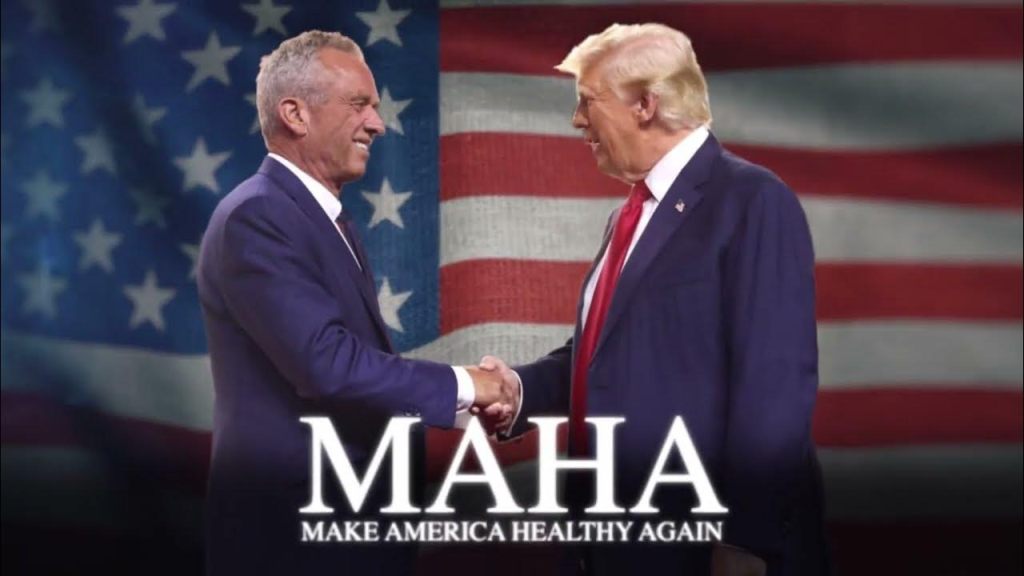
Climate change, human rights, economic development. While interconnecting these critical issues, national health seems neglected from electoral commentary—except for Donald Trump and Robert F. Kennedy’s surprising alliance to ‘Make America Healthy Again.’ Improving health requires a systematic overhaul of the American food system–but MAHA falls short of achieving the necessary reforms. In the month leading up to the 2024 Election, we need bipartisan support for anti-trust policies to break up agribusiness and their harmful activities.
Something Fishy about the Food System
Today, over 58 percent of Americans’ total energy intake is ultra-processed foods, products with ingredients “not commonly used in culinary preparations” including colorants, flavors, artificial sweeteners, and emulsifiers. Emerging research suggests the consumption of ultra-processed food exacerbates health issues, including obesity. The Centers for Disease Control and Prevention reports that obesity affects over 2 in 5 U.S. adults and amasses medical expenditures exceeding $173 billion. Upon further examining these costs for children, a Health Economics study found obesity raises individual medical costs across all major categories of care: outpatient expenditures, inpatient expenditures, and prescription drug expenditures. Costs rise with the severity of obesity severity; while $314 higher per year for patients with obesity, inpatient expenditures nearly double to $552 per year for patients with severe obesity. Former USDA Deputy Jerold Mande warns that “what we are eating is making us sick, and ultra-processed foods seem to be a large driver,” instead of supporting our health.
Human health is not the only area in which our food system fails. Released this summer, the documentary Food, Inc. 2 emphasizes the food system’s impact on climate change, human rights, and economic development. Food production contributes a third of greenhouse gas emissions and uses up half of global habitable land. Since 1990, emissions related to agricultural energy use have risen 14 percent, contributing to the increasingly prevalent global temperature extremes.
Additionally, the food system’s disregard for human rights is evident in its abuse of farmworkers. The Coalition of Immokalee Workers (CIW) reports that farm workers across the nation are trapped in indentured servitude and forced to work against their will by violent employers. In his article “The Price of Tomatoes,” Barry Estabrook exposed how tomato pickers in Immokalee, Florida endured low pay, poor living conditions, and abuse such as being “slashed with knives, tied to posts, and shackled in chains.” While enduring horrific mistreatment, many of the farmworkers are undocumented or migrants who speak limited English, unable to risk their livelihoods to testify against their exploitative employers. In bringing their case U.S. vs. Navarrete to court in 2008, the farm employers were sentenced to jail time and $200,000 in restitution to the victims. While the CIW has helped liberate over 1200 abused workers in the past decade, violations of farmworkers’ human rights persist—like the policies deficient at protecting them.
Profit-driven corporations negatively impact humans’ health, environment, and rights—yet continue to dominate America’s present food system. In 2023, McDonald’s generated annual revenue of $25.5 million from its burgers and shakes, produced with ultra-processed ingredients such as dextrose. Such mega-food corporations create jobs, profits, and spend millions on advertising, stimulating other sectors of the economy.
Beyond food production and processing, the agribusiness industry encompasses chemical labs, marketing firms, and industrial-scale corporations. However, profit incentives drive agribusiness to invest and create unhealthy food, the consumption of which accumulates millions of dollars of health expenses burdening the American people. Despite causing such harm, the agribusiness industry expended over $523 million lobbying in the past five years—securing power to limit regulation that would restrict its activities while improving public health.
The current lobby-based politics empower profitable companies, despite their human and environmental damages. The food system requires reforms to reward healthy food producers, crack down on ultra-processed food advertising, and break up powerful corporate trusts and monopolies.
New Alliance, New Hat
During his presidency, Donald Trump’s administration reversed its ban on the pesticide chlorpyrifos, linked to neurological problems in children; weakened school nutrition standards; and otherwise sabotaged climate change and human rights advances. It seems paradoxical that the former president recently pledged his support to make America great again—through targeting agribusiness and health. Given the contradictions in Trump’s actions on health, ‘MAHA’ is merely a strategy to eliminate voter competition from RFK rather than amend the American food system.
At the end of August, Donald Trump’s 2024 Presidential Campaign had already undergone many ups and downs: the former president’s removal from state primary ballots due to his 2021 insurrection involvement; opposing Democratic candidate Joe Biden’s drop from the race; an attempted assassination at a rally. At the same time, independent candidate Robert F. Kennedy, notorious for spreading political falsehoods, also experienced campaign struggles, including lawsuits to list his name on state ballots, a decline in popularity, and the depletion of his campaign’s funds. Even though Trump called RFK Jr. “radical left” and annoying “fly” at May’s National Rifle Association Convention, political calculation on both sides culminated in an unexpected alliance between the two.
In his August 23 Address to the Nation, RFK suspended his independent campaign and endorsed Trump. His reason for withdrawing from the race laid the groundwork for this new acronym and colored cap. “The chronic disease crisis was one of the primary reasons for my running for president,” said RFK. “It’s the reason I’ve made the heart-wrenching decision to suspend my campaign and to support President Trump.”
In a recent video, RFK officially introduced the MAHA campaign, sporting a forest green baseball cap with ‘Make America Healthy Again,’ not to be confused with salad chain Sweetgreen’s 2016 #makeamericahealthyagain merchandise. RFK promises to “replace the corrupt industry-captured officials” of public health agencies, “identify [chronic disease’s] root cause and eliminate those exposures,” and “support tens of millions of Americans who choose alternative medicine.” Despite the urgency of targeting these interconnected issues, Donald Trump and Robert F. Kennedy’s MAHA fails to address the systematic transformation necessary to improve the food industry. Trump simply advances his political agenda—at the cost of Americans, who the food system continues to harm.
Bi-Partisan Break Up with Agribusiness
Even if wearing green hats, the MAHA campaign’s roots in misinformation and contradiction prevent the political changes necessary to improve health, climate, rights, and the agribusiness economy. As we enter the final month before the 2024 Presidential Election, politicians need to unite across partisan lines and break up food business trusts promoting unhealthy diets, harming the environment, and abusing farmworkers.
While skeptical of MAHA’s potential to improve the food system, long-time health journalist Helena Bottemiller Evich notices a bi-partisan push toward food policy reforms. Pennsylvania Republican Representative Natalie Mihalek recently initiated a bill to ban food dyes connected to health issues. Across the political aisle, New Jersey Senator Cory Booker advocates for regulation of agribusiness trusts and monopolies, such as the Food and Agribusiness Merger Moratorium and Antitrust Review Act to break up large food corporations to support other producers and ensure consumer access to essential goods for health. If executed beyond the state level, such reforms could pave the way toward corporate transparency and robust health standards nationally.
Like the black warning labels implemented in Chile, the United States could enforce labeling of ultra-processed foods to raise awareness of their health detriments—which previously helped reduce smoking and tobacco consumption. Under a transformed food system, as Booker put it, “We can actually grow good food, create good jobs, while we’re also healing the planet. And that’s sort of the world I’d love to live in.” Harnessing the food system holds the potential to improve the quality of Americans’ lives—if we can overcome the political power plays between corporations and distrustful politicians.
 The Gate
Leave a comment