This article was originally written by: Aman Tiku
An earlier version of this piece was published to the website without the approval of the Editors in Chief, as is customary for all of The Gate’s online pieces. The piece below is the version that was approved for online publication. You can find an archived copy of the previous version here.
The author is the Opinion Editor of The Gate, the University of Chicago’s Undergraduate Political Review. The University of Chicago’s Institute of Politics is a partner of The Gate. The opinion(s) expressed in this article reflect the author’s opinions alone.
Last Friday, I woke up to an unexpected email: the Japanese Ministry of Education had asked my high school in Tokyo to close for the whole month of March, and the school had agreed to do so. Japan has closed all public schools in March as a precautionary measure to prevent the spread of coronavirus. The news came as a shock to me: I, like many other students at the University, had been following news about the virus, but learning that it had affected the health and safety of people in my alma mater’s community, and in the city I grew up in, put the virus in a new, personal context.
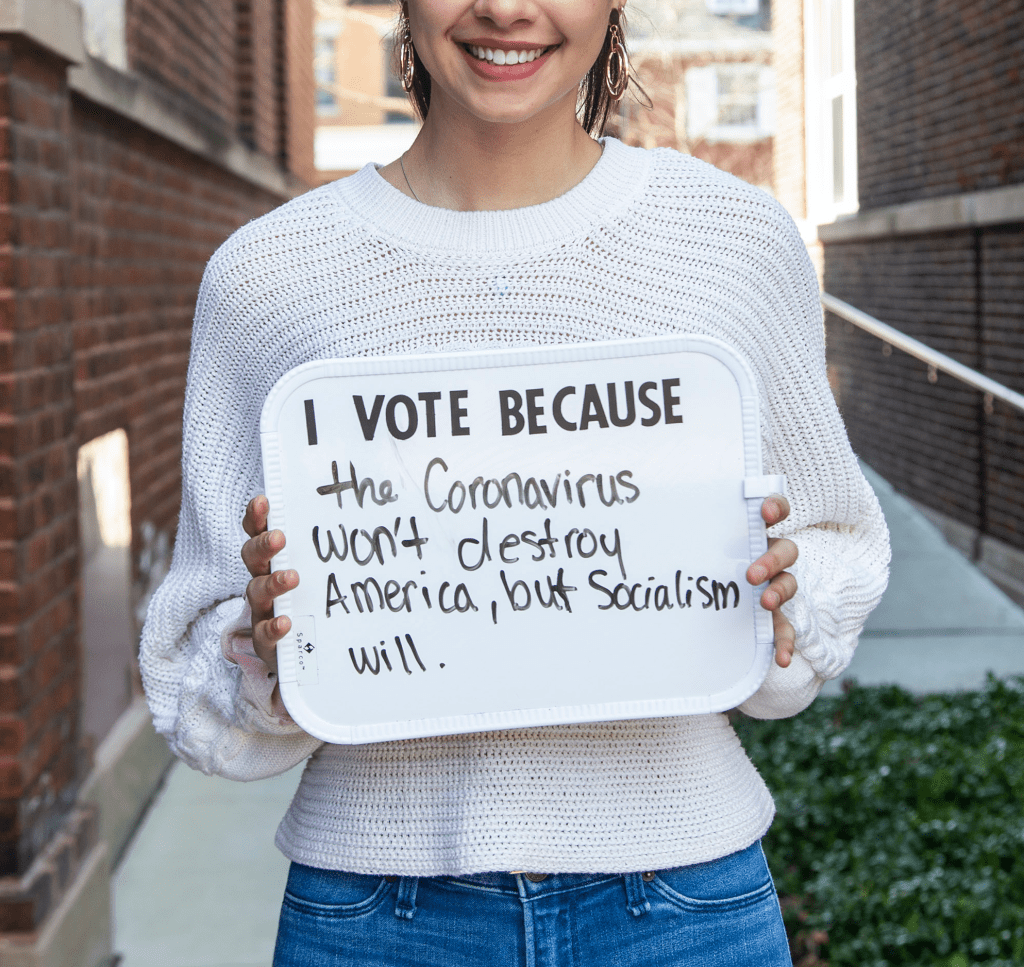
This Monday evening, as I absentmindedly scrolled through my Facebook feed, I came across something equally alarming: a photo post of a student named Eva, holding up a sign that reads, “I vote because the coronavirus won’t destroy America, but socialism will.” The post is part of the Institute of Politics (IOP) UChiVotes program, “a student-led, non-partisan voter engagement initiative at the University.” Comments on the post range from praise to criticism: Benyamin Rios wrote that “to say that on a liberal college campus takes guts,” while Andrea Buford commented that she “votes because [Eva] apparently votes and someone has to cancel out her vote.” At the time of writing, the post has received hundreds of reactions, and has spurred the creation of countless UChicago memes.
My first reaction upon seeing the post was bewilderment: how could employees at the IOP not only plan to take such a photo, but also intentionally post it on the IOP’s social media? The IOP maintains that it is nonpartisan, and that “content posted [on the IOP’s Facebook page] reflects the views/opinions of featured speakers, not that of the nonpartisan Institute of Politics.” Unfortunately, the IOP’s ironclad commitment to free speech is not an impenetrable shield against being held accountable for disseminating deeply immoral and problematic content under the guise of absolute and universal free speech (something our University likes to fond over to no end).
My second reaction was a mixture of anger and disappointment that another student would be at the front and center of such a post. I do not mean to lambast Eva for the political opinions she appears to hold. However, once again, freedom of speech is not freedom from responsibility for speech. The MAGA proponents and Trump supporters who have shared the post dozens of times on Facebook would probably exclaim that my article proves that they have “owned the libs.” Fine by me—I am not interested in jumping feet first into an unwinnable political battle between liberals and conservatives.
I am also not seeking to attack the IOP for its constant centrism veiled under alleged nonpartisanship. Instead, I would like to point out how the IOP’s post indicates a deep-rooted flaw in the education we receive at UChicago. At the University, we are taught to think in abstractions. From the Core onwards into our diverse majors, we are trained to turn real facts into abstract concepts and deal with them as such. Making sense of abstract truths is how we are taught to engage in critical thinking and problem-solving. Anyone who has had the pleasure of listening to Professor Larry McEnerney, Director of the University’s Writing Program, is familiar with that interpretation of the University’s philosophy of education and the ways in which it impacts how we engage with the real world on a daily basis.
The IOP’s post demonstrates the consequences of unchecked abstraction. In Eva’s reason for voting, the coronavirus seems to be nothing but an abstraction. It is not an ongoing, spreading pandemic that has killed over three thousand people worldwide; it is not the cause of an entire country closing its schools; it is not a medium for xenophobia against Asians; it is not a bizarre disruption of daily life (at least not yet). In fact, the coronavirus is all of these things. Its real-world casualties are going to increase, but for many of us, it is not something that currently exists in our reality (again, at least not yet). As a result, it is very easy to turn the coronavirus into a politically expedient punchline. To be clear, I am not claiming that nobody on our campus has ever previously made a political joke related to the virus; this particular post is by no means unique, but rather representative of a community-wide issue.
However, the IOP has gone beyond that with the photo post. The sign could have easily omitted any reference to the virus, and it would still make sense. One might disagree that socialism will destroy America, but the claim would be self-sufficient. Rather, the coronavirus is unnecessarily included in the service of a political opinion. The virus exists only as an abstraction, a convenient component of a political jab at socialism, which is seen as a threat to a certain vision for America. Socialism is itself an abstract ideology; the coronavirus is not. But the parallel between socialism and the virus abstracts the coronavirus to the level of an ideology, and it downplays the real threat of the virus.
I do not think it is far-fetched to suggest that the people involved in creating the IOP’s post were so deep in abstraction, so divorced from the reality of the coronavirus, and so committed to the principle of free speech that they saw the photo as simply a good way to continue publicizing UChiVotes. On the contrary, the IOP has amplified a student’s irresponsible abstraction—using a concrete threat to unnecessarily jest at an opposing political ideology—and has acted in a way that is unbecoming of its status as the preeminent center for politics at UChicago. Nobody emerges looking good—unless the goal was to attract attention, in which case the post is a job well done.
What is even more ironic is that an organization like the IOP has the ability to ground students in political and social realities, and avoid replicating the dangerous outcomes of using and relishing in abstractions. The IOP describes itself as an organization that “provides extracurricular opportunities, hosts visiting fellows, and presents programming in politics and policymaking.” I would meekly recommend that, in the process of carrying out those responsibilities, the IOP should seek to recognize and avoid the dangers of abstraction and try to help students understand the realities of the world around them—one where the coronavirus has amplified racism against Asians, has sent governments around the world scrambling to protect citizens, and has already begun to “destroy” American lives.
I think that the IOP can empower its students to express their passion for public service and politics without abstracting real-world dilemmas to make crude, attention-grabbing jokes. The UChicago community cannot prepare for actual challenges in peoples’ lives if it abstracts them, and does not take them seriously.
The image featured with this article is courtesy of the Institute of Politics. The image has been altered.
 The Gate
Leave a comment