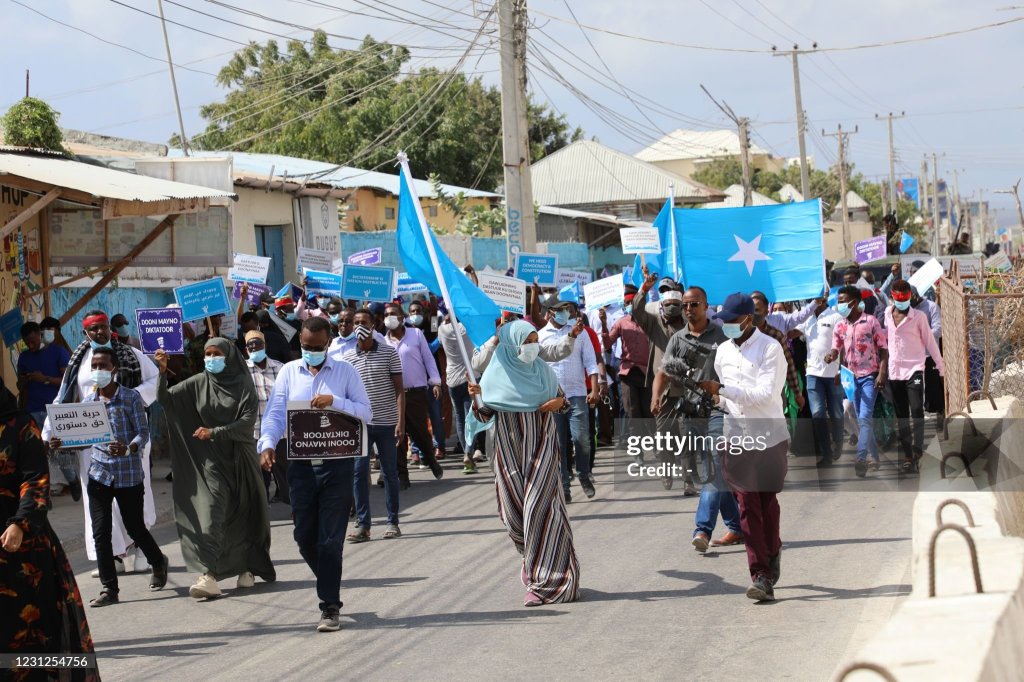
Thirty-seven percent in need of humanitarian assistance, 3.8 million internally displaced, and 4.3 million facing dangerous levels of food insecurity in Somalia. This is a statistic President Trump will greatly influence in his upcoming term, and one that in this day and age sounds far too common.
While often overlooked by the average American, Somalia continues experiencing an internal conflict, heightened since its official start in 2009. The country struggles to maintain cohesion, security, and autonomy as an independent state in East Africa. The terrorist group al-Shabaab, affiliates of the widely known al-Qaeda, took power in Somalia in 2006. Militia groups targeted Somalia and riddled the country with political instability for decades. With no central government, the country fell into a vulnerable state, allowing the Islamist militia group Islamic Courts Union (ICU) to take power. However, in 2008, the ICU broke into different groups, leading to the creation of al-Shabaab.
Since then, al-Shabaab aims to destroy the Federal Government of Somalia—formally established in 2012—and establish the entity of a “Greater Somalia” throughout East Africa under strict Islamic rule. In addition to facing prior political and economic instability, Somalia’s citizens are forced to pay higher taxes and fight for food, which is becoming increasingly scarce as al-Shabaab targets Somali livestock, food deliveries, and water wells. Throughout the past decade and a half, the group conducted multiple inter-country and foreign terrorist attacks, most notably when they killed 76 people through suicide bombings in Kampala, Uganda in 2010. In 2019 and 2020, they attacked parts of Somalia’s capital Mogadishu and parts of northern Kenya, including an attack on a Kenyan military base housing U.S. forces in which three U.S. service members were killed. Most recently, in May 2022, President Hassab Sheikh Mohamud declared “total war” against al-Shabaab.
Attacks like these sparked U.S. involvement in the war, especially given its role in global humanitarian aid as well as its importance on the world stage. For the past 16 years, the U.S. fought a counterterrorism war against al-Shabbab. Allotting $1.3 billion to the country since October 2021, the U.S. is the largest provider of humanitarian aid to Somalia. Working alongside organizations like the African Union Mission in Somalia (AMISOM) and Danaab, a special forces unit of the Somalian National Army, the U.S. fought against al-Shabaab primarily through air strikes. In September 2014, a U.S. airstrike killed Ahmed Abdi Godane, the former group leader. During his first presidency, Trump authorized more airstrikes into Somalian territory than three prior presidents combined. He supplied more troops in 2017, which he later withdrew after the deaths of several U.S. personnel. In 2022, Biden authorized a series of air strikes which resulted in the deaths of over 300 militants. In addition to combat aid, the U.S. military has also worked to train the Danaab to fight against al-Shabaab.
While the U.S. has successfully pushed al-Shabaab out of certain rural areas, the question lies, how will President Trump’s second presidency affect this war?
During Trump’s first term in office, the U.S. stationed around 700 troops to battle al-Shabaab and other Islamic State militants. Publically against U.S.-provided aid, Trump demanded the withdrawal of nearly all U.S. troops from Somalia by January 15, 2021. He issued similar orders in Iraq and Afghanistan, two countries where the U.S. battled terrorism. Trump generally criticized U.S. military interventions, calling them “costly and ineffective.” He even fired members of his cabinet, like former U.S. Defense Secretary Mark Esper, who publicly favored military interventions. Not soon after Trump ordered the withdrawal of troops, the Pentagon released a statement that claimed Trump’s “order to ‘reposition the majority of personnel and assets out of Somalia by early 2021’ did not signify a change in U.S. policy.”’ This statement prompted criticism from the Somalis and, according to Senator Ayub Ismail Yusuf, the U.S.’ decision was “extremely regrettable.” He acknowledged that U.S. troops made “a ‘huge contribution’ to the training and operational effectiveness of Somali troops.” Trump did so while being warned that U.S. withdrawal could conversely strengthen militant groups in the Horn of Africa. Additionally, his efforts were also criticized due to the high level of civilian casualties that resulted. A report conducted by Amnesty International in March of 2019 showed that fourteen civilians were killed in just five of the seventy air strikes conducted by the U.S. since 2017.
The future of U.S. counterterrorism wars under Trump remains unknown. He will have to combat threats in Somalia on top of those from Shia extremist groups like Hezbollah, the Houthis — who have recently become prevalent with the Israel-Palestine conflict — and other militia groups across Iraq and Syria. Even with the significant damage that Israel has inflicted on Hamas and Hezbollah, the groups are not permanently defeated.
The risk of terrorist attacks in the West has only increased after the October 7 attack, adding to the imminent threat from al-Shabaab in Somalia. According to the U.S. Department of Homeland Security (DHS), “Hamas’ 7th October terrorist attack against Israel and the subsequent Israeli government operations in Gaza drive an increase in media calls from FTOs like ISIS and al’Qaeda for lone offender attacks against critical infrastructure, including U.S. government buildings and U.S.-based foreign embassies.” This is coupled with an increase in domestic pushback towards Trump and his policies towards counterterrorism. He has threatened to characterize groups like ANTIFA (a network of anti-fascist activists) as a terrorist group in the U.S. and claimed that he is willing to deploy the military to handle any protests against him. He has also talked about reducing the size of the Federal Bureau of Investigation (FBI), which could severely diminish U.S. counterterrorism efforts.
The U.S. should continue to fight counterterrorism with military and monetary aid, however, they should do so in a manner as minimally harmful to civilians as possible. Trump’s previous approach to counterterrorism makes it virtually impossible to predict his future policy. Will he deploy the U.S. military to re-enter the country inhabiting a terrorist organization? Will he fight back to terrorist attacks, potentially sparking a full-blown war? These questions can only partly be answered from Trump’s approach to pivotal wars such as Somalia, but the future of this country and the potential of war lies entirely in his hands.
The image used in this article is copyrighted by AFP for Getty Images and can be found here.

 The Gate
Leave a comment