“It’s the economy, stupid.”
That sentence helped propel Bill Clinton’s 1992 presidential campaign to victory over the incumbent, George H.W. Bush. Simple as it may be, those four words introduce two central tenets of election season: the economy matters, and nobody really understands it.
Yet when the average voter issues their referendum on the administration in power, the economy is front and center. In the lead-up to the 2024 election, polls revealed that 81% of the electorate characterized the economy as a “very important issue,” placing it more than a dozen points ahead of any other subject. This is hardly a new trend: Ronald Reagan soared to victory in 1980 after propositioning Americans to ask themselves if they were better off now than they were four years ago.
The electorate tends to rely on feel to evaluate the economy. People do not look at statistics and the stock market so much as they assess how comfortable they feel in the present economy. A Gallup poll conducted in October highlighted this sentiment; the Economic Confidence Index (ECI) sits at -26, the lowest since 2008. Even if it’s not centered around statistical data, people’s perception of the economy dramatically affects the outcome of elections. Since 1992, only once (in 2012) did the incumbent party win an election where the ECI was below zero.
This trend proved accurate this November, with a red wave crashing onto the shores of D.C. The economy was listed as the second-most important voting issue (32%) according to a CNN Exit Poll, and the ECI served as an excellent bellwether for the election outcome. President-Elect Trump polled 80-19 among the voters who considered the economy their top priority.
However, lost within the bubble issue of “the economy” are its nuances. One such nuance has been among the few remaining bipartisan policies in American politics: the tariff.
Tariffs are taxes on imports from foreign markets. In general, enacting tariffs serves two overarching purposes: protecting domestic markets and disincentivizing behaviors deemed disadvantageous or egregious abroad. Tariffs also seek to punish violators of international trade agreements. The general consensus among economists is that tariffs carry costs over onto consumers, raising the price of a good. In that same vein, taking the most recent high-profile tariff exchange, Trump’s trade war with China (2018), the tariff did succeed in incentivizing domestic production and job creation. Unfortunately, like most other tariffs, this program amounted to a very expensive job creation program, costing the United States government roughly $815,000 per new job.
Tariffs fall into several distinct categories. One of which is the industrial tariff. Responsible for “94 percent of merchandise imports,” the industrial tariff applies to non-agricultural goods. The average rate on industrial imports sits at 2 percent. However, contrary to Trump’s rhetoric and proposals, tariffs have become less and less prevalent since the conclusion of the Second World War. I sat down with political science professor and tariff expert Robert Gulotty to discuss tariff policy in the modern era; he concurred with the assessment that tariffs are no longer the prolific tool they once were: “In the 1930s, nations pointed to the emergence of blocks and high tariff barriers between empires as a source of national conflict.”
Gulotty specializes in international trade and describes that shift away from tariffs as intentional and cooperative: “In the U.S., tariffs used to be basically a domestic policy. It went up under Republican administrations; it would go down under Democratic ones.” In essence, the party in control of Congress would enact their tariff agenda, in line with their economic priorities. The post-war era facilitated the creation of the General Agreement on Tariffs and Trade (GATT) in 1948, in which a coalition helmed by the U.S. promoted international trade and made the enactment of tariffs a matter of international diplomacy.
That context, Gulotty explains, accounts for the gradual decline in U.S. tariffs. Right now, the United States is committed to a 5% average tariff around the world. Another international agreement regulating trade is the Most Favored Nation (MFN) policy established by the World Trade Organization (WTO). The MFN has provisions that prevent countries from enacting tariffs with a discriminatory rate. Not all countries heed these regulations, though, with China being the most notable offender. In the United States, the MFN provisions are dubbed Normal Trade Relations in most statutes, but the sentiment remains.
Gulotty attributes the general decline in gun and bullet wars to these regulations, as they have internationalized the economic interests of each country. War means instability for global markets, and with every major economy intertwined in some form, there exists a strong disincentive towards conflict.
It is in the above historical context that modern tariff policy exists. The modern political landscape is of note as well. Division and political partisanship have been rising in the last decade, with Republicans and Democrats collaborating and interacting less and less. Yet, in this time of extreme tumult, when the American political fabric seems disjointed, there exists some bipartisan consensus around tariff policy.
The central motive behind the consensus is China. Both party leaders agree that the old bet, the original attitude towards China, an attempt to integrate China into the international economic system, failed. There was a transformation of the Chinese economy, but it did not coincide with those original American aspirations. In other words, China is still the principal economic adversary of the United States, and it’s no less threatening than it was when politicians advocated for its integration. As such, the consensus has built up around a need to go on the offensive against China to limit its global influence.
The main point of bipartisanship, says Gulotty, is this recognition that “the previous path of free trade isn’t sufficient for what [both parties] want right now. Both parties have embraced using industrial policy to achieve their ends.” The justification used to enact Trump’s tariffs, a provision allowing for retaliatory action against countries that violate trade agreements, has been used by the last several administrations. Those types of tariffs attempt to restore free trade where there is a violation of market access commitments. Another type of targeted tariff allows for the preservation of domestic industry: “If there’s a sudden inflow of imports to a certain industry, the U.S. can raise a safeguard to allow industry to survive in the presence of sudden competition.”
The protective tariffs, defined above, have been employed several times over the past four administrations. Most notably, the 2002 Steel Tariff under President Bush and the 2009 Tire Tariff under President Obama. In the face of very low prices from imports, placing tariffs on such goods allowed domestic producers, whose costs are higher, to compete without the U.S. risking the decline of the entire industry.
The efficacy of protective tariffs is disputed, but Gulotty argues it depends on what the point is. “The critics say they’re too slow, they’re too limited, and they only last for a few years.” Gul0tty also stressed the importance of expectations, as temporary tariffs alone rarely alter a trajectory.
More recently, the Biden Administration rolled out a number of new product-by-product tariffs, one of which increased the 25% tariff on Chinese Electric Vehicles (EVs) to a 100% tariff. This policy is not significant to American consumers, given Chinese car brands are very limited in the U.S. market, but it does incentivize domestic producers to continue to manufacture EVs. Chinese producers have to abide by fewer international regulations, assume fewer environmental and labor costs and already have an EV infrastructure completed. Not to mention the $231 billion subsidy awarded to Chinese companies to manufacture them. In other words, this tariff makes it such that domestic producers here feel like they can start catching up.
Despite the bipartisan agreement to handle China, each party has slightly different ways of doing it. According to Gulotty, for Trump and the modern GOP, tariffs are “a coercive tool” used to force China into making concessions. “Trump believes in bilateral, direct negotiations. He tends to be much more skeptical of trade as a concept.”
Trump still shakes up the bipartisan status quo with tariffs too. He isn’t Reagan, who used trade restrictions to limit Japanese economic growth when it was the primary economic adversary. Gulotty argues that Trump is more simplistic: “imports detract from the GDP, so we should only do it when it’s necessary. He’s less interested in getting people to follow the agreements so much as he feels the agreements themselves are unfair and unnecessary.” This connects to a frustration Trump has echoed for years: that America continues to give and give to its allies without receiving anything back. “Trump believes imports are just bad. [To Trump,] they subtract from our national wealth and the GDP. [He believes] it would be better if everything was made here.”
Gulotty understands this shift from traditional conservative policies to Trumpism as a product of several factors. One central factor Gulotty introduces is Trump’s background; Trump did not follow a traditional pathway into politics. Many political higher-ups started out as lawyers, which understandably makes them both followers of and experts in law. Trump defies this logic. His felonies are evidence of a disregard for traditional legal structures, and given his international policy track record, he seems disinterested in sticking to global regulations.
Trump’s perspective on international economics rejects the importance of alliances. Instead, he wants to cut deals with single parties quickly. This is in line with his business background.
Whereas, for the Democrats, there’s more of a focus on “multilateral building and involving international coalitions.” Those different methods still ultimately lead to tariffs being used as a coercive tactic. Gulotty does characterize democratic policy as being more subsidy-forward.
In short, each policy aims to facilitate domestic production. The democratic tools, though, as per Gulotty, “can be designed to be less toxic to American allies, which enables the multilateral response to China.”
Past tariffs are all well and good, but with Trump returning to the White House, tariffs have further re-emerged as a major economic tool. Former President Trump’s campaign has committed to instituting an across-the-board 60% tariff on Chinese goods and a 20% tariff on all other foreign goods. Trump is a big fan of tariffs as a policy, and he is hardly quiet about it: “The word ‘tariff’ is the most beautiful word in the dictionary. More beautiful than love.”
This new policy, however, veers away from any semblance of bipartisanship. The Harris campaign had deemed the tariff a sales tax in all but name, a notion Gulotty qualified: “It may have the consequences that an across-the-board sales tax might if a sales tax also angered and upset all our trade partners.” Gulotty insists that Trump’s policy will have ripple effects here and abroad: “It will have the effect of raising prices at home and distorting international markets in a way that’s going to make other countries retaliate against the United States. So typically a sales tax wouldn’t hurt American exporters the way that this import tax will.”
The implications of the 20% tax on all other countries could prove dire. The closest parallel, the Embargo Acts of 1807, saw the U.S. ban all trade with foreign powers to disengage from international trade. It wound up damaging the American economy, alienating Jefferson’s party, and accelerating tensions on the way to the War of 1812.
One of the remaining bastions of relative bipartisanship might just be crumbling as the results of the 2024 election reverberate around the globe.
With Trump poised to become the second President ever to serve two non-consecutive terms, there will be a major shake-up in the way America considers international trade. The changes will impact everyday Americans, which is why tariffs need to be thrust into the limelight. In an economy of “feel,” people are very disengaged from what these tariffs would mean. As such, the status quo of relative bipartisanship should not be taken for granted, especially after Trump’s convincing victory over Harris.
It might not be here to stay.
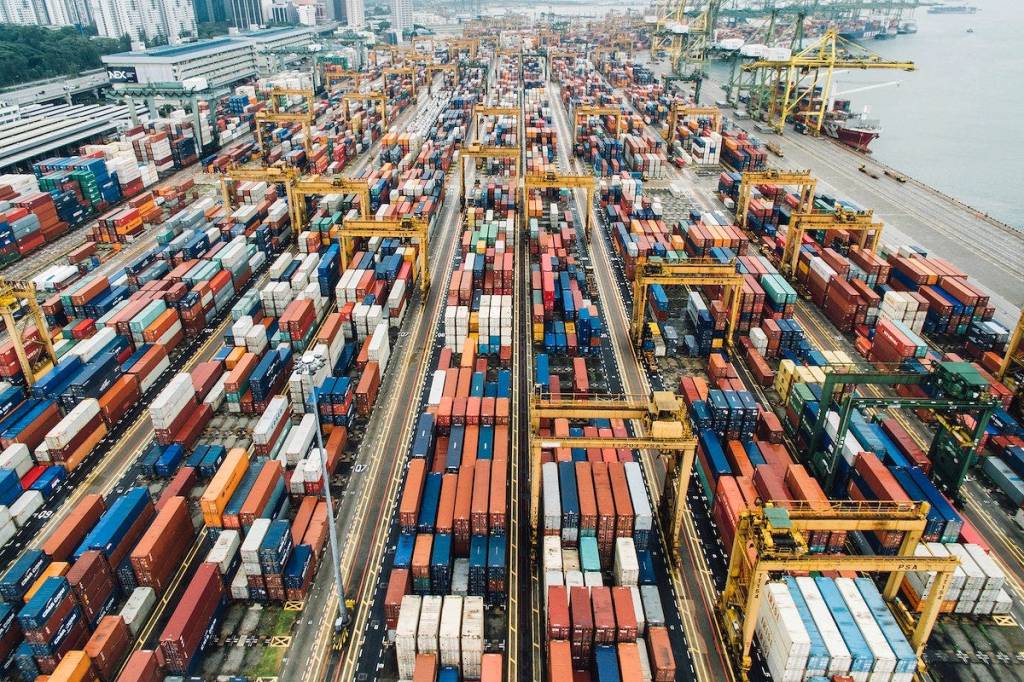
The image featured in this article is licensed for reuse under the Creative Commons 1.0 Universal license. No changes were made to the original image, which was taken by the Industrial Products Finder and can be found here.
 The Gate
Leave a comment