Saturday, April 20 concluded the 49th Spring Meetings of the International Monetary Fund (IMF) and the World Bank Group (WBG), attended by over 10,000 people, including financial governors from the 190 member countries. Attendees discussed concerns about rising inflation, increasing global debt, insufficient climate finance funding, and global supply chain disruptions from ongoing geopolitical conflicts in the Taiwan Strait and Gaza. Egypt, amidst one of its worst economic crises, is bearing the brunt of these challenges. While it received an IMF bailout in March, it remains an open question whether Egypt will recover or simply sink under a new surge of debt.
EGYPT’S ‘SLIP’ TO ECONOMIC DOWNFALL
From January to March 2024, I was in Egypt at the height of its most recent economic crisis. At the greatest disparity between the “official bank” and “black market” currency exchange rates, the official was 31 Egyptian Pounds (EGP) to the United States Dollar (USD), versus the black market of EGP 75 per USD 1. Following this extreme currency devaluation, Egypt received foreign capital in March, including USD 35 billion of United Arab Emirates (UAE) investment, USD 8.1 billion in a European Union aid package, USD 6 billion from the World Bank, and a total of USD 8 billion (a $5 billion addition to a prior $3 billion loan) from the IMF. In his Spring Meeting statement on behalf of Egypt, UAE Minister of State for Financial Affairs Mohammed bin Hadi Al Hussaini expressed optimism for the recent IMF deal introducing “a strong economic stabilization plan,” targeted “to correct policy slippages” in Egypt.
While facing external conflicts including wars on all three of its borders, slow COVID-19 recovery, and tourism losses, Egypt’s economic troubles also stem from within. Egyptian President Abdel Fattah al-Sisi spent on excessive infrastructure projects such as ‘satellite cities,’ including the 58-billion-USD New Administrative Capital. While creating jobs, reviving industry, and attracting wealthy foreign investors, the Capital project is unlikely to impact the 29.7 percent of Egyptians in poverty as much as the privileged elite and military. Despite its growth over the past few years, personal wealth in Egypt remains concentrated in the hands of the wealthiest 10 percent of nationals, who control 63 percent of the aggregate net wealth. Tax-exempt and multi-business owners, the military’s economic role even supersedes the growth of Egypt’s private sector. These failing fiscal policies exacerbate both the country’s economic troubles and social inequalities.
IMF SOLUTIONS: WITH STRINGS ATTACHED
In accepting this spring’s IMF loan, Egypt received access to immediately withdraw USD 820 million, bailing itself out from imminent economic collapse. But the country also agreed to conditions of “correcting macroeconomic imbalances, including unification of the exchange rate, clearance of the foreign exchange demand backlog, and significant tightening of monetary and fiscal policies.” Such reforms require policy changes that challenge al-Sisi and the military’s political and economic power. Owing USD 15.9 billion, Egypt is the IMF’s second biggest debtor, meaning the pressure is on for the country to gain enough fiscal stability both to escape its financial crisis and repay its loans. However, al-Sisi has previously fallen short of his promises to the IMF: while agreeing to float its currency and reduce the state and military control stunting private industry in 2022, Egypt never saw these changes through, at the cost of spiraling into even further economic turmoil.
Meeting the IMF’s conditionality measures is essential for both the state borrower and IMF lender to benefit: the conditions are intended to encourage policy change for long-term economic stability, consequently ensuring repayment to the IMF. However, economists, including Nobel Prize Laureate Economist Joseph E. Stiglitz, have questioned the suitability of IMF conditions—and their true benefits in practice. Especially within emerging market and developing countries (EMDCs), such as Egypt, Stiglitz shows that international capital flows result in ‘sudden stops’ where monetary conditions tighten—derailing growth, weakening exchange rates, and exacerbating debt. If misaligned with true policy needs, IMF conditions may be more than difficult, but even counterproductive for EMDCs. Egypt’s shortcomings in fulfilling the IMF lending conditions and payback may prove dire for both the state and international organization, sending both into greater debt.
In light of these challenges, the IMF endorsed new reforms to support lending to countries undertaking debt restructuring, during the Spring Meetings on April 16th. Based on a policy of Lending Into Official Arrears (LIOA), this move eases the burden of borrowing, and consequently, increases the creditors’ chances of payback. Another key piece is this policy counters loaning dependence on China, enabling countries to more accessible lend from the IMF. While it could fuel cash flow and debt restructuring to aid state economic recovery, LIOA introduces riskier lending for the IMF. If the organization can stomach the greater initial costs, this new structure may enable lending beyond the rigidity of controversial conditions; but through a two-way relationship supporting debt restructuring matching countries’ specific fiscal circumstances. Such might foster true economic endurance benefitting the IMF, state, and all members of its public across incomes and state affiliations.
SPRINGING FORWARD
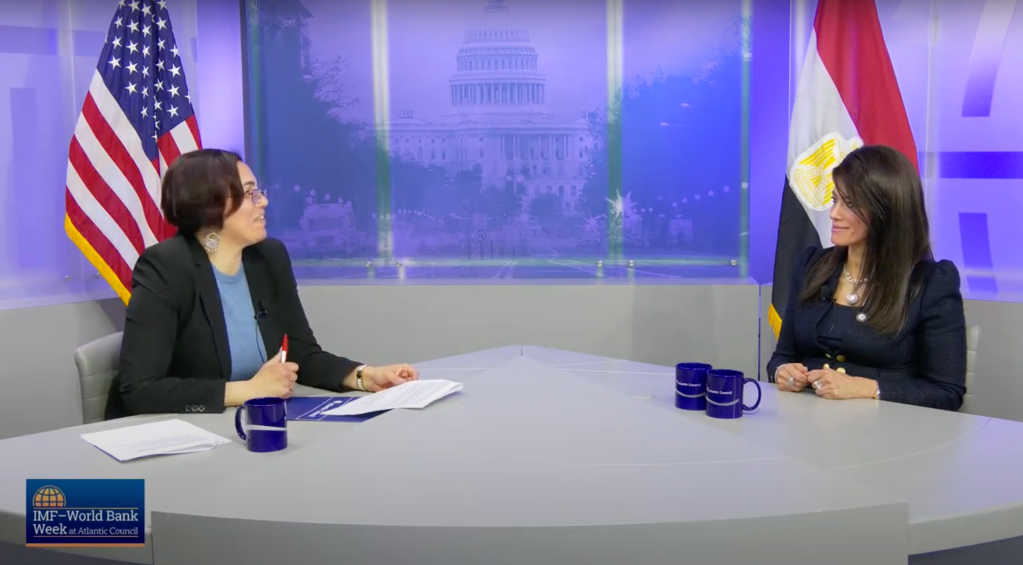
In conversation with the Atlantic Council, Egyptian Minister of International Cooperation Rania A. Al-Mashat reflected on the IMF Spring Meeting and Egypt’s path forward, restating the importance of “continuing macro-fiscal stabilization, improving the business environment & increasing the economy’s competitiveness, and supporting the green transition.” Al-Mashat’s suggestions to foster GDP growth, stabilize the exchange rate, and cut excessive spending by blowing up Egypt’s primary deficit hold the potential to create a more sustainable economic environment—but their implementation is another question.
With the March lending augmentation and LIOA policy, the IMF provided the liquidity necessary for Egypt to spring forward from the recent crisis toward a fruitful summer of economic recovery. But, the country—and al-Sisi—must take policy revising and debt restructuring seriously. Otherwise, the IMF and Egypt only postponed their financial problems, to cycle to a colder and bleaker economic winter.
The image used in this article is licensed for noncommercial reuse by the Atlantic Council. The original image can be found here.
 The Gate
Leave a comment