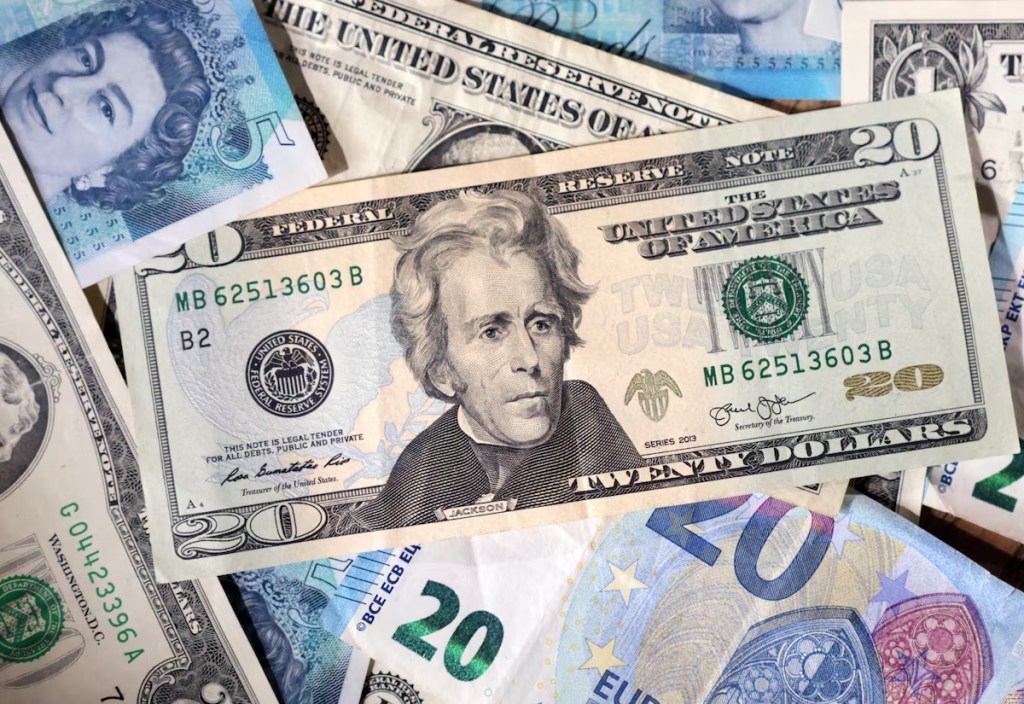
When U.S. President Donald Trump unveiled tariffs in what he called “Liberation Day,” he upended global markets. Imports from all countries confronted tariffs as high as 145%. As investors rushed to sell off stocks, equities and bonds, the White House confronted a crisis. In particular, Treasury Secretary Scott Bessent had to placate fears that the U.S. dollar would no longer be the world’s dominant currency. The dollar’s dominance has long kept interest rates stable, accruing debt sustainable and America the kingmaker of world politics, but that era of dollar dominance, some economists say, may be coming to an end.
Although the world does not have a currency, the United States dollar is the closest to a universal note. At the end of 2024, $2.3 trillion circulated around the globe, making the U.S. dollar involved in 59% of foreign exchanges. Because international parties use the dollar to make exchanges, dollarization of foreign exchange gives the U.S. what some economists call “exorbitant privileges.” The U.S. can easily issue bonds as it prints the world’s highly sought-after currency. This control allows the U.S. to sustain a high level of debt. It also gives the U.S. substantial leverage in foreign affairs. The U.S. government can isolate countries by restricting access to the U.S. dollar. When the Biden administration imposed financial sanctions on Russia for invading Ukraine in 2022, Russia no longer had the funds to pay off foreign debt and went into default.
Since the 1970s, though, experts have questioned whether dollarization was at risk. While most speculations have not come to fruition, U.S. President Donald Trump’s global and reciprocal tariffs pose the most significant challenge yet to the internationally-circulated currency.
The U.S. became the bearer of the world’s currency largely due to its appeal to foreign investors, who prioritize stability. The U.S. dollar, a currency that has been reliable since the 1913 creation of the Federal Reserve, reduces the risks that exchanging between different cultures already entails. Its status as a safe haven comes from the country’s political and economic stability. The dollar emerged as the world’s leading currency in 1944 after economists grew concerned that Britain’s looming bankruptcy would undermine the stability of the British pound.
The Trump administration’s desire to retreat from superpower politics, along with the increased volatility from tariffs, has led traders to wonder if the U.S. dollar can continue being reliable. The value of the U.S. dollar slid 7% in the subsequent month, its biggest drop in years. Even though a weakening dollar should attract foreign investors, they unusually sold off U.S. bonds. It signals that investors are losing confidence in the dollar’s strength. Liz Ann Sonders, chief investment strategist at Charles Schwab & Co., noted that “our partners are questioning whether we’re reliable when it comes to trade.”
On a macro level, countries may find U.S. tariffs to be the catalyst for trading with other countries. When the United Kingdom and India signed a trade deal on May 6, U.K. Prime Minister Keir Starmer stated that “in a new era for trade and the economy,” the goal of “reducing trade barriers with economies around the world” was his objective. Other countries are eager to exclude the U.S. from trade relationships. BRICS—a coalition of the largest emerging markets like Brazil and China—is pursuing non-American investment platforms to combat increasing interest and tariff rates. These partnerships hurt dollarization because foreign exchange markets have begun understanding the adverse effects of relying on a single currency.
While developing economies and adversaries of the U.S. might want to reduce the dollar’s dependence, other experts contend that de-dollarization is unlikely to happen soon. According to Joyce Chang, the Chair of Global Research at J.P. Morgan, de-dollarization supporters face the problem of “the factors that support dollar dominance remain well-entrenched.” The alternative to the U.S. dollar and its scheme is the Chinese yuan. Investors would rather face American courts than Chinese courts, if using either currency brought trouble. Furthermore, China is not keen to promote its currency because it wants to keep control over the distribution of the yuan.
Years of speculation that the dollar hegemony was nearing its end have yielded little tangible support. The reason actors choose not to use the dollar — a lack of a relatively stable alternative — has not changed. Until a currency emerges, market strategist Bob Stark says, “you’re probably going to choose the US dollar because it’s the least volatile of the currencies.”
Most economists agree that de-dollarization is not happening in the short term. However, the recent bouts of political instability in the U.S. mean that “the exorbitant privilege is not so exorbitant anymore,” writes Ben Bernanke, the former chair of the federal reserve. As the world accelerates its search for alternative currencies, the U.S. leaves itself vulnerable as an increasingly isolated superpower. Economists already worry that America is incurring too much debt relative to what its economy can handle in a hegemony-less world. Countries alienated by the U.S., such as Russia, are also finding that using their customers’ currency in exchange for petroleum can sometimes work. The White House’s lack of reliability will likely accelerate de-dollarization efforts—efforts problematic for America even if in the long term.
Right now, the U.S. can be confident that it can enjoy the privileges of being the world’s currency. But as the beating of the British pound over two world wars shows, fortunes can change quickly.
The image in this article was created by Dado Ruvic for Reuters, and can be accessed in its original form here.
 The Gate

Leave a comment